The knee joint is one of the most complex and heavily used structures in the human body. It must balance mobility and stability while transmitting forces between the upper and lower limbs during everyday activities like walking, running, and jumping.
Understanding how the knee works mechanically—and how it handles force—can help explain everything from athletic performance to common injuries.
Overview of the Knee Joint Structure
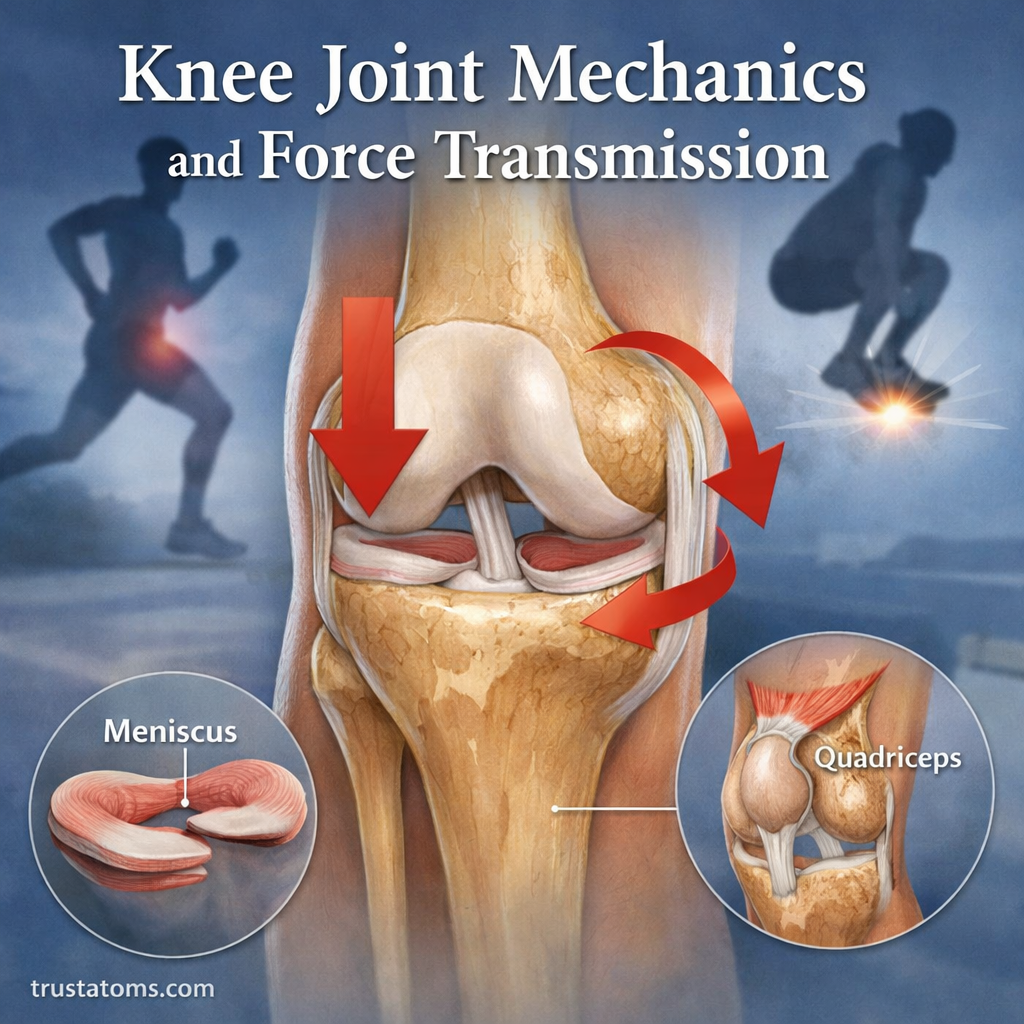
The knee is primarily a hinge joint, but it also allows slight rotation and translation. It connects three main bones:
- Femur (thigh bone)
- Tibia (shin bone)
- Patella (kneecap)
Key supporting structures include:
- Articular cartilage – reduces friction and absorbs shock
- Menisci (medial and lateral) – distribute load and improve joint stability
- Ligaments:
- ACL (anterior cruciate ligament)
- PCL (posterior cruciate ligament)
- MCL (medial collateral ligament)
- LCL (lateral collateral ligament)
- Muscles and tendons – especially the quadriceps and hamstrings
Together, these components allow the knee to handle significant mechanical stress while maintaining smooth movement.
Types of Movement in the Knee
Although often described as a simple hinge joint, the knee performs multiple motions:
Primary Movements
- Flexion – bending the knee
- Extension – straightening the knee
Secondary Movements
- Internal rotation (when flexed)
- External rotation (when flexed)
- Slight gliding and rolling between joint surfaces
These combined movements are essential for efficient walking, running, and directional changes.
How Force Is Transmitted Through the Knee
The knee acts as a critical link in the kinetic chain, transferring forces between the hip and the foot.
Weight-Bearing Forces
When standing or walking:
- Body weight travels from the femur → through the knee → into the tibia
- Forces are distributed across the joint surfaces
- The menisci help spread these loads to prevent concentrated stress
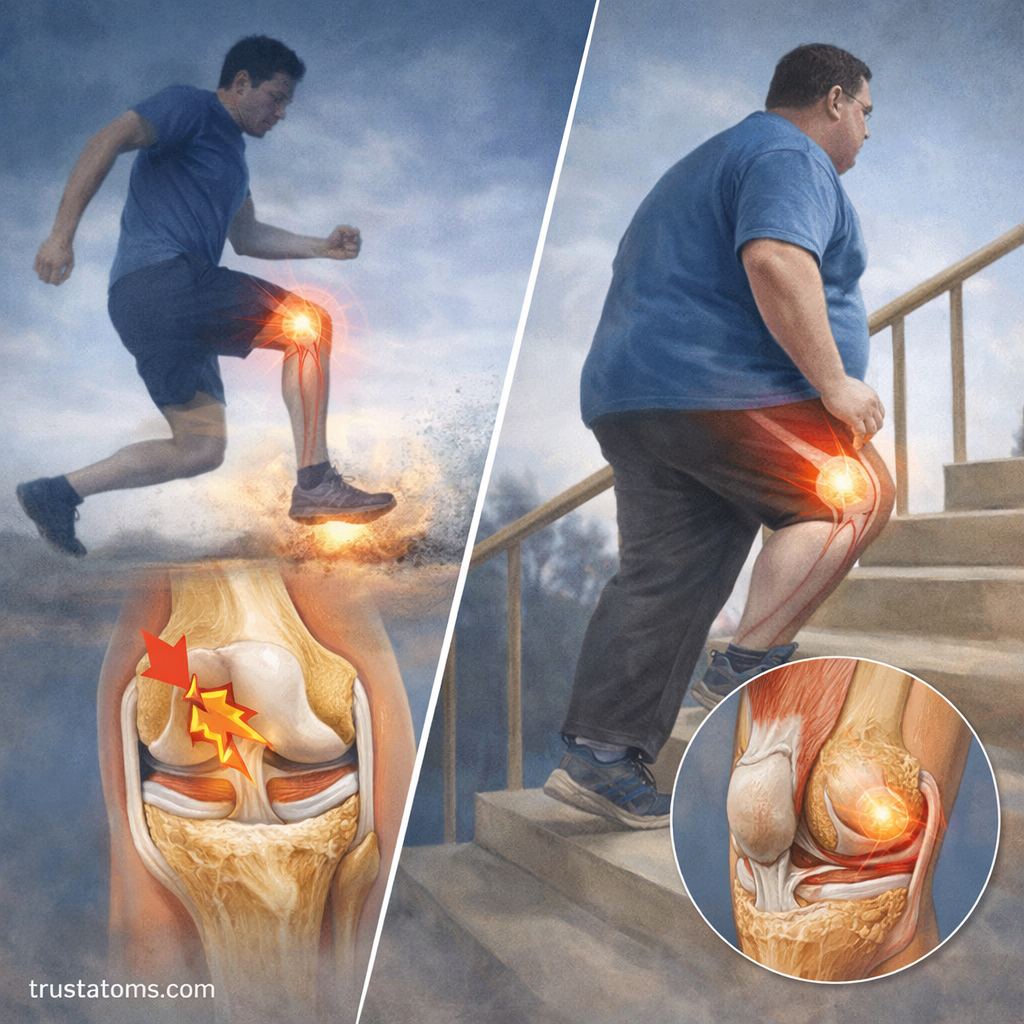
During high-impact activities (like running or jumping), the knee can experience forces up to:
- 3–6 times body weight during walking
- 7–10+ times body weight during running or landing
Role of the Menisci in Force Distribution
The medial and lateral menisci play a crucial role in load management:
- Increase contact area between femur and tibia
- Reduce peak stress on cartilage
- Act as shock absorbers
Without the menisci, force becomes more concentrated, increasing the risk of cartilage damage and osteoarthritis.
Patellofemoral Force Mechanics
The patella improves the efficiency of the quadriceps muscle by acting as a pulley.
- Increases leverage during knee extension
- Distributes compressive forces across the front of the knee
However, this also creates high compressive forces:
- Especially during squatting, stair climbing, and jumping
- Can reach several times body weight
Stability vs. Mobility: A Mechanical Balance
The knee must remain stable under load while allowing motion.
Static Stabilizers
- Ligaments (ACL, PCL, MCL, LCL)
- Joint capsule
These structures:
- Prevent excessive movement
- Maintain proper alignment
Dynamic Stabilizers
- Quadriceps
- Hamstrings
- Calf muscles
These muscles:
- Control motion
- Absorb and redistribute forces
- Protect ligaments from overload
Load Transmission During Common Activities
Walking
- Alternating loading and unloading phases
- Smooth force transfer through joint surfaces
- Moderate compressive forces
Running
- Increased ground reaction forces
- Rapid force absorption and release
- Greater demand on muscles and ligaments
Jumping and Landing
- Extremely high impact forces
- Requires coordinated muscle activation
- Poor mechanics can increase injury risk
Key Mechanical Concepts
Compression
- Primary force in the knee
- Occurs when weight pushes joint surfaces together
Shear Forces
- Forces that cause sliding between surfaces
- Controlled by ligaments (especially ACL and PCL)
Torque
- Rotational forces acting on the knee
- Occur during twisting or directional changes
Balanced interaction between these forces is essential for joint health.
Common Mechanical Stress Points
Certain areas of the knee are more vulnerable due to how forces are distributed:
- Medial compartment – often bears more load during walking
- Patellofemoral joint – high compressive stress during bending
- Ligaments – susceptible to shear and rotational forces
Over time or under excessive stress, these areas may develop:
- Ligament injuries (e.g., ACL tears)
- Meniscus damage
- Cartilage degeneration
Factors That Influence Knee Force Mechanics
Several variables affect how forces are transmitted through the knee:
Biomechanical Factors
- Alignment (e.g., knock-knees or bowlegs)
- Joint structure and anatomy
Muscular Strength
- Strong quadriceps and hamstrings improve force control
- Muscle imbalances can increase joint stress
Movement Patterns
- Poor technique (e.g., improper landing mechanics)
- Repetitive stress without recovery
Body Weight
- Increased weight raises compressive forces
- Even small increases can significantly impact joint load
Why Knee Mechanics Matter
Understanding knee joint mechanics is important for:
- Injury prevention
- Athletic performance optimization
- Rehabilitation after injury
- Long-term joint health
Proper force distribution and control reduce the risk of:
- Ligament tears
- Cartilage wear
- Chronic knee pain
Final Thoughts
The knee joint is a remarkable structure designed to handle large and complex forces while allowing fluid movement. Its ability to transmit and distribute force depends on the coordinated function of bones, cartilage, ligaments, and muscles.
When this balance is maintained, the knee performs efficiently and reliably. When disrupted—through injury, poor mechanics, or overuse—problems can quickly arise. Understanding these mechanics provides a strong foundation for protecting and improving knee health over time.