Mechanical advantage is a key concept in biomechanics that explains how the human body produces movement efficiently. It describes how muscles, bones, and joints work together to either increase force or increase speed and range of motion.
Understanding mechanical advantage helps explain why some movements feel powerful while others prioritize speed and precision.
What Is Mechanical Advantage?
Mechanical advantage (MA) refers to how effectively a system amplifies force.
Simple Definition
- Mechanical advantage > 1 → force is amplified (easier to lift heavy loads)
- Mechanical advantage < 1 → speed and range of motion are prioritized
In the Human Body
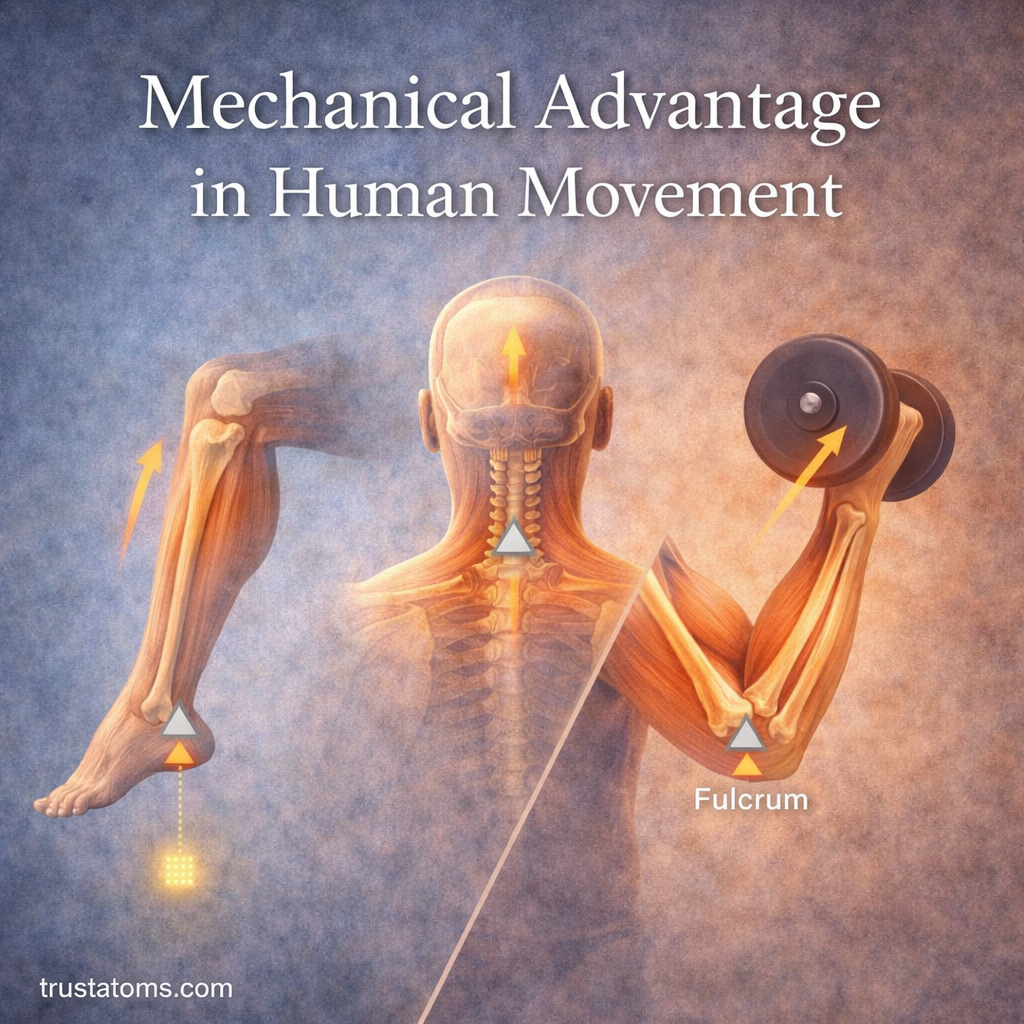
- Bones act as levers
- Joints act as fulcrums
- Muscles provide effort
- External resistance or body weight acts as the load
The arrangement of these components determines whether the body favors strength or speed.
How Mechanical Advantage Works in the Body
Mechanical advantage depends on the distance between the fulcrum, effort, and load.
Key Factors
- Effort arm: distance from the muscle attachment to the joint
- Load arm: distance from the joint to the load
Basic Principle
- Longer effort arm → greater force advantage
- Longer load arm → greater speed and movement range
This balance determines how efficiently a movement is performed.
Mechanical Advantage in Different Lever Types
The human body uses three types of levers, each affecting mechanical advantage differently.
First-Class Levers
Structure
Fulcrum between effort and load
Mechanical Advantage
- Can provide either force or speed advantage depending on positioning
Example
- Head movement at the neck
Key Benefit
- Versatile: can balance forces or change direction of motion
Second-Class Levers
Structure
Load between fulcrum and effort
Mechanical Advantage
- High mechanical advantage (>1)
- Requires less effort to move heavy loads
Example
- Standing on tiptoes
Key Benefit
- Maximizes strength and force output
Third-Class Levers
Structure
Effort between fulcrum and load
Mechanical Advantage
- Low mechanical advantage (<1)
- Requires more effort but allows faster movement
Example
- Biceps curl at the elbow
Key Benefit
- Maximizes speed, control, and range of motion
Why the Human Body Favors Speed Over Force
Most lever systems in the body are third-class levers, which prioritize movement efficiency rather than strength.
Advantages of This Design
- Faster limb movement
- Greater flexibility and control
- Improved coordination
Trade-Off
- Muscles must generate more force
- Less efficient for lifting heavy loads
This design allows humans to perform complex and precise movements.
Real-World Examples of Mechanical Advantage

Mechanical advantage plays a role in nearly every physical activity.
Everyday Activities
- Lifting groceries: depends on arm positioning and leverage
- Walking and running: lower limbs use levers for propulsion
- Reaching and throwing: prioritize speed and range
Sports Applications
- Sprinters use leverage for speed
- Weightlifters optimize body position for force
- Athletes adjust technique to improve efficiency
How Body Position Affects Mechanical Advantage
Small changes in posture or joint angle can significantly alter mechanical advantage.
Examples
- Holding a weight closer to the body reduces load arm distance
- Bending knees while lifting improves force distribution
- Adjusting grip or stance changes leverage
Why It Matters
- Improves performance
- Reduces injury risk
- Enhances efficiency in movement
Mechanical Advantage and Injury Prevention
Poor biomechanics can reduce mechanical advantage and increase strain on the body.
Risk Factors
- Incorrect lifting technique
- Weak supporting muscles
- Poor posture
- Repetitive stress
Benefits of Proper Mechanics
- Even load distribution
- Reduced stress on joints and discs
- Better muscle efficiency
Improving Mechanical Advantage in Movement
You can optimize mechanical advantage through proper technique and training.
Practical Tips
- Keep loads close to your body when lifting
- Maintain proper posture and alignment
- Strengthen core and stabilizing muscles
- Use controlled, efficient movements
- Learn proper technique for exercises and activities
Why Mechanical Advantage Is Important
Mechanical advantage is fundamental to how the body moves and performs tasks.
Key Takeaways
- Mechanical advantage determines force vs speed efficiency
- Second-class levers maximize force
- Third-class levers maximize speed and control
- Body positioning affects leverage and efficiency
- Proper biomechanics improve performance and reduce injury risk
Final Thoughts
Mechanical advantage explains how the human body transforms muscle effort into effective movement. While the body often sacrifices force for speed and flexibility, this trade-off allows for the wide range of motion and precision needed in daily life.
By understanding and applying these principles, you can move more efficiently, improve performance, and protect your body from unnecessary strain.