Earth’s climate has changed dramatically over millions of years, cycling between ice ages and warmer periods. One of the key drivers behind these long-term changes is a set of predictable variations in Earth’s movement through space known as Milankovitch cycles.
These cycles influence how sunlight is distributed across the planet, gradually altering global climate patterns over tens of thousands of years.
What Are Milankovitch Cycles?
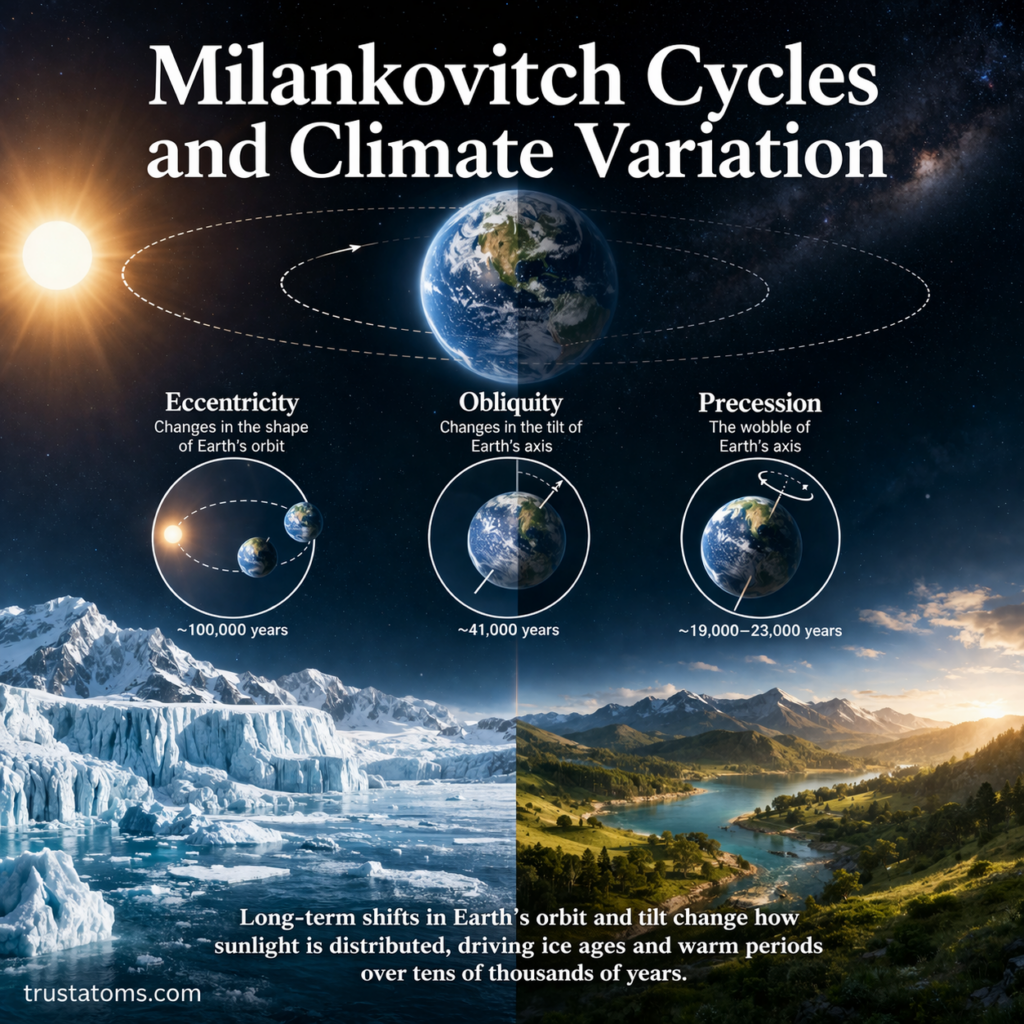
Milankovitch cycles are long-term changes in Earth’s orbit and orientation relative to the Sun. They were named after Serbian scientist Milutin Milankovitch, who studied how these variations affect Earth’s climate.
There are three main types of Milankovitch cycles:
- Eccentricity (shape of Earth’s orbit)
- Obliquity (tilt of Earth’s axis)
- Precession (wobble of Earth’s axis)
Each cycle operates over thousands to hundreds of thousands of years and plays a role in shaping long-term climate trends.
Eccentricity: The Shape of Earth’s Orbit
Eccentricity refers to how circular or elliptical Earth’s orbit is around the Sun.
Key Features
- Cycle length: ~100,000 years
- Orbit shifts between nearly circular and slightly elliptical
- Affects the distance between Earth and the Sun
Climate Impact
When Earth’s orbit becomes more elliptical:
- Seasonal differences can become more pronounced
- One hemisphere may experience stronger seasonal contrasts
When the orbit is more circular:
- Seasonal variations are less extreme
Eccentricity alone has a relatively small effect but amplifies the impact of the other cycles.
Obliquity: The Tilt of Earth’s Axis
Obliquity describes the angle of Earth’s axial tilt, which currently sits at about 23.5 degrees.
Key Features
- Cycle length: ~41,000 years
- Tilt varies between about 22.1° and 24.5°
Climate Impact
Changes in tilt influence the intensity of seasons:
- Greater tilt:
- Hotter summers
- Colder winters
- Smaller tilt:
- Milder summers
- Less severe winters
This cycle is especially important for high-latitude regions, where ice sheets can grow or shrink depending on summer temperatures.
Precession: The Wobble of Earth’s Axis
Precession is the slow wobble in Earth’s rotation axis, similar to the motion of a spinning top.
Key Features
- Cycle length: ~19,000 to 23,000 years
- Changes the timing of seasons relative to Earth’s position in orbit
Climate Impact
Precession affects which hemisphere points toward the Sun during different parts of the orbit:
- Can intensify or weaken seasonal contrasts
- Influences monsoon patterns and regional climates
For example, when summer in one hemisphere occurs closer to the Sun, that hemisphere experiences stronger seasonal heating.
How Milankovitch Cycles Work Together
While each cycle has its own effect, their combined influence drives major climate changes over long periods.
Interaction of Cycles
- Eccentricity modifies the overall shape of Earth’s orbit
- Obliquity controls the intensity of seasons
- Precession determines seasonal timing
Together, they influence how much solar energy (insolation) different parts of Earth receive.
Milankovitch Cycles and Ice Ages

Milankovitch cycles are strongly linked to the timing of ice ages and interglacial periods.
How Ice Ages Form
- Cooler summers prevent snow and ice from melting
- Ice sheets gradually build up over time
- Increased ice reflects more sunlight (albedo effect), reinforcing cooling
Evidence from Earth’s History
Scientists have found strong evidence supporting Milankovitch cycles in:
- Ice core samples
- Ocean sediment layers
- Fossil records
These records show repeating climate patterns that match the timing of orbital cycles.
Why Milankovitch Cycles Matter Today
Milankovitch cycles operate over very long timescales, but they are still relevant for understanding Earth’s climate system.
Key Insights
- Help explain natural climate variability
- Provide context for current climate trends
- Improve long-term climate modeling
Important Distinction
While Milankovitch cycles influence climate over thousands of years, modern climate change is occurring much faster due to human activities, particularly greenhouse gas emissions.
Limitations and Additional Factors
Milankovitch cycles are not the only drivers of climate change.
Other Influencing Factors
- Volcanic activity
- Atmospheric greenhouse gases
- Ocean circulation patterns
- Solar output variations
These factors can amplify or counteract the effects of orbital changes.
Final Thoughts
Milankovitch cycles reveal how subtle shifts in Earth’s orbit and orientation can lead to major climate changes over long periods. By influencing how sunlight is distributed across the planet, these cycles help drive ice ages and warm periods.
Understanding these natural processes provides valuable insight into Earth’s climate history and helps scientists better predict future changes.