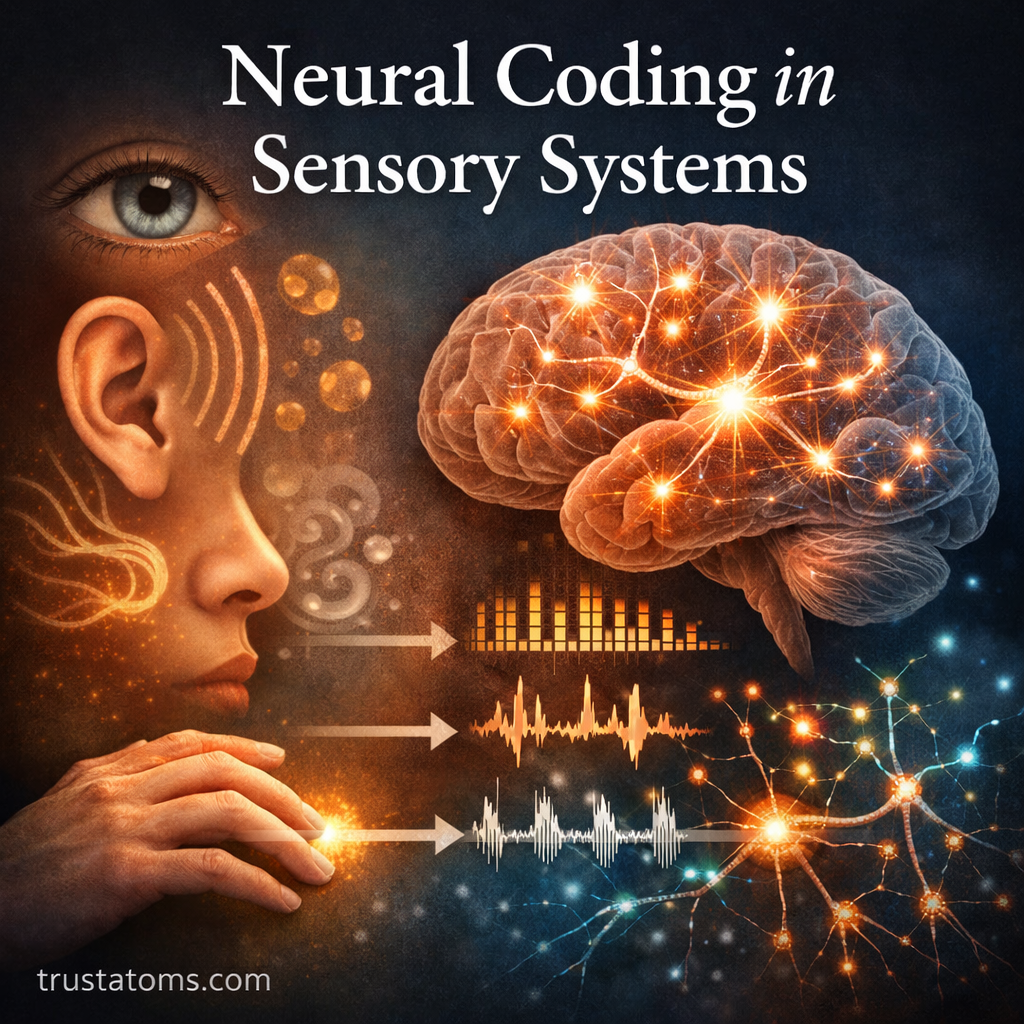
Understanding how the brain interprets the world begins with one key concept: neural coding. Every sight, sound, smell, taste, and touch you experience is converted into electrical signals and interpreted by the nervous system. This process allows the brain to transform raw sensory input into meaningful perception.
In this article, we’ll explore how neural coding works, the major coding strategies used by the brain, and why this process is essential for perception and behavior.
What Is Neural Coding?
Neural coding refers to the way sensory information is represented by patterns of electrical activity in neurons.
When sensory receptors detect a stimulus—such as light hitting the retina or pressure on the skin—they convert that stimulus into neural signals. These signals are then transmitted to the brain, where they are decoded and interpreted.
At its core, neural coding answers a fundamental question:
- How does the brain represent information using electrical signals?
The Basics of Sensory Transduction
Before neural coding begins, sensory systems must first convert physical stimuli into electrical signals—a process called transduction.
Different sensory systems specialize in detecting specific types of energy:
- Vision: light waves
- Hearing: sound vibrations
- Touch: mechanical pressure
- Smell: chemical molecules
- Taste: dissolved substances
Once detected, these stimuli are transformed into action potentials—the electrical impulses neurons use to communicate.
Key Neural Coding Strategies
The brain uses multiple strategies to encode sensory information. These strategies often work together to provide a complete representation of the environment.
Rate Coding
Rate coding is one of the simplest forms of neural coding. It is based on the frequency of action potentials.
- Stronger stimuli → higher firing rates
- Weaker stimuli → lower firing rates
For example, pressing harder on your skin increases the firing rate of touch-sensitive neurons.
Temporal Coding
Temporal coding focuses on the timing of neural spikes rather than just their frequency.
- Precise spike timing can carry information
- Important in auditory processing and speech recognition
This allows the brain to detect subtle differences in timing, such as distinguishing similar sounds.
Population Coding
Population coding involves groups of neurons working together to represent information.
- Each neuron responds to a specific feature
- The combined activity creates a detailed representation
For instance, direction of movement in vision is encoded by many neurons, each tuned to different angles.
Sparse Coding
Sparse coding uses a small number of highly selective neurons to represent stimuli.
- Only a few neurons fire strongly
- Increases efficiency and reduces overlap
This strategy is often associated with higher-level brain areas involved in memory and recognition.
Feature Detection and Tuning
Neurons are often “tuned” to specific features of a stimulus.
Examples include:
- Visual neurons that respond to edges or motion
- Auditory neurons tuned to specific frequencies
- Somatosensory neurons sensitive to pressure or vibration
This tuning allows the brain to break down complex stimuli into simpler components for easier processing.
Topographic Organization
Many sensory systems are organized in maps that preserve spatial relationships.
Examples:
- Retinotopic map: visual space mapped onto the visual cortex
- Somatotopic map: body surface mapped onto the somatosensory cortex
- Tonotopic map: sound frequencies mapped in the auditory system
These maps help the brain maintain a structured representation of sensory input.
Noise and Efficiency in Neural Coding
Neural signals are not perfectly precise—they contain variability, often referred to as “noise.”
Despite this, the brain is highly efficient at extracting meaningful information.
Key strategies for handling noise include:
- Redundancy across multiple neurons
- Averaging signals over time
- Using patterns rather than single spikes
This allows reliable perception even in uncertain conditions.
Neural Coding Across Sensory Systems
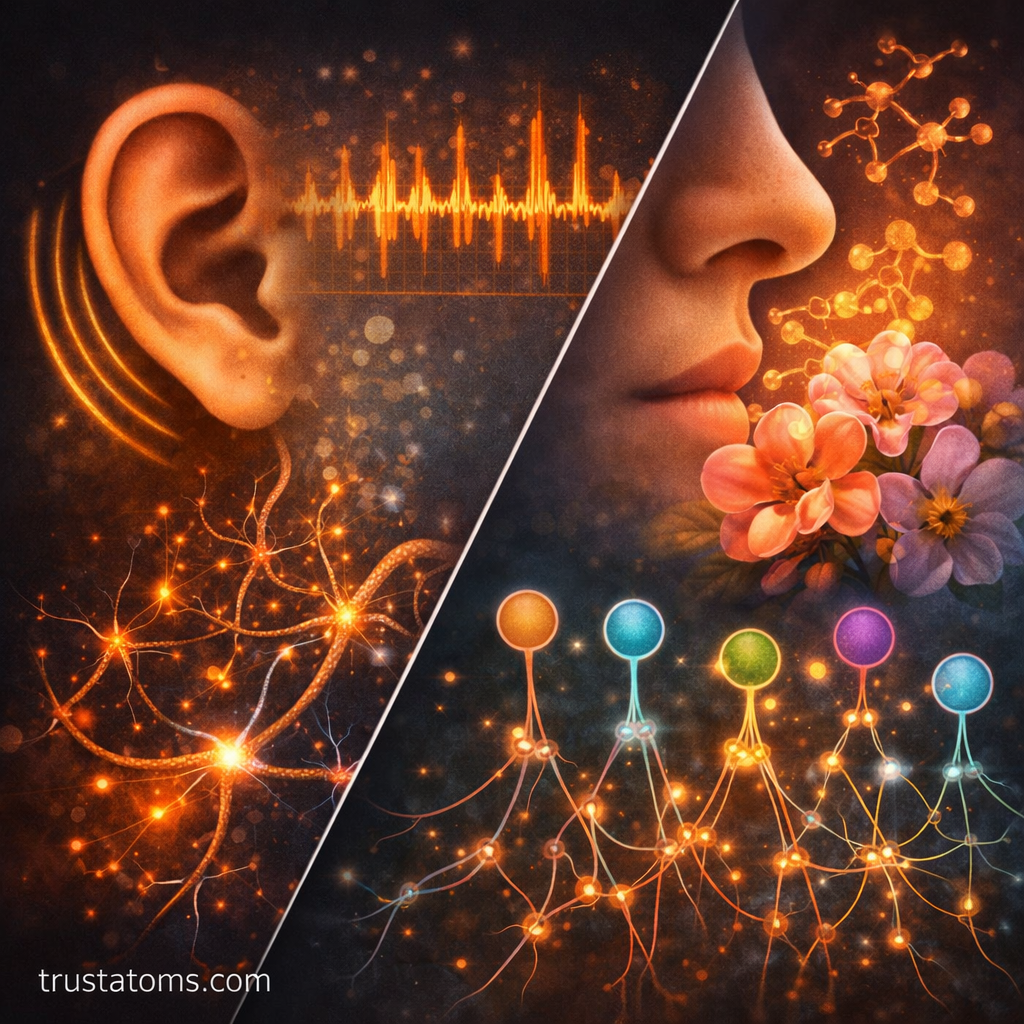
While each sensory system has unique features, they all rely on common coding principles.
Visual System
- Encodes light intensity, color, and motion
- Uses both rate and population coding
Auditory System
- Encodes frequency, amplitude, and timing
- Strong reliance on temporal coding
Somatosensory System
- Encodes touch, temperature, and pain
- Combines rate and spatial coding
Olfactory System
- Encodes chemical identity
- Uses combinatorial and sparse coding
Why Neural Coding Matters
Neural coding is essential for understanding how perception works. It has broad implications across multiple fields:
- Neuroscience: understanding brain function
- Medicine: diagnosing sensory disorders
- Artificial intelligence: inspiring neural network design
- Robotics: improving sensory processing systems
By studying neural coding, researchers can better understand how the brain processes information and how to replicate these processes in technology.
Common Misconceptions About Neural Coding
It’s Not Just About Firing Rate
While rate coding is important, timing and patterns also play critical roles.
Individual Neurons Don’t Work Alone
Most information is encoded by groups of neurons rather than single cells.
The Brain Doesn’t Use a Single Strategy
Different coding methods are used depending on the type of sensory input and context.
Final Thoughts
Neural coding is the foundation of perception. It bridges the gap between the physical world and our internal experience by translating stimuli into meaningful neural signals.
From the timing of spikes to the coordination of entire neural populations, the brain uses sophisticated strategies to ensure accurate and efficient processing. As research advances, our understanding of neural coding continues to deepen, revealing just how remarkable the human sensory system truly is.