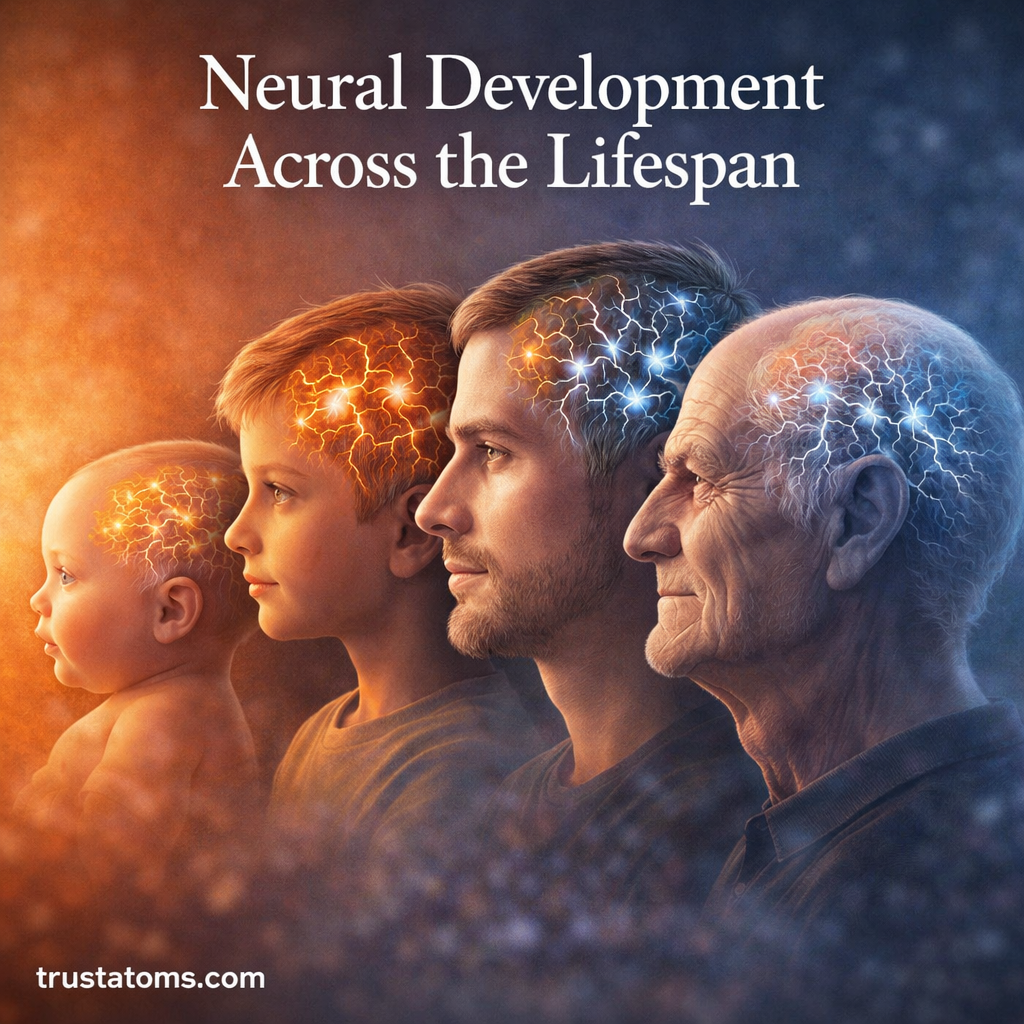
The human nervous system is not static—it evolves continuously from before birth through old age. Neural development across the lifespan involves the growth, organization, adaptation, and gradual changes of brain cells and neural connections that shape how we think, move, feel, and respond to the world.
Understanding these changes helps explain everything from early learning in childhood to cognitive aging later in life.
What Is Neural Development?
Neural development refers to the processes by which the nervous system forms, matures, and changes over time.
These processes include:
- Formation of neurons (neurogenesis)
- Migration of neurons to correct locations
- Creation of connections (synaptogenesis)
- Elimination of excess connections (synaptic pruning)
- Strengthening of important pathways
- Changes in brain plasticity
These stages begin before birth and continue throughout life.
Prenatal Neural Development
Neural development begins very early during pregnancy.
Key Processes Before Birth
- The neural tube forms, which becomes the brain and spinal cord
- Rapid production of neurons occurs
- Neurons migrate to specific brain regions
- Basic neural circuits begin forming
By the third trimester, the brain is already capable of basic sensory processing, although it is still far from fully developed.
Why This Stage Matters
- Sets the foundation for all future brain function
- Highly sensitive to environmental factors (nutrition, toxins, stress)
- Early disruptions can have long-term effects
Infancy and Early Childhood
This stage is marked by rapid brain growth and extreme plasticity.
Key Features
- Massive synapse formation (synaptogenesis)
- Overproduction of neural connections
- Beginning of synaptic pruning
- Development of motor and sensory systems
Learning and Adaptation
Infants and young children learn quickly because their brains are highly adaptable.
- Language acquisition begins
- Motor skills (crawling, walking) develop
- Sensory systems become more refined
Critical Periods
Certain abilities must develop during specific time windows:
- Language learning
- Vision development
- Emotional bonding
If missed, these skills become harder to develop later.
Middle Childhood and Adolescence

As children grow, the brain becomes more efficient rather than simply larger.
Synaptic Pruning
The brain removes weaker or unused connections:
- Improves efficiency
- Strengthens frequently used pathways
- Supports skill specialization
Myelination
Myelin (a fatty coating around neurons) increases:
- Speeds up signal transmission
- Improves coordination and reaction time
- Enhances learning and memory
Adolescent Brain Changes
During adolescence:
- The prefrontal cortex (decision-making) is still developing
- Emotional centers (like the limbic system) are highly active
- Risk-taking and impulsive behavior may increase
This imbalance explains many typical teenage behaviors.
Adulthood: Stability and Adaptation
In adulthood, neural development shifts toward maintenance and refinement.
Key Characteristics
- Stable neural networks
- Continued learning and skill development
- Ongoing neuroplasticity
Even though the brain is fully developed, it remains capable of change.
Neuroplasticity in Adults
Adults can still:
- Learn new skills
- Form new neural connections
- Adapt after injury (to some extent)
Examples include learning a new language or recovering from a stroke.
Aging and Neural Changes
As the brain ages, gradual structural and functional changes occur.
Common Age-Related Changes
- Slower processing speed
- Reduced synaptic density
- Changes in neurotransmitter levels
- Mild memory decline
However, not all changes are negative.
Preserved and Strengthened Abilities
- Vocabulary and knowledge often remain stable or improve
- Emotional regulation may become stronger
- Experience-based decision-making improves
Brain Plasticity in Aging
Although reduced, plasticity still exists:
- Cognitive training can help maintain function
- Physical activity supports brain health
- Social engagement helps preserve neural connections
Factors That Influence Neural Development
Neural development is shaped by both biological and environmental factors.
Biological Factors
- Genetics
- Hormones
- Overall health
Environmental Factors
- Nutrition
- Education and learning experiences
- Social interactions
- Stress levels
- Exposure to toxins
Lifestyle Influences
Healthy habits support neural function at every stage:
- Regular exercise
- Mental stimulation
- Quality sleep
- Balanced diet
Neuroplasticity: The Lifelong Ability to Change
One of the most important principles in neural development is neuroplasticity.
Neuroplasticity refers to the brain’s ability to:
- Reorganize itself
- Form new connections
- Adapt to new experiences or injuries
Examples Across the Lifespan
- Children learning language rapidly
- Teenagers developing reasoning skills
- Adults acquiring new expertise
- Older adults maintaining cognition through mental activity
This adaptability is what allows humans to learn and grow throughout life.
Clinical Significance
Understanding neural development has important real-world applications.
Early Intervention
- Identifies developmental delays
- Supports learning disabilities
- Improves long-term outcomes
Mental Health
- Many disorders emerge during development (e.g., anxiety, ADHD)
- Early support can improve brain function and coping strategies
Aging and Cognitive Health
- Helps prevent or delay neurodegenerative conditions
- Guides therapies for memory and cognitive decline
Key Takeaways
- Neural development begins before birth and continues throughout life
- Early life is marked by rapid growth and high plasticity
- Adolescence refines brain efficiency and decision-making
- Adulthood focuses on stability and adaptation
- Aging brings gradual changes but also preserved strengths
- Neuroplasticity allows learning and change at every stage
Final Thoughts
Neural development across the lifespan highlights the brain’s remarkable ability to grow, adapt, and reorganize. From the rapid wiring of infancy to the refined efficiency of adulthood and the resilience of aging, the nervous system remains dynamic throughout life.
By understanding these changes, we can better support learning, improve mental health, and promote long-term brain function at every stage of life.