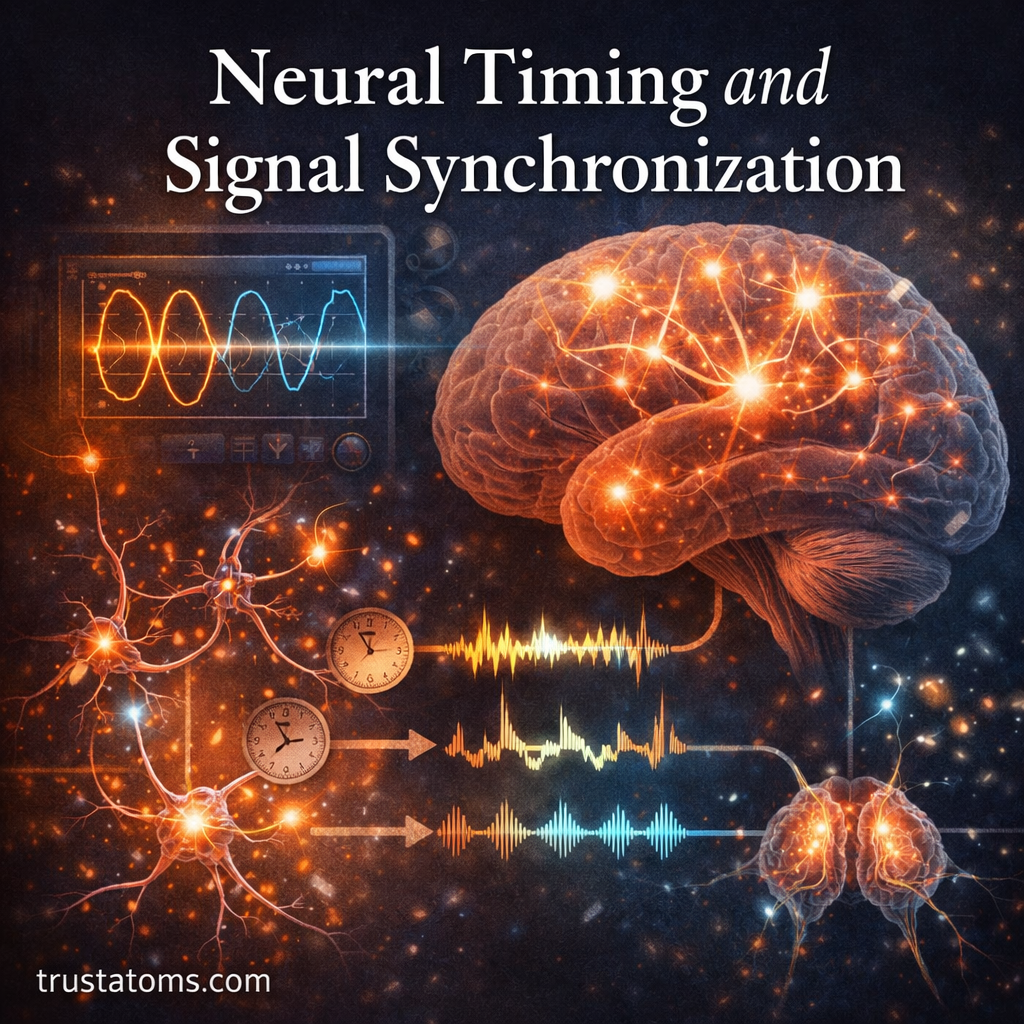
The human brain is not just a network of neurons firing randomly—it is a precisely timed system where when signals occur can be just as important as how often they occur. Neural timing and signal synchronization play a critical role in how the brain processes information, coordinates actions, and creates perception.
In this article, we’ll explore how timing shapes neural communication, why synchronization matters, and how these processes influence everything from movement to memory.
What Is Neural Timing?
Neural timing refers to the precise moment at which neurons fire electrical signals (action potentials). Unlike simple on/off signals, the brain often relies on the exact timing of spikes to encode and transmit information.
Key idea:
- The brain uses both when neurons fire and how frequently they fire to represent information.
Even small differences in timing—on the scale of milliseconds—can significantly change how signals are interpreted.
Understanding Signal Synchronization
Signal synchronization occurs when groups of neurons fire in coordinated patterns. Instead of acting independently, neurons align their activity in time.
This synchronization allows the brain to:
- Strengthen communication between regions
- Bind different types of sensory information
- Improve signal clarity amid background noise
Synchronized activity is often observed as rhythmic patterns known as brain waves.
Why Timing Matters in the Brain
Precise timing is essential for efficient neural communication. Without it, signals could become disorganized or misinterpreted.
Key functions of neural timing include:
- Information encoding: Timing can carry detailed information beyond firing rate
- Coordination: Helps align signals across different brain regions
- Speed: Enables rapid processing of sensory input
- Accuracy: Reduces errors in signal transmission
For example, in hearing, the brain detects tiny timing differences between sounds reaching each ear to determine direction.
Types of Neural Timing Mechanisms
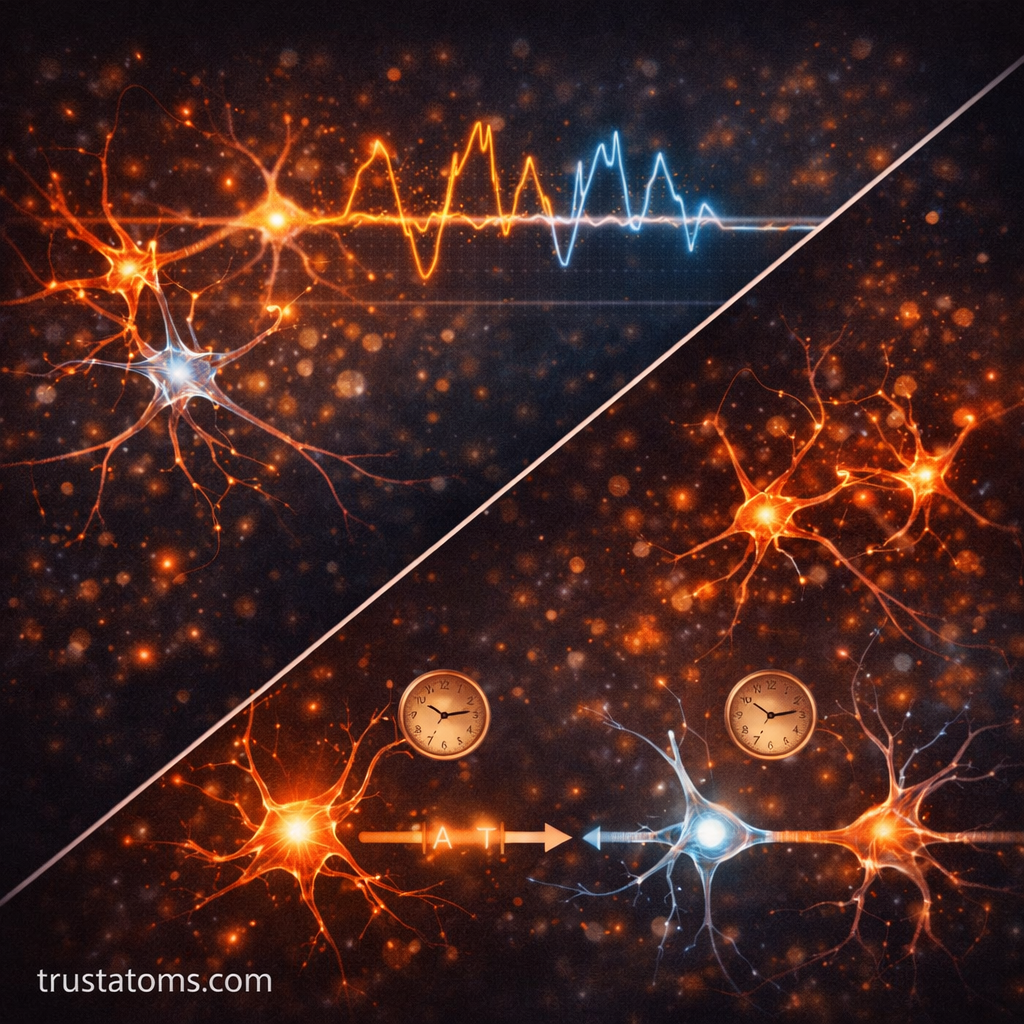
The brain uses several timing strategies to process information effectively.
Temporal Coding
Temporal coding relies on the exact timing of spikes rather than just their frequency.
- Spike patterns can represent specific stimuli
- Critical for auditory and speech processing
Phase Coding
In phase coding, neuron firing is linked to the phase of an ongoing brain rhythm.
- Neurons fire at specific points within a wave cycle
- Helps organize information over time
Spike Timing-Dependent Plasticity (STDP)
STDP is a learning mechanism based on timing differences between neurons.
- If one neuron fires just before another → connection strengthens
- If timing is reversed → connection weakens
This timing-based learning plays a major role in memory and adaptation.
Brain Waves and Synchronization
Neural synchronization often appears as rhythmic electrical activity known as brain waves.
These waves are categorized by frequency:
- Delta (0.5–4 Hz): Deep sleep
- Theta (4–8 Hz): Memory and navigation
- Alpha (8–12 Hz): Relaxed wakefulness
- Beta (13–30 Hz): Active thinking and focus
- Gamma (30+ Hz): High-level processing and perception
Each type of wave reflects synchronized activity across groups of neurons.
Communication Between Brain Regions
Synchronization allows distant parts of the brain to work together efficiently.
Examples include:
- Visual and auditory areas coordinating during speech perception
- Motor and sensory regions aligning during movement
- Memory systems interacting during learning
When neurons fire in sync, their signals are more likely to influence each other, strengthening communication pathways.
Neural Timing in Sensory Systems
Timing is especially important in how the brain processes sensory input.
Auditory System
- Detects microsecond differences in sound arrival time
- Enables sound localization
Visual System
- Coordinates timing across neurons to detect motion and changes
- Helps integrate visual scenes
Somatosensory System
- Uses timing to distinguish textures and vibrations
- Supports precise touch perception
Synchronization and Cognitive Function
Neural synchronization is closely linked to higher-level brain functions.
Attention
- Synchronized activity enhances relevant signals
- Filters out distractions
Memory
- Timing patterns help encode and retrieve information
- Coordination between brain regions supports recall
Consciousness
- Some theories suggest synchronized neural activity contributes to awareness
When Timing Goes Wrong
Disruptions in neural timing and synchronization can lead to neurological and psychological issues.
Examples include:
- Epilepsy: Excessive synchronization causing seizures
- Schizophrenia: Altered synchronization affecting perception and cognition
- Parkinson’s disease: Abnormal rhythmic activity impacting movement
- Autism spectrum conditions: Differences in timing and connectivity
These conditions highlight how critical precise timing is for normal brain function.
How the Brain Maintains Synchronization
The brain uses several mechanisms to regulate timing and coordination:
- Neural circuits: Feedback loops help align activity
- Inhibitory neurons: Control and refine timing patterns
- Oscillatory networks: Generate rhythmic activity
- Neurotransmitters: Adjust signal strength and timing
Together, these systems ensure that neural communication remains efficient and stable.
Practical Implications of Neural Timing
Understanding neural timing has real-world applications across multiple fields:
- Medicine: Improving treatments for neurological disorders
- Neurotechnology: Developing brain-computer interfaces
- Artificial intelligence: Designing systems inspired by temporal processing
- Education: Enhancing learning strategies based on brain rhythms
As research continues, timing-based approaches are becoming increasingly important in both science and technology.
Final Thoughts
Neural timing and signal synchronization reveal that the brain is not just about activity—but about precision. The exact timing of neural signals and their coordination across networks enable perception, movement, learning, and consciousness.
By studying how neurons align in time, scientists gain deeper insight into how the brain operates as a unified, highly efficient system. These discoveries continue to shape our understanding of the human mind and its remarkable capabilities.