The ability to move—whether lifting a weight, walking, or even blinking—relies on a precise connection between the nervous system and muscles. This connection occurs at a specialized site called the neuromuscular junction (NMJ).
Understanding how the neuromuscular junction works helps explain how muscles contract, how signals travel through the body, and what happens when this system is disrupted.
What Is the Neuromuscular Junction?
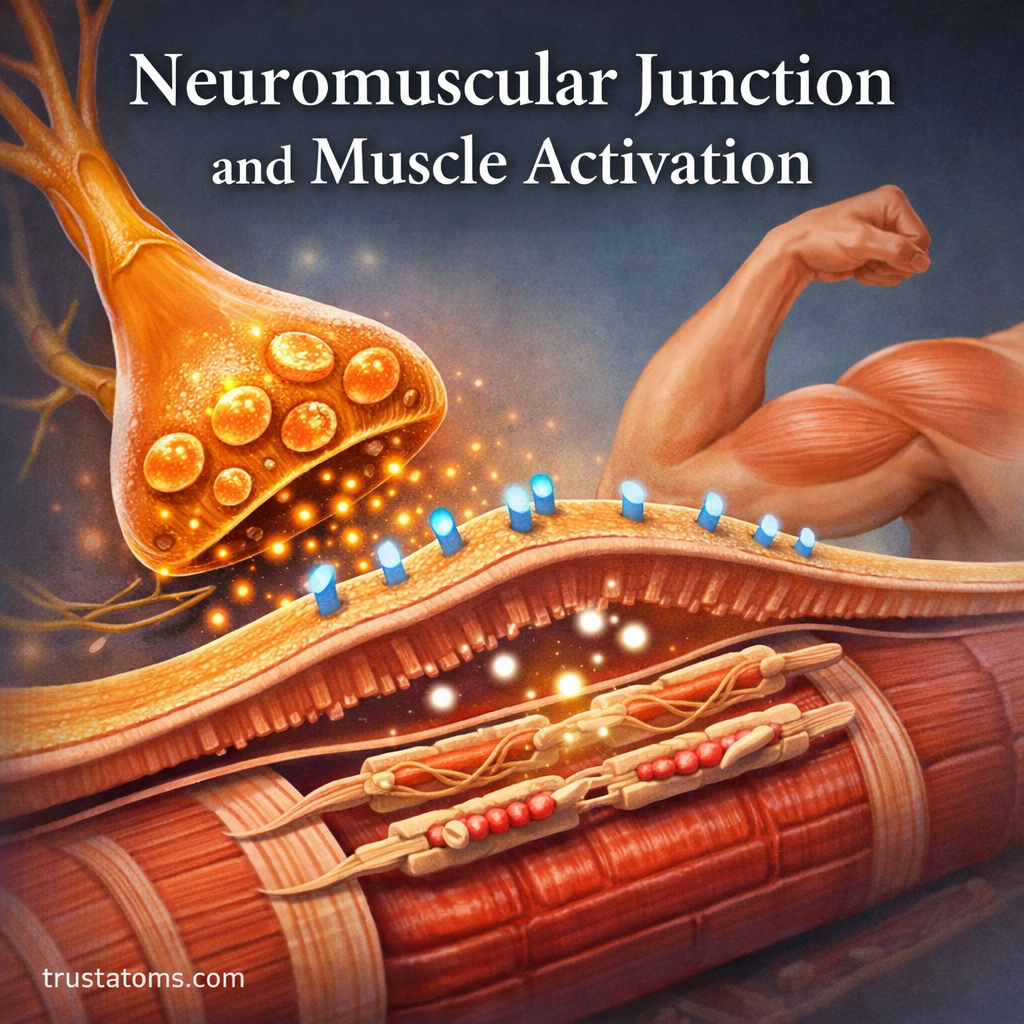
The neuromuscular junction is the point where a motor neuron communicates with a skeletal muscle fiber.
It acts as a communication bridge between:
- The nervous system (which sends signals)
- The muscular system (which responds by contracting)
Key Components of the Neuromuscular Junction
The NMJ consists of three main parts:
- Presynaptic terminal (motor neuron ending)
- Synaptic cleft (tiny gap between neuron and muscle)
- Postsynaptic membrane (muscle fiber surface)
Each part plays a critical role in transmitting the signal that leads to muscle contraction.
How Muscle Activation Begins
Muscle activation starts in the brain or spinal cord and travels through motor neurons to the neuromuscular junction.
Step-by-Step Process
- Signal generation
A nerve impulse (action potential) is created in the central nervous system. - Signal transmission
The impulse travels down a motor neuron toward the muscle. - Arrival at the NMJ
The signal reaches the presynaptic terminal. - Neurotransmitter release
Calcium ions enter the neuron, triggering the release of acetylcholine (ACh). - Crossing the synaptic cleft
Acetylcholine diffuses across the gap. - Receptor binding
ACh binds to receptors on the muscle fiber membrane. - Muscle activation signal
This generates a new electrical signal in the muscle.
Role of Acetylcholine in Muscle Activation
Acetylcholine (ACh) is the primary neurotransmitter involved in muscle contraction.
What Acetylcholine Does
- Carries the signal from nerve to muscle
- Binds to specific receptors on the muscle fiber
- Triggers depolarization (electrical change)
Once ACh binds to receptors, sodium channels open, leading to an electrical impulse within the muscle.
Breaking Down Acetylcholine
After its job is done, ACh must be removed quickly to prevent continuous contraction.
This is done by:
- The enzyme acetylcholinesterase
- Which breaks ACh into inactive components
This ensures muscles can relax and prepare for the next signal.
From Electrical Signal to Muscle Contraction
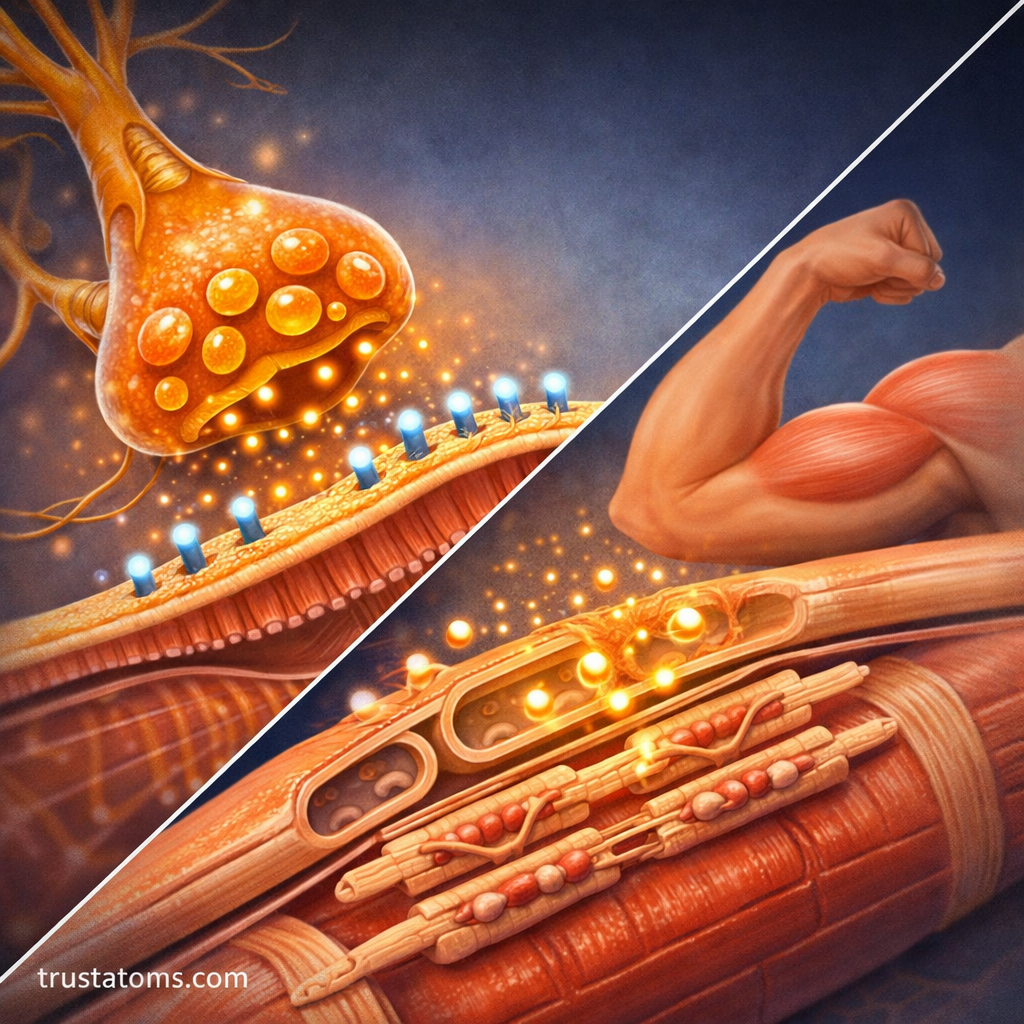
Once the muscle fiber receives the signal, a sequence of internal events begins.
Key Steps Inside the Muscle
- The electrical signal spreads along the muscle membrane
- It travels down structures called T-tubules
- The sarcoplasmic reticulum releases calcium ions
- Calcium binds to regulatory proteins
- This allows actin and myosin to interact
- Muscle contraction occurs (sliding filament mechanism)
This entire process happens in milliseconds.
Motor Units and Muscle Control
A motor unit consists of:
- One motor neuron
- All the muscle fibers it controls
Why Motor Units Matter
- Small motor units = precise movements (e.g., eyes, fingers)
- Large motor units = powerful movements (e.g., legs, back)
The body controls muscle strength by:
- Recruiting more motor units
- Increasing firing frequency
This allows for both delicate and powerful actions.
Factors That Affect Neuromuscular Function
Several factors influence how efficiently the NMJ works.
Biological Factors
- Age-related changes
- Hormonal balance
- Nutritional status (especially electrolytes)
External Influences
- Exercise and training
- Fatigue
- Medications and toxins
Neurological Conditions
Certain disorders directly affect the neuromuscular junction, including:
- Myasthenia gravis (autoimmune attack on receptors)
- Lambert-Eaton syndrome (impaired neurotransmitter release)
These conditions can lead to muscle weakness and fatigue.
Common Mistakes in Understanding Muscle Activation
Many people oversimplify how muscles work. Here are some common misconceptions:
- Muscles contract on their own (they require nerve signals)
- Stronger muscles always mean better activation (coordination matters)
- Fatigue is only muscular (it can also be neurological)
Understanding the NMJ highlights how closely the nervous and muscular systems are connected.
Why the Neuromuscular Junction Is Important
The NMJ is essential for:
- Voluntary movement
- Reflexes
- Posture and stability
- Breathing (via diaphragm control)
Without proper neuromuscular communication, even simple movements become difficult or impossible.
Final Thoughts
The neuromuscular junction is a critical link between thought and movement. Every action you take—whether conscious or automatic—depends on the successful transmission of signals across this microscopic gap.
By understanding how muscle activation works at the NMJ, you gain insight into everything from athletic performance to neurological health.