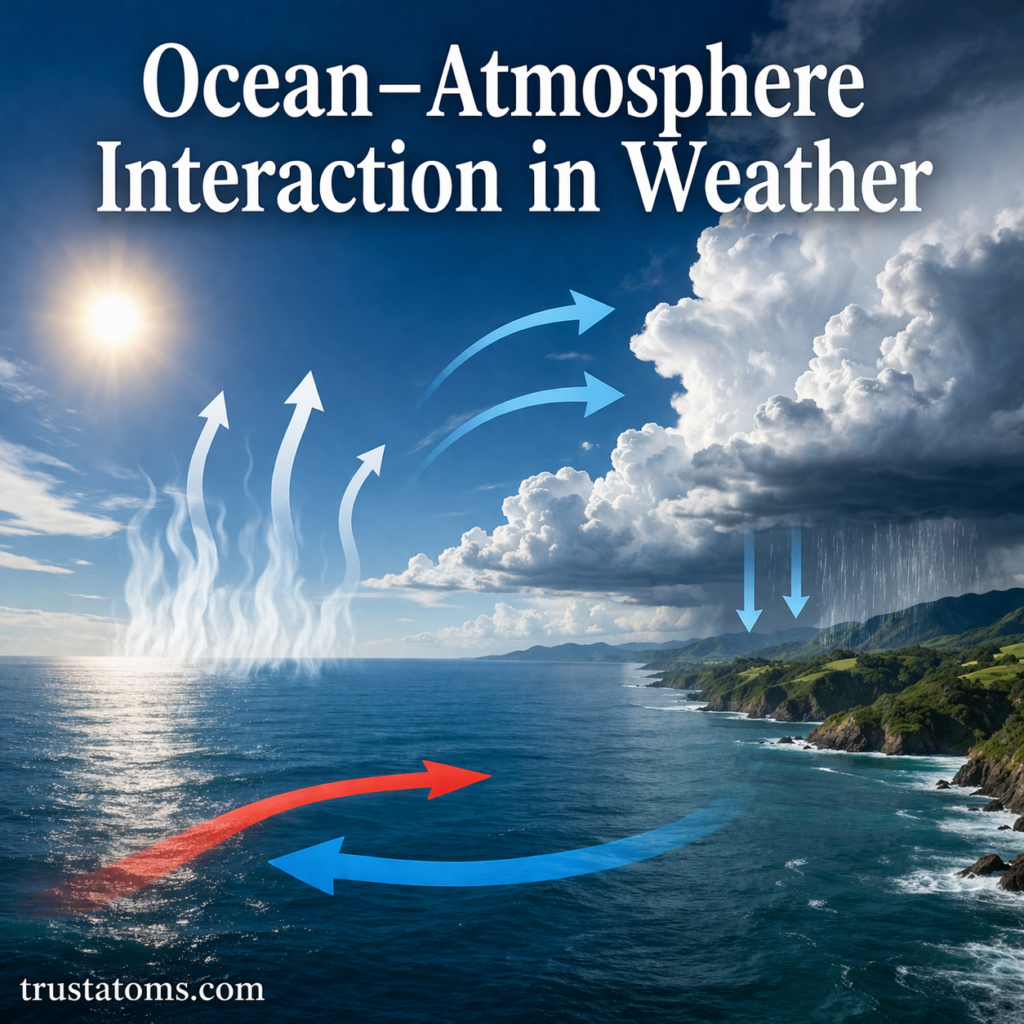
The Earth’s weather system is driven by a constant exchange of energy and moisture between the oceans and the atmosphere. Because oceans cover over 70% of the planet’s surface, they act as a massive heat reservoir, influencing everything from daily weather patterns to long-term climate systems.
Understanding ocean–atmosphere interaction is key to explaining storms, rainfall, wind patterns, and even extreme events like hurricanes and droughts.
How the Ocean and Atmosphere Work Together
The ocean and atmosphere are tightly linked through continuous physical processes:
Heat Exchange
- The ocean absorbs solar radiation and stores heat.
- Warm ocean surfaces transfer heat to the atmosphere through conduction and convection.
- This heat fuels atmospheric circulation and weather systems.
Moisture Transfer
- Water evaporates from the ocean surface into the atmosphere.
- This moisture forms clouds and precipitation.
- The process releases latent heat, which strengthens storms and weather systems.
Gas Exchange
- Oceans absorb and release gases like carbon dioxide (CO₂) and oxygen.
- This influences atmospheric composition and temperature regulation.
The Water Cycle and Weather Formation
Ocean–atmosphere interaction plays a central role in the global water cycle.
Key Steps:
- Evaporation from ocean surfaces
- Condensation into clouds
- Precipitation over land and sea
- Runoff returning water to the ocean
This cycle directly affects:
- Rainfall distribution
- Storm development
- Humidity levels
Regions near warm oceans often experience higher rainfall due to increased evaporation.
Ocean Currents and Their Impact on Weather
Ocean currents redistribute heat across the planet, shaping regional climates and weather patterns.
Types of Ocean Currents
Surface Currents
- Driven by wind patterns
- Move warm and cold water across oceans
Deep Ocean Currents
- Driven by temperature and salinity differences (thermohaline circulation)
- Regulate long-term climate patterns
Effects on Weather
- Warm currents (like the Gulf Stream) bring milder, wetter conditions.
- Cold currents can stabilize air and reduce precipitation.
- Currents influence storm paths and intensity.
Air Pressure, Winds, and Ocean Influence
Temperature differences between ocean and land create pressure gradients that drive wind systems.
Sea Breezes and Land Breezes
- Daytime: Land heats faster → air rises → cool ocean air moves inland (sea breeze)
- Nighttime: Land cools faster → air flows from land to sea (land breeze)
Global Wind Patterns
- Trade winds and westerlies interact with ocean surfaces.
- These winds drive surface currents and influence weather systems globally.
El Niño and La Niña: Ocean–Atmosphere Events
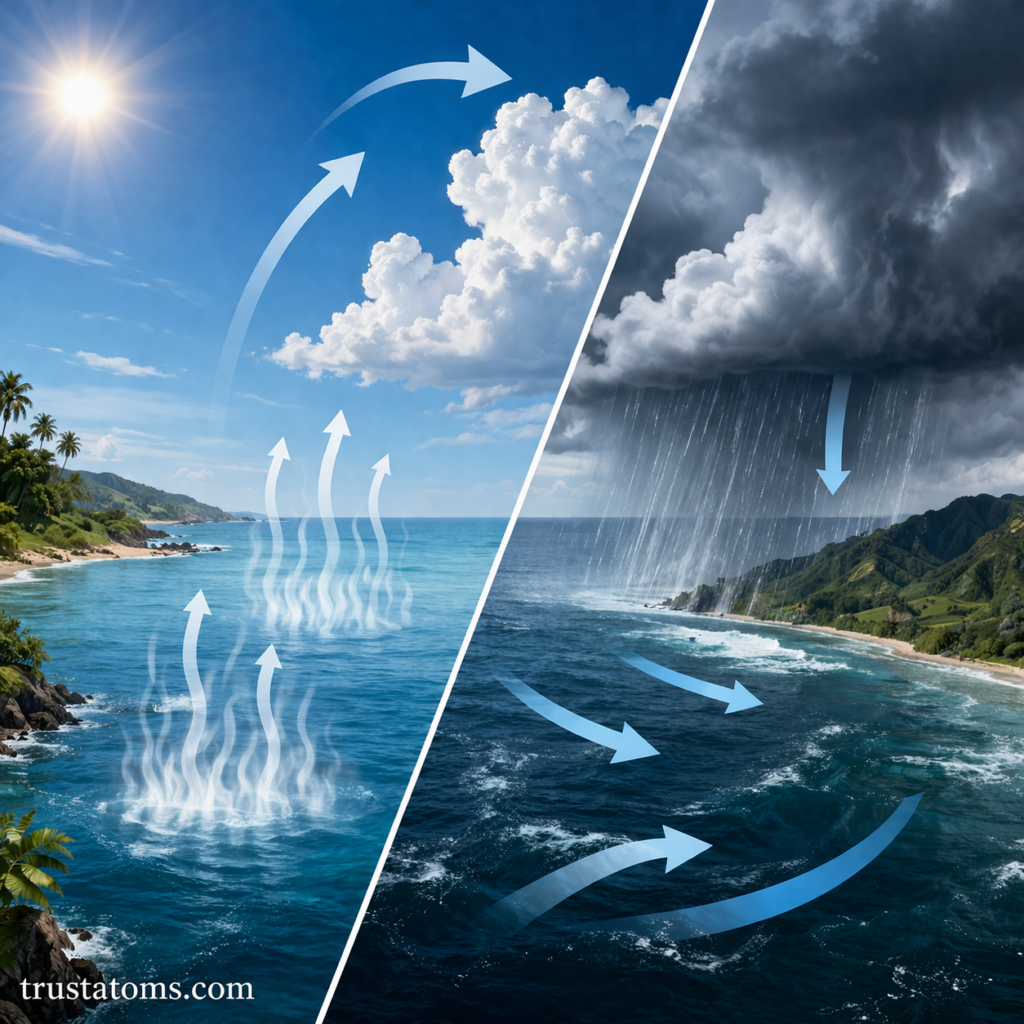
One of the most important examples of ocean–atmosphere interaction is the El Niño–Southern Oscillation (ENSO).
El Niño
- Warmer-than-average ocean temperatures in the Pacific
- Leads to:
- Increased rainfall in some regions
- Droughts in others
- Weakened trade winds
La Niña
- Cooler-than-average ocean temperatures
- Often causes:
- Stronger storms in certain areas
- Enhanced trade winds
- Opposite weather patterns of El Niño
These events can disrupt global weather patterns for months or even years.
Hurricanes and Ocean Energy
Tropical storms and hurricanes are powered by warm ocean waters.
How It Works:
- Warm water (typically above 26.5°C / 80°F) fuels evaporation
- Rising moist air creates low pressure
- Condensation releases heat, intensifying the storm
Key Factors:
- Sea surface temperature
- Ocean heat depth
- Atmospheric conditions
Without warm oceans, hurricanes cannot form or sustain themselves.
Feedback Loops Between Ocean and Atmosphere
Ocean–atmosphere systems often involve feedback mechanisms:
Positive Feedback
- Warmer oceans → more evaporation → more heat in atmosphere → stronger storms
Negative Feedback
- Increased cloud cover → reflects sunlight → cools ocean surface
These feedback loops help regulate Earth’s climate but can also amplify extreme weather events.
Long-Term Climate Influence
Ocean–atmosphere interactions are not just short-term—they shape global climate patterns.
Key Roles:
- Regulating global temperature
- Driving monsoon systems
- Influencing polar ice melt
- Affecting long-term climate variability
Changes in these interactions are central to understanding climate change.
Why Ocean–Atmosphere Interaction Matters
Understanding this system helps scientists:
- Predict weather more accurately
- Forecast extreme events like hurricanes and droughts
- Study climate change impacts
- Improve global climate models
For everyday life, these interactions determine:
- Local weather conditions
- Seasonal changes
- Agricultural productivity
- Water availability
Final Thoughts
Ocean–atmosphere interaction is one of the most powerful forces shaping Earth’s weather and climate. Through heat exchange, moisture transfer, and dynamic feedback loops, the oceans and atmosphere work together as a single, interconnected system.
From gentle sea breezes to powerful hurricanes and global climate shifts, nearly every aspect of weather is influenced by this relationship. Understanding it provides a clearer picture of how our planet functions—and how it may change in the future.