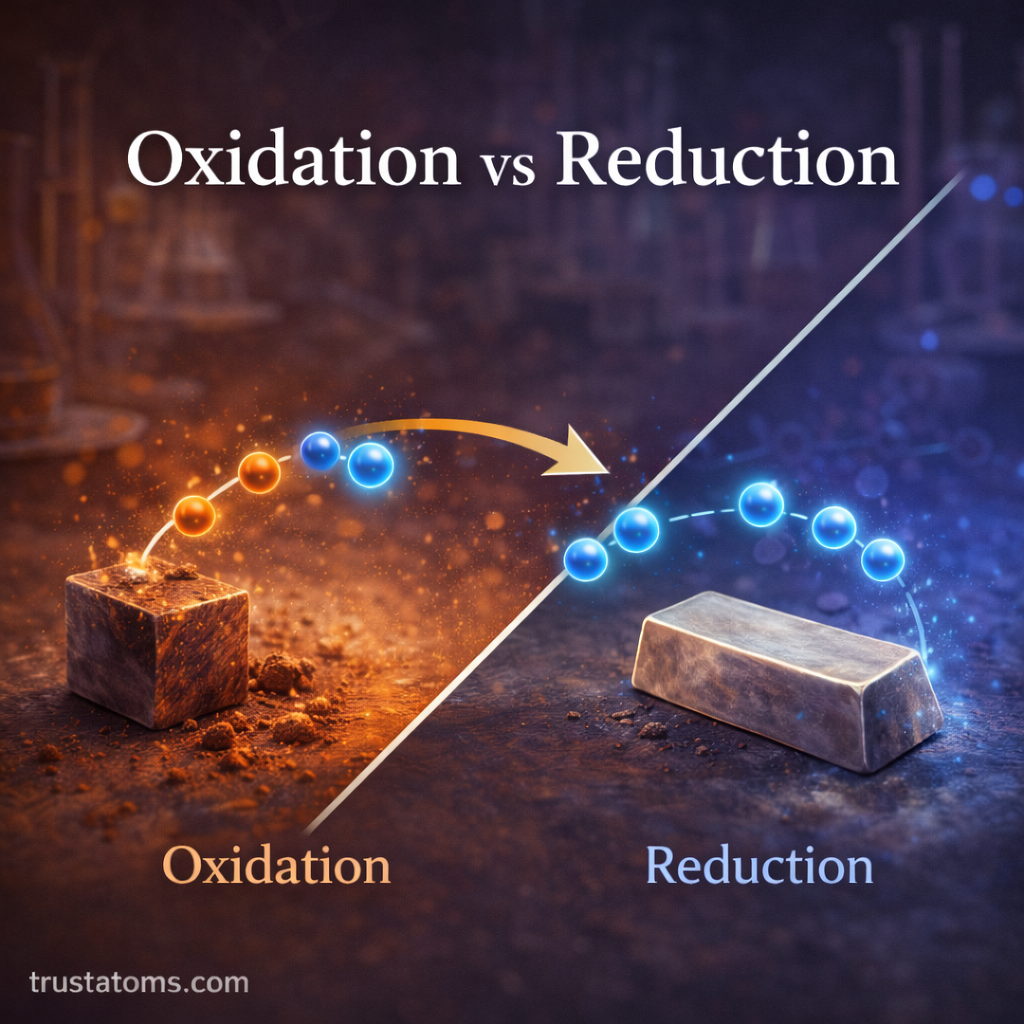
Oxidation and reduction are two closely connected chemical processes that occur together in what are called redox reactions. These reactions involve the transfer of electrons between substances, allowing matter to change form and energy to be released or stored.
In simple terms:
- Oxidation = loss of electrons
- Reduction = gain of electrons
Understanding the difference between oxidation and reduction is essential for studying chemistry, biology, energy systems, and industrial processes.
What Is Oxidation?
Oxidation is the process in which a substance loses electrons during a chemical reaction.
When oxidation occurs:
- The substance gives up one or more electrons
- Its oxidation number increases
- It often becomes more positively charged
Historically, oxidation referred specifically to reactions involving oxygen, such as metals reacting with oxygen in air. Today, the definition focuses on electron loss, whether oxygen is involved or not.
Example of Oxidation
A common example is iron rusting.
Iron atoms lose electrons as they react with oxygen and water in the air, forming iron oxide (rust). This gradual oxidation weakens metal structures over time.
What Is Reduction?
Reduction is the opposite process of oxidation. It occurs when a substance gains electrons during a chemical reaction.
When reduction occurs:
- The substance receives electrons
- Its oxidation number decreases
- It often becomes more negatively charged or less positive
Because electrons must come from somewhere, reduction cannot occur alone. Whenever reduction happens, oxidation must also occur.
Example of Reduction
In metal extraction, metal ions gain electrons and form pure metal.
For instance, aluminum ions gain electrons during electrolysis to produce aluminum metal.
Why Oxidation and Reduction Always Occur Together
Oxidation and reduction are inseparable processes.
If one substance loses electrons (oxidation), another must gain those electrons (reduction). This transfer of electrons forms a redox reaction.
For example:
- One chemical substance releases electrons
- Another chemical substance accepts those electrons
This electron exchange drives many chemical reactions in nature and technology.
Quick Memory Trick
Chemists often remember oxidation and reduction using this phrase:
OIL RIG
- Oxidation Is Loss (of electrons)
- Reduction Is Gain (of electrons)
This simple rule helps identify which process is occurring in a reaction.
Oxidation vs Reduction: Key Differences
Although they occur together, oxidation and reduction have opposite characteristics.
Oxidation:
- Loss of electrons
- Oxidation number increases
- Often associated with corrosion or combustion
- Occurs at the anode in electrochemical cells
Reduction:
- Gain of electrons
- Oxidation number decreases
- Often associated with metal formation or energy storage
- Occurs at the cathode in electrochemical cells
Recognizing these differences helps chemists analyze chemical reactions accurately.
Redox Reactions Explained
A redox reaction is any chemical reaction involving electron transfer between substances.
In a redox reaction:
- One substance is oxidized (loses electrons)
- Another substance is reduced (gains electrons)
These reactions are fundamental to many chemical processes.
Examples include:
- Combustion reactions
- Corrosion of metals
- Battery operation
- Photosynthesis
- Cellular respiration
Real-World Examples of Redox Reactions
Redox reactions occur in many everyday situations.
Rust Formation
Iron reacts with oxygen and moisture in the air.
- Iron atoms lose electrons (oxidation)
- Oxygen gains electrons (reduction)
This creates rust, a reddish-brown iron oxide.
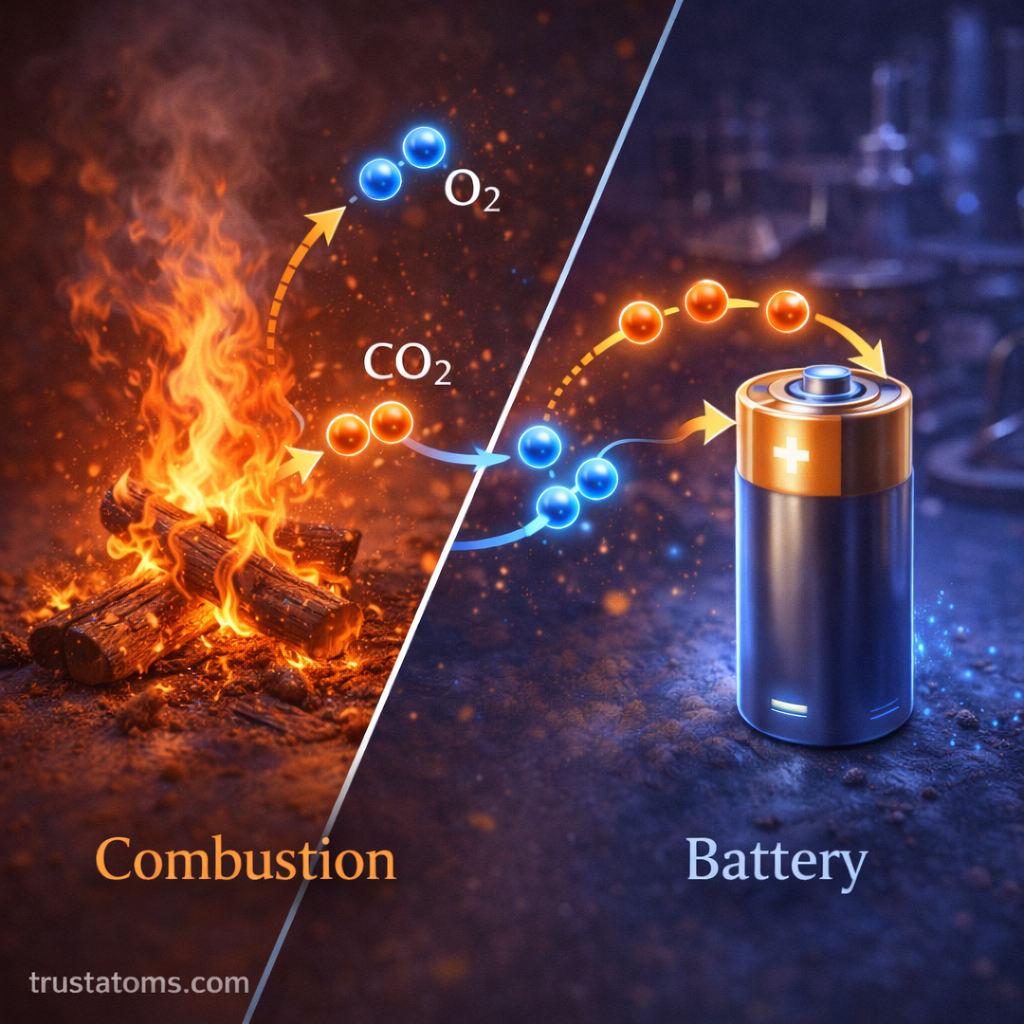
Combustion
When fuels burn, they undergo rapid oxidation.
Examples include:
- Gasoline burning in engines
- Natural gas burning on stoves
- Wood burning in fireplaces
Oxygen is reduced while the fuel is oxidized.
Batteries
Batteries rely on controlled redox reactions.
Inside a battery:
- Oxidation occurs at the anode
- Reduction occurs at the cathode
Electrons flow through an external circuit, producing electricity.
Cellular Respiration
Living organisms use redox reactions to generate energy.
During respiration:
- Glucose molecules are oxidized
- Oxygen molecules are reduced
This process produces ATP, the energy molecule used by cells.
Oxidizing Agents and Reducing Agents
In redox reactions, substances are often classified as agents.
Oxidizing agent:
- Causes another substance to oxidize
- Gains electrons
- Is reduced during the reaction
Reducing agent:
- Causes another substance to reduce
- Loses electrons
- Is oxidized during the reaction
Understanding these roles helps explain how chemical reactions proceed.
Oxidation Numbers and Electron Transfer
Chemists track oxidation and reduction using oxidation numbers.
An oxidation number represents the apparent charge of an atom in a compound.
Changes in oxidation numbers reveal what is happening in a reaction:
- Increase in oxidation number → oxidation
- Decrease in oxidation number → reduction
This system allows chemists to analyze complex reactions step by step.
Why Redox Chemistry Is Important
Oxidation and reduction reactions are essential to both natural systems and modern technology.
They play a role in:
- Energy production
- Industrial chemical manufacturing
- Environmental chemistry
- Biological metabolism
- Metal extraction and refining
- Electrochemistry and batteries
Without redox chemistry, many processes that power modern life would not exist.
Final Thoughts
Oxidation and reduction are two sides of the same chemical process involving electron transfer. Oxidation occurs when electrons are lost, while reduction occurs when electrons are gained.
Together, these processes form redox reactions that drive countless chemical transformations—from rust forming on metal to the production of energy in living cells.
Understanding oxidation vs reduction provides a foundation for studying chemistry, energy systems, and the chemical reactions that shape the world around us.