What Is Thermal Expansion?

Illustration showing examples of thermal expansion including railway tracks, a thermometer rising, heated metal expanding, and bridge structures adjusting to heat.
Educational illustration showing real-world examples of thermal expansion such as expanding railway tracks, heated metal, thermometers, and bridge expansion joints. trustatoms.com.

Introduction

Thermal expansion is a physical phenomenon where materials expand when heated and contract when cooled. This occurs because heat increases the motion of particles inside a substance, causing them to spread farther apart.

Thermal expansion affects solids, liquids, and gases, though the degree of expansion varies depending on the material. This concept is important in physics, engineering, construction, and many everyday situations.

From bridges and railroad tracks to thermometers and pipelines, engineers must account for thermal expansion to ensure structures remain safe and functional as temperatures change.

Continue reading “What Is Thermal Expansion?”
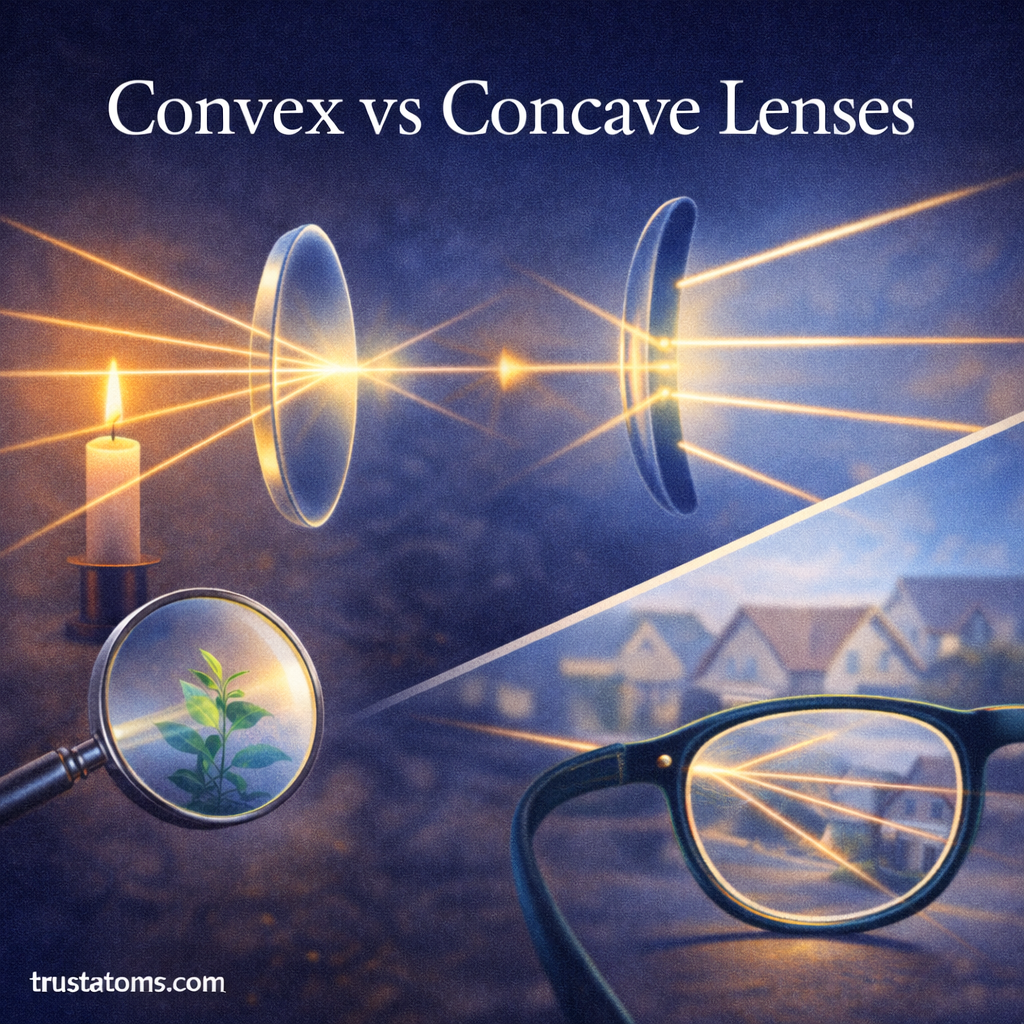
Convex vs Concave Lenses

Illustration comparing convex and concave lenses showing how convex lenses focus light and concave lenses spread light rays.
Educational illustration comparing convex and concave lenses and how each lens changes the direction of light rays. trustatoms.com.

Introduction

Lenses are essential tools in physics and everyday technology. From eyeglasses and cameras to microscopes and telescopes, lenses help control how light travels and forms images.

Two of the most common lens types are convex lenses and concave lenses. While both bend light through the process of refraction, they do so in different ways. Convex lenses bring light rays together, while concave lenses spread them apart.

Understanding the differences between convex and concave lenses helps explain how optical devices work and how vision problems can be corrected.

Continue reading “Convex vs Concave Lenses”

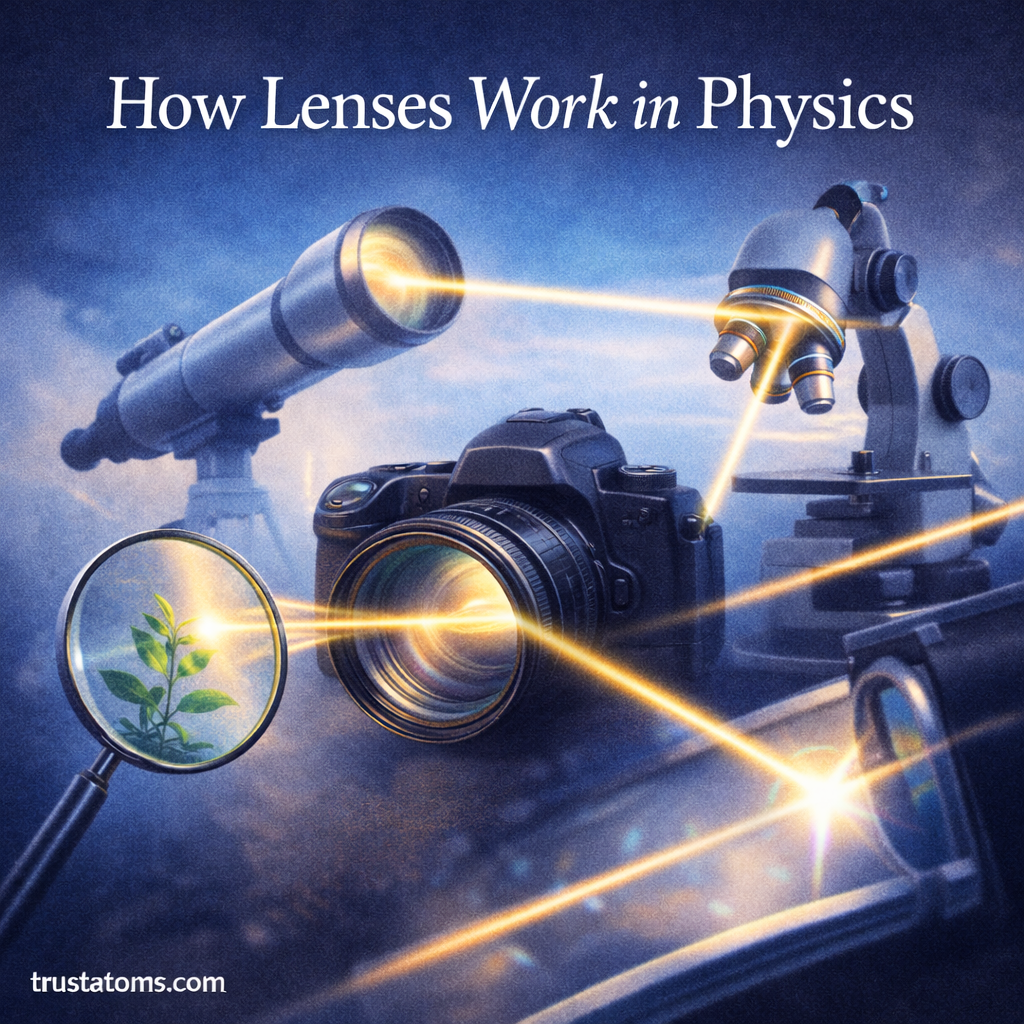
How Lenses Work in Physics

Illustration showing how lenses focus light in optical devices such as a magnifying glass, camera, microscope, and telescope.
Educational illustration showing how lenses focus light in optical tools like magnifying glasses, cameras, microscopes, and telescopes. trustatoms.com.

Introduction

Lenses are optical devices that bend light to form images. They are used in many everyday technologies, including eyeglasses, cameras, microscopes, telescopes, and projectors.

In physics, lenses work by refracting light, which means bending light rays as they pass from one medium to another. By carefully shaping transparent materials such as glass or plastic, lenses can focus light to create magnified, reduced, or corrected images.

Understanding how lenses work helps explain how we see clearly, how cameras capture images, and how scientists observe extremely small or distant objects.

Continue reading “How Lenses Work in Physics”

What Is Total Internal Reflection?

Illustration showing light reflecting inside water at the surface to demonstrate total internal reflection.
Educational illustration showing a beam of light reflecting inside water at the surface, demonstrating total internal reflection. trustatoms.com.

Introduction

Total internal reflection is a fascinating optical phenomenon that occurs when light traveling through a dense medium hits a boundary with a less dense medium and reflects completely back into the original material instead of passing through.

Unlike normal reflection, which occurs at the surface of mirrors or other objects, total internal reflection happens inside transparent materials such as glass, water, or optical fibers.

This principle plays a crucial role in modern technology, including fiber-optic communication, medical imaging tools, and advanced optical devices.

Continue reading “What Is Total Internal Reflection?”

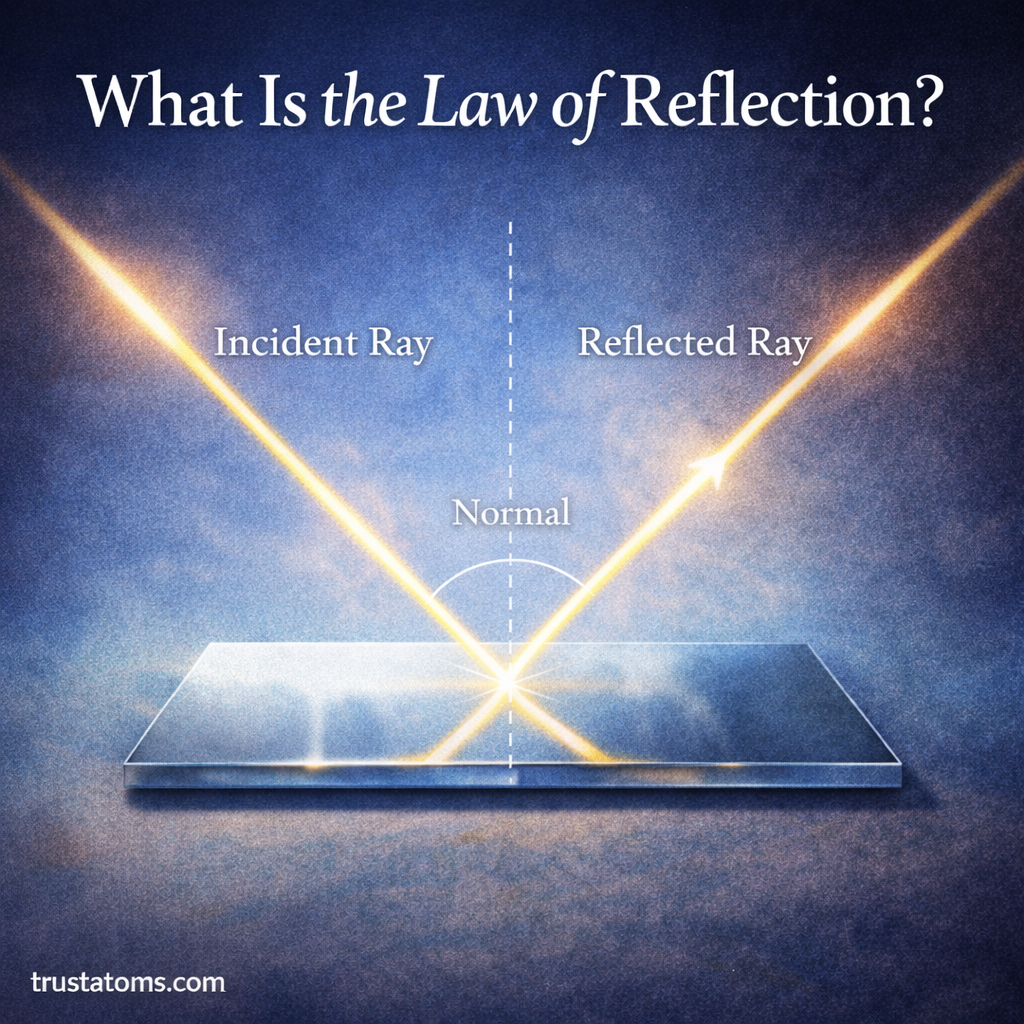
What Is the Law of Reflection?

Illustration showing a beam of light hitting a mirror and reflecting away at the same angle to explain the law of reflection.
Simple physics diagram showing an incoming light ray reflecting off a mirror surface to demonstrate the law of reflection. trustatoms.com.

Introduction

The law of reflection is a fundamental principle in physics that explains how light behaves when it strikes a reflective surface. It describes the predictable way in which light bounces off surfaces such as mirrors, calm water, or polished metal.

Understanding the law of reflection helps scientists and engineers design optical systems, telescopes, cameras, and many everyday technologies that rely on controlled light behavior.

In simple terms, the law of reflection states that light reflects off a surface at the same angle it arrives.

Continue reading “What Is the Law of Reflection?”

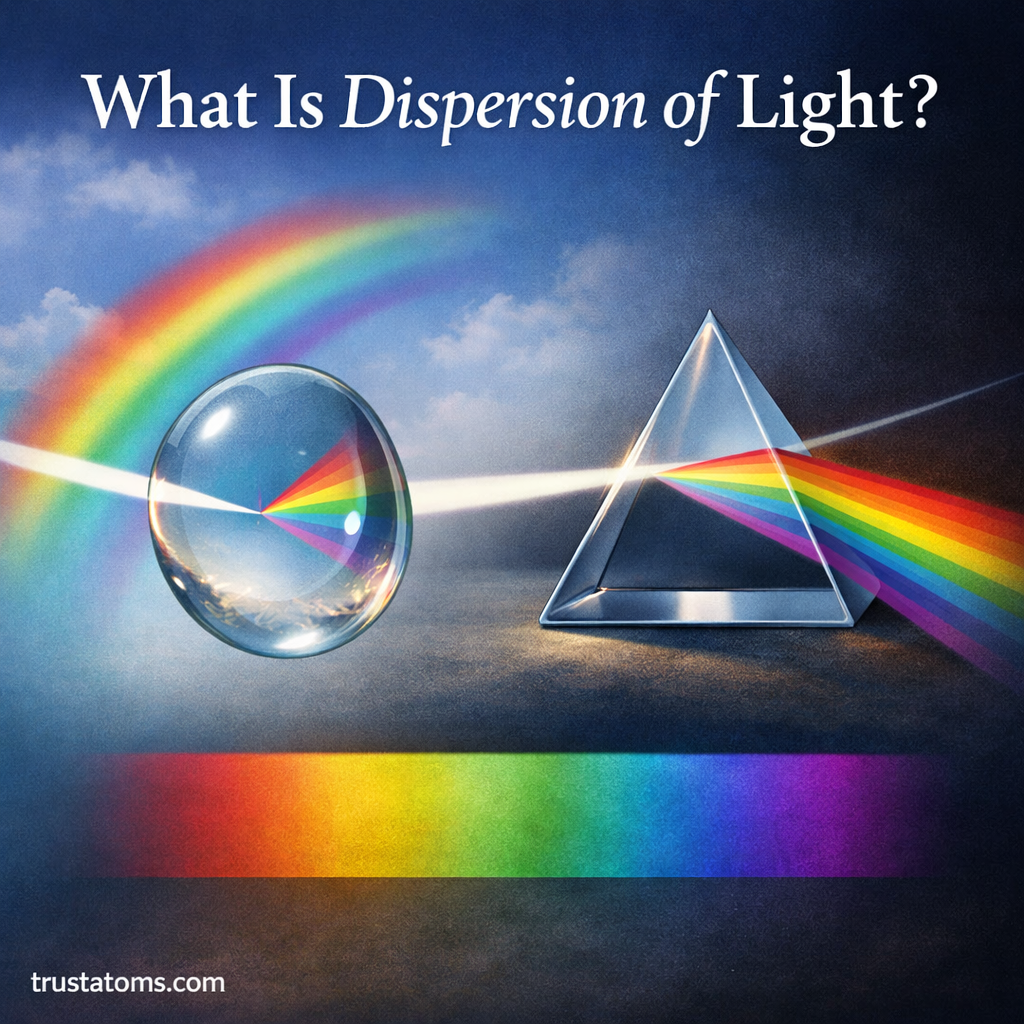
What Is Dispersion of Light?

Illustration showing white light entering a prism and separating into a rainbow spectrum to explain dispersion of light.
Simple diagram showing white light splitting into rainbow colors through a prism to demonstrate dispersion of light. trustatoms.com.

Introduction

Dispersion of light is a fascinating optical phenomenon where white light separates into its individual colors when it passes through certain materials. This effect occurs because different wavelengths of light travel at different speeds when entering a new medium, such as glass or water.

The most familiar example of dispersion is the rainbow, where sunlight is split into a spectrum of colors by water droplets in the atmosphere. Dispersion helps scientists understand the nature of light and plays an important role in optics, spectroscopy, and many scientific instruments.

Continue reading “What Is Dispersion of Light?”

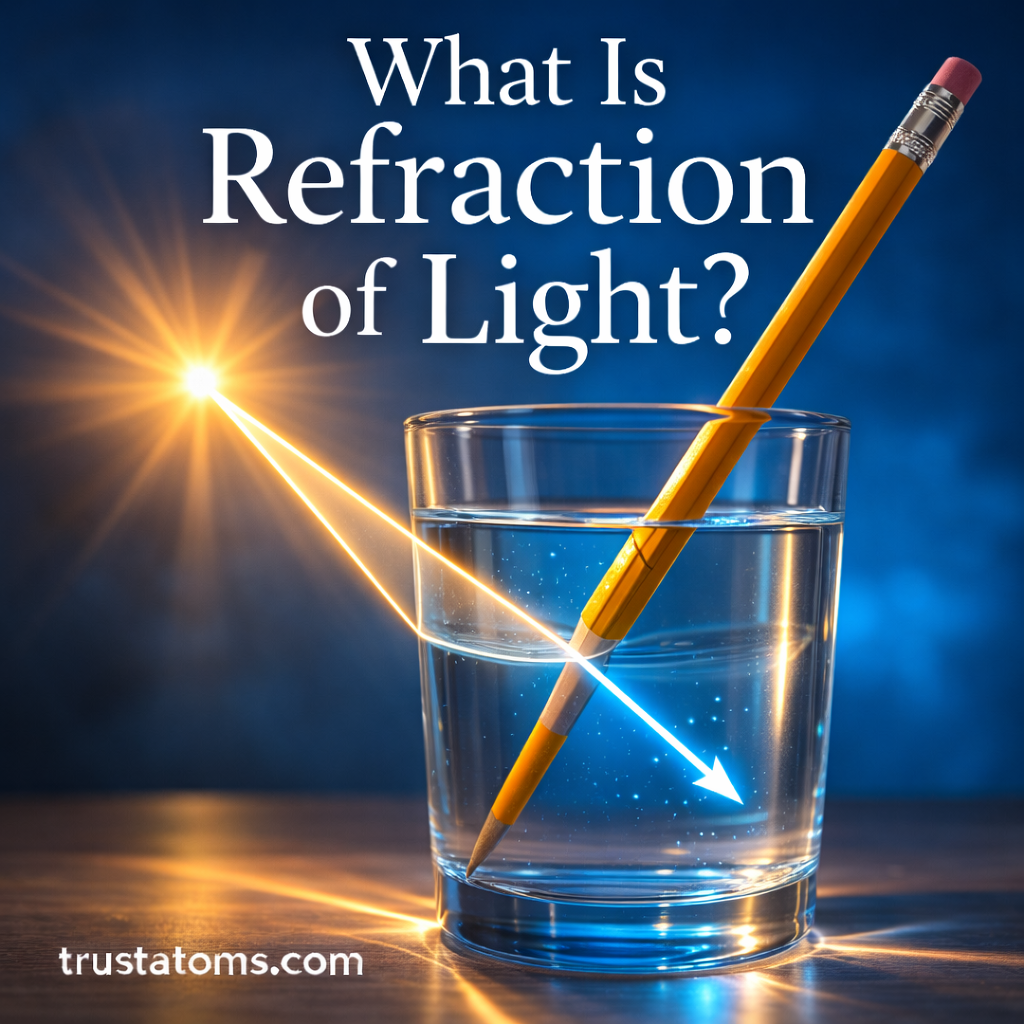
What Is Refraction of Light?

Illustration showing a pencil appearing bent inside a glass of water due to refraction of light.
Educational illustration demonstrating refraction of light using a pencil placed in a glass of water where the pencil appears bent due to light bending between air and water. trustatoms.com.

Refraction of light is a fundamental concept in physics that explains how light changes direction when it passes from one medium to another. This bending of light occurs because light travels at different speeds in different materials.

Refraction is responsible for many everyday visual effects, such as a straw appearing bent in a glass of water or rainbows forming in the sky. It also plays a key role in technologies like lenses, cameras, microscopes, and eyeglasses.

Understanding refraction helps scientists and engineers design optical systems and explains how light behaves as it moves through the world.

Continue reading “What Is Refraction of Light?”

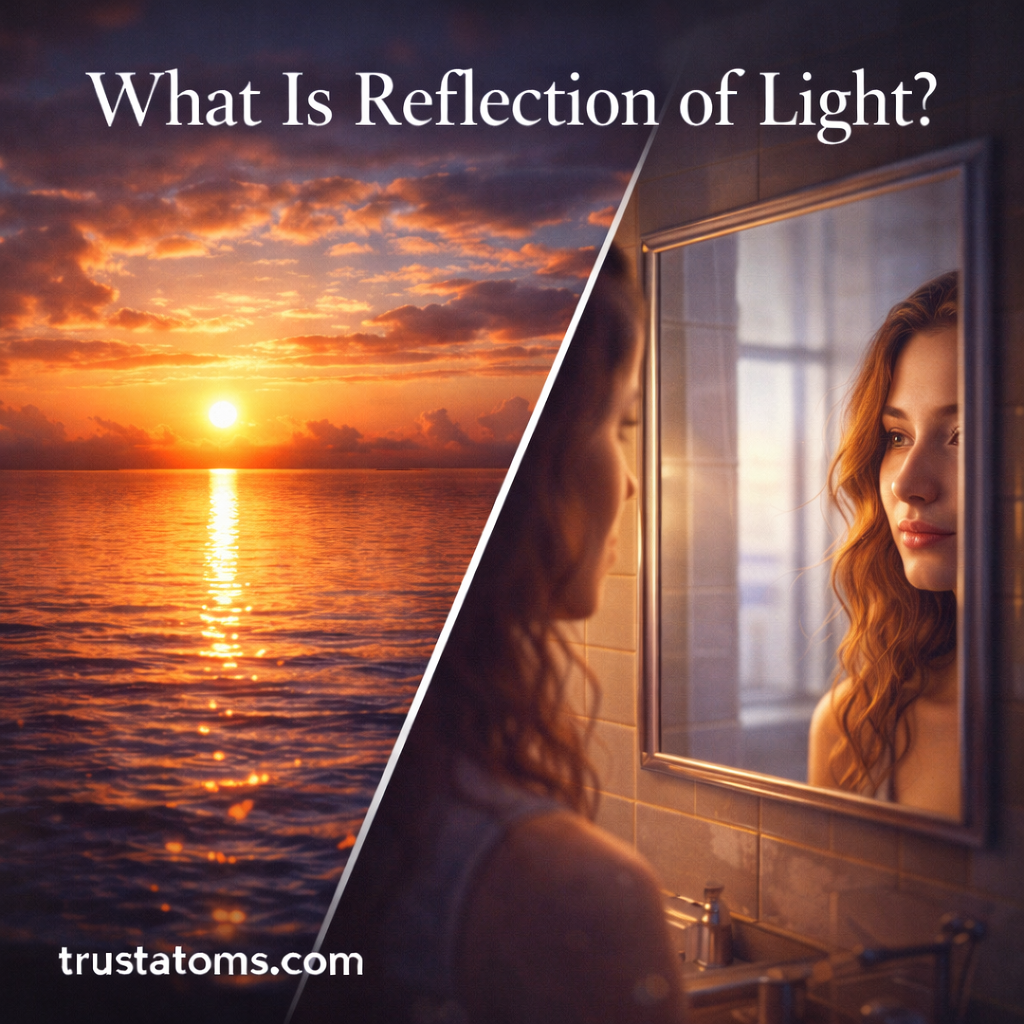
What Is Reflection of Light?

Split illustration showing sunlight reflecting on ocean water and a woman looking at her reflection in a mirror.
Educational illustration demonstrating reflection of light with examples of sunlight reflecting off water and a mirror reflecting a person’s image. trustatoms.com.

Reflection of light is a basic physical process that occurs when light waves bounce off a surface instead of passing through it. This phenomenon allows us to see objects, observe mirrors, and understand how light interacts with the world around us.

Every day, reflection makes many common experiences possible—from looking at your reflection in a mirror to seeing sunlight reflecting off water or glass. In physics, studying how light reflects helps scientists understand optics, imaging systems, and the behavior of electromagnetic waves.

Continue reading “What Is Reflection of Light?”

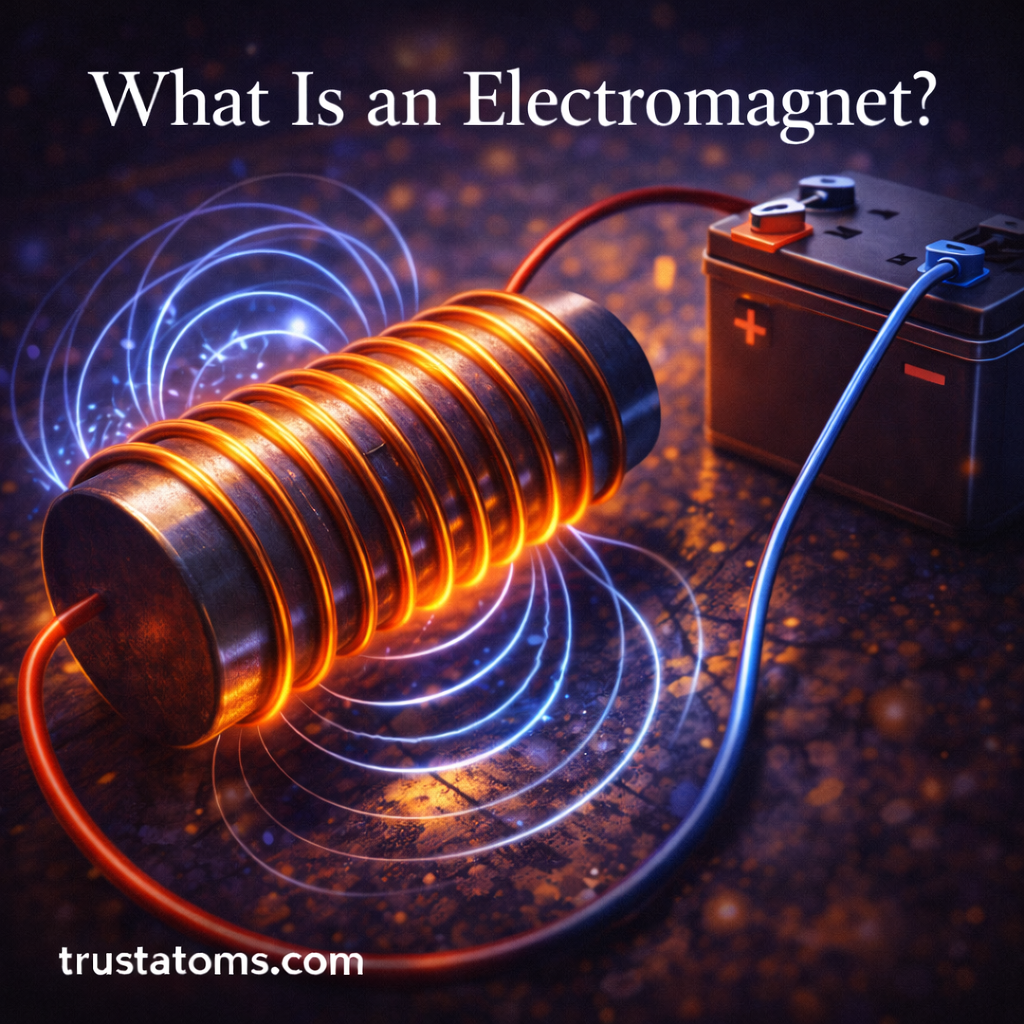
What Is an Electromagnet?

Illustration showing a simple electromagnet made of copper wire coiled around an iron core connected to a battery creating a magnetic field.
Educational illustration showing how an electromagnet works using a coiled copper wire around an iron core connected to a battery that generates a magnetic field. trustatoms.com.

Magnets are commonly associated with permanent materials such as iron magnets on refrigerators. However, some magnets only produce magnetic fields when electricity flows through them. These are known as electromagnets.

Electromagnets are an essential part of modern technology. They power motors, enable data storage, operate industrial machines, and even help doctors create detailed medical images. Unlike permanent magnets, electromagnets can be turned on or off simply by controlling the flow of electricity.

Understanding electromagnets helps explain how electricity and magnetism are connected and how many everyday technologies work.

Continue reading “What Is an Electromagnet?”

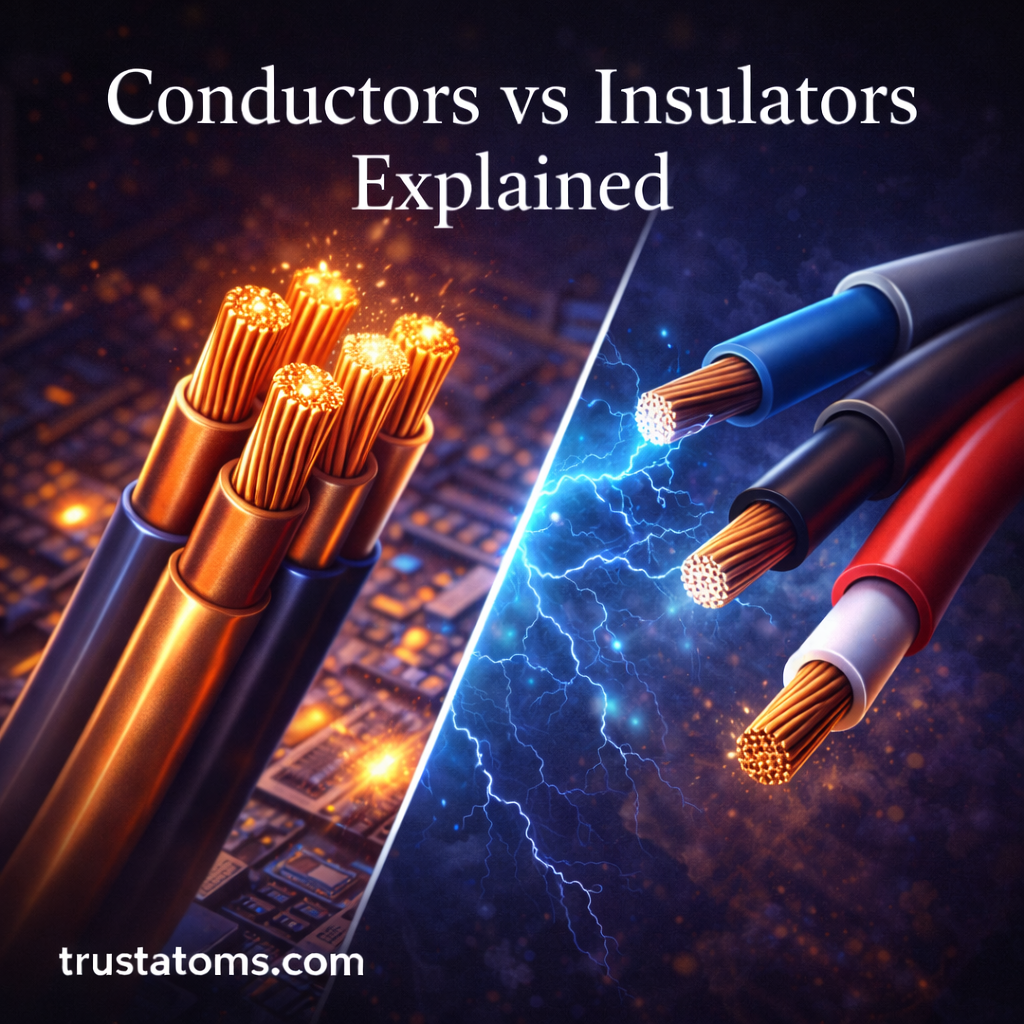
Conductors vs Insulators Explained

Illustration comparing electrical conductors and insulators showing exposed copper wires conducting electricity and insulated wires preventing current flow.
Educational illustration comparing conductors and insulators, showing copper wires that allow electricity to flow and insulated wires that prevent electrical current from escaping. trustatoms.com.

Electricity powers modern technology, from household appliances to global communication networks. But electricity does not move through all materials in the same way. Some materials allow electric current to flow easily, while others resist the movement of electric charge.

These two categories are known as conductors and insulators. Understanding the difference between them is essential in physics, electrical engineering, and everyday electrical safety.

In simple terms, conductors allow electricity to flow, while insulators prevent or restrict that flow.

Continue reading “Conductors vs Insulators Explained”