Fluid Pressure in Static Equilibrium

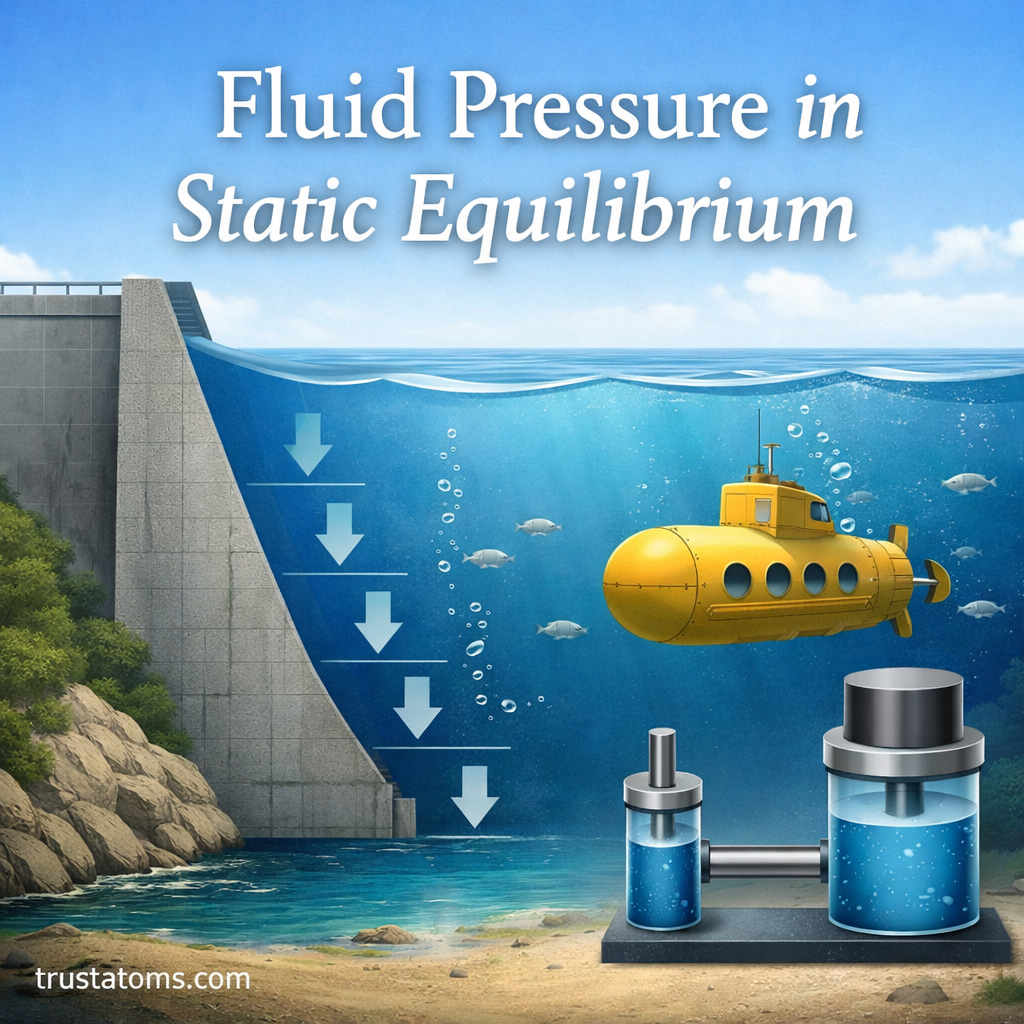
Illustration of fluid pressure in static equilibrium showing increasing pressure with depth near a dam, a submarine underwater, and a hydraulic system demonstration.
Contextual illustration of fluid pressure in static equilibrium showing how pressure increases with depth in a fluid at rest. trustatoms.com

Fluid pressure in static equilibrium is one of the most important foundations in physics. It explains how liquids and gases behave when they are at rest — from water sitting in a glass to pressure deep in the ocean.

Understanding this concept helps you make sense of hydrostatic pressure, dams, blood pressure, hydraulic systems, and even why your ears pop underwater.

In this guide, we’ll break it down clearly and practically.

Continue reading “Fluid Pressure in Static Equilibrium”

Electromechanical Systems in Applied Physics

Contextual illustration showing an electric motor, generator, robotic arm, wind turbine, and solar panel representing electromechanical systems in applied physics with trustatoms.com watermark.
Illustration of electromechanical systems in applied physics showing motors, generators, robotics, and renewable energy technologies. trustatoms.com

Electromechanical systems sit at the heart of modern engineering. From electric vehicles and robotic arms to washing machines and power plants, these systems convert electrical energy into mechanical motion — and vice versa.

In applied physics, electromechanical systems represent the practical bridge between electromagnetic theory and real-world machines. Understanding how they work helps explain everything from motors and generators to advanced automation and renewable energy technologies.

This guide breaks down the core principles, components, and real-world applications of electromechanical systems in clear, practical terms.

Continue reading “Electromechanical Systems in Applied Physics”

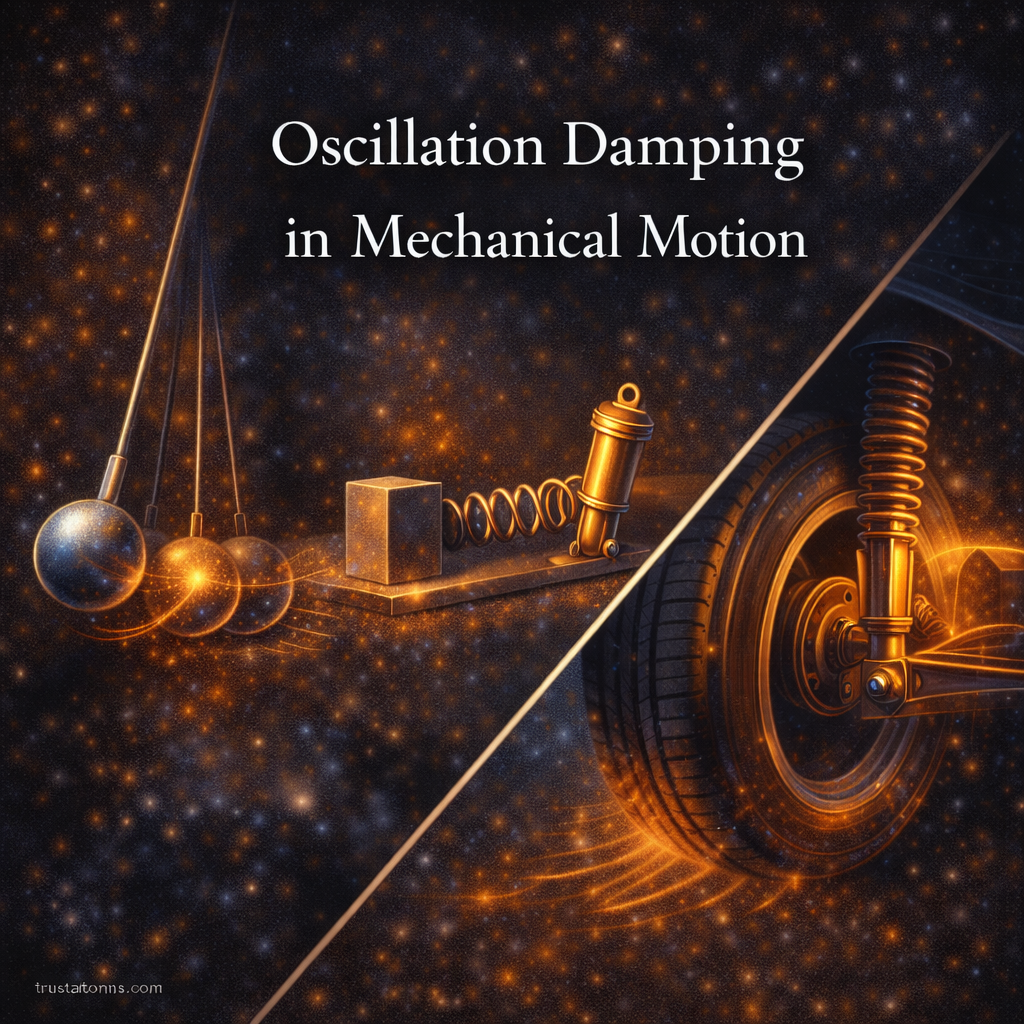
Oscillation Damping in Mechanical Motion

Illustration showing oscillation damping in mechanical motion with a swinging pendulum, spring-mass-damper system, and car suspension shock absorber.
Conceptual illustration of oscillation damping in pendulums, spring systems, and vehicle suspensions. trustatoms.com

Oscillation damping in mechanical motion explains why swinging pendulums eventually stop, why car suspensions settle after a bump, and why vibrations in buildings fade over time.

In an ideal world, oscillations would continue forever. But in reality, energy is gradually lost due to friction, air resistance, and internal material forces. This loss of energy reduces the amplitude of motion — a process known as damping.

In this article, we’ll explore what oscillation damping is, the different types of damping, and how it affects real-world mechanical systems.

Continue reading “Oscillation Damping in Mechanical Motion”

Thermodynamic Potentials in Energy Systems

Illustration of thermodynamic potentials in energy systems showing internal energy, enthalpy, Helmholtz free energy, and Gibbs free energy concepts in industrial and scientific contexts.
Conceptual illustration of thermodynamic potentials guiding energy behavior in physical and chemical systems. trustatoms.com

Thermodynamic potentials are powerful tools that help physicists and engineers predict how energy systems behave under different conditions.

From chemical reactions and power plants to batteries and phase transitions, thermodynamic potentials determine:

  • Whether a process will occur spontaneously
  • How energy is exchanged
  • What equilibrium state a system will reach

In this article, we’ll break down the major thermodynamic potentials, explain when each one is used, and explore their role in real-world energy systems.

Continue reading “Thermodynamic Potentials in Energy Systems”

Charge Distribution in Conductive Bodies

Illustration showing charge distribution in conductive bodies including a charged sphere, pointed lightning rod, Faraday cage, and capacitor plates with electric field lines.
Conceptual illustration of how electric charge distributes on conductive surfaces and in shielding systems. trustatoms.com

Charge distribution in conductive bodies is a foundational concept in electromagnetism. It explains why electric charges move to the surface of metals, why lightning rods work, and why electric fields behave differently inside and outside conductors.

Understanding how charge arranges itself in conductive materials helps explain everything from circuit behavior to shielding in electronic devices.

In this article, we’ll explore how charges distribute in conductors, the physics behind electrostatic equilibrium, and real-world applications of these principles.

Continue reading “Charge Distribution in Conductive Bodies”

Magnetic Dipoles in Field Interactions

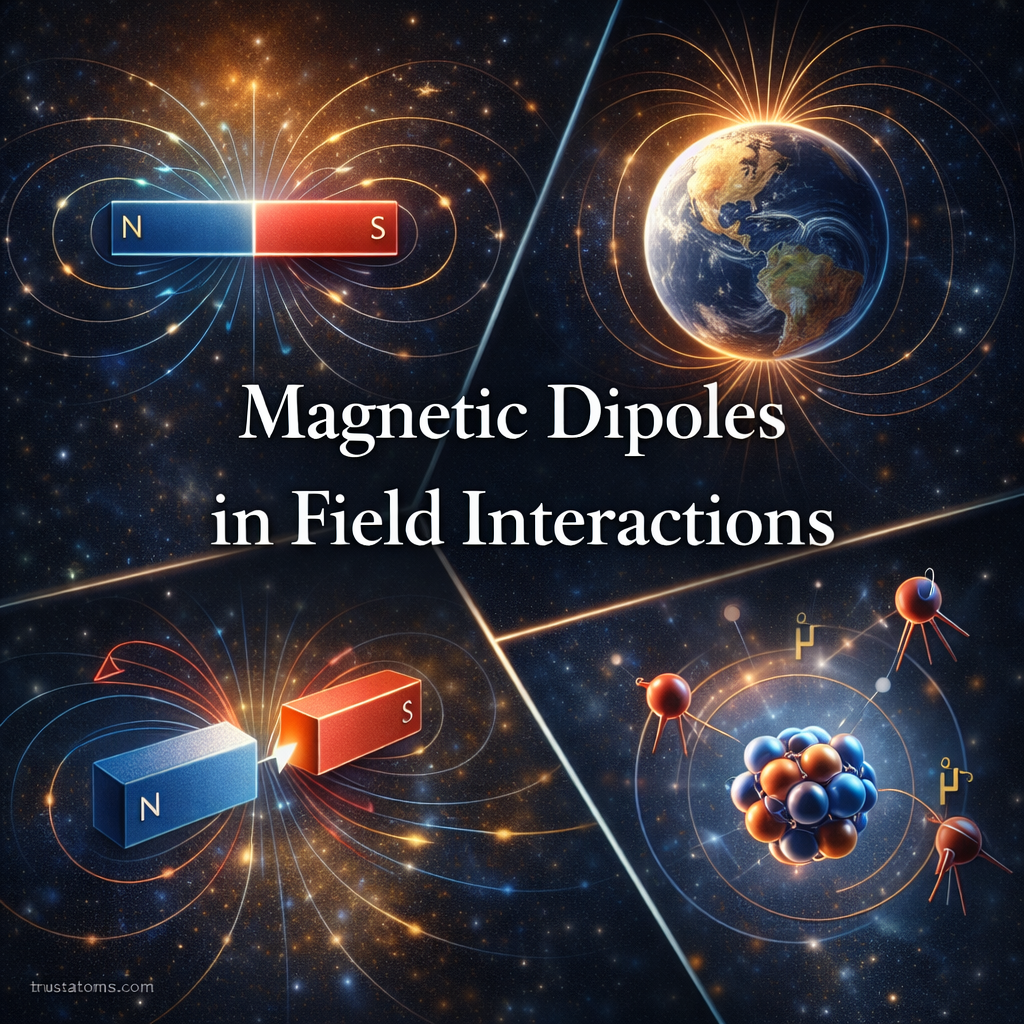
Illustration of magnetic dipoles in field interactions showing a bar magnet with field lines, Earth’s magnetic field, interacting magnets, and atomic magnetic moments.
Conceptual illustration of magnetic dipoles interacting with magnetic fields in classical and atomic systems. trustatoms.com

Magnetic dipoles are fundamental to understanding how magnets behave, how electric currents generate magnetic fields, and how materials respond to external magnetic influences.

From simple bar magnets to atomic-scale magnetic moments, dipoles shape the structure of magnetic field interactions across physics.

In this article, we’ll explore what magnetic dipoles are, how they interact with fields, and why they matter in both classical and modern physics.

Continue reading “Magnetic Dipoles in Field Interactions”

Energy Minimization in Physical Systems

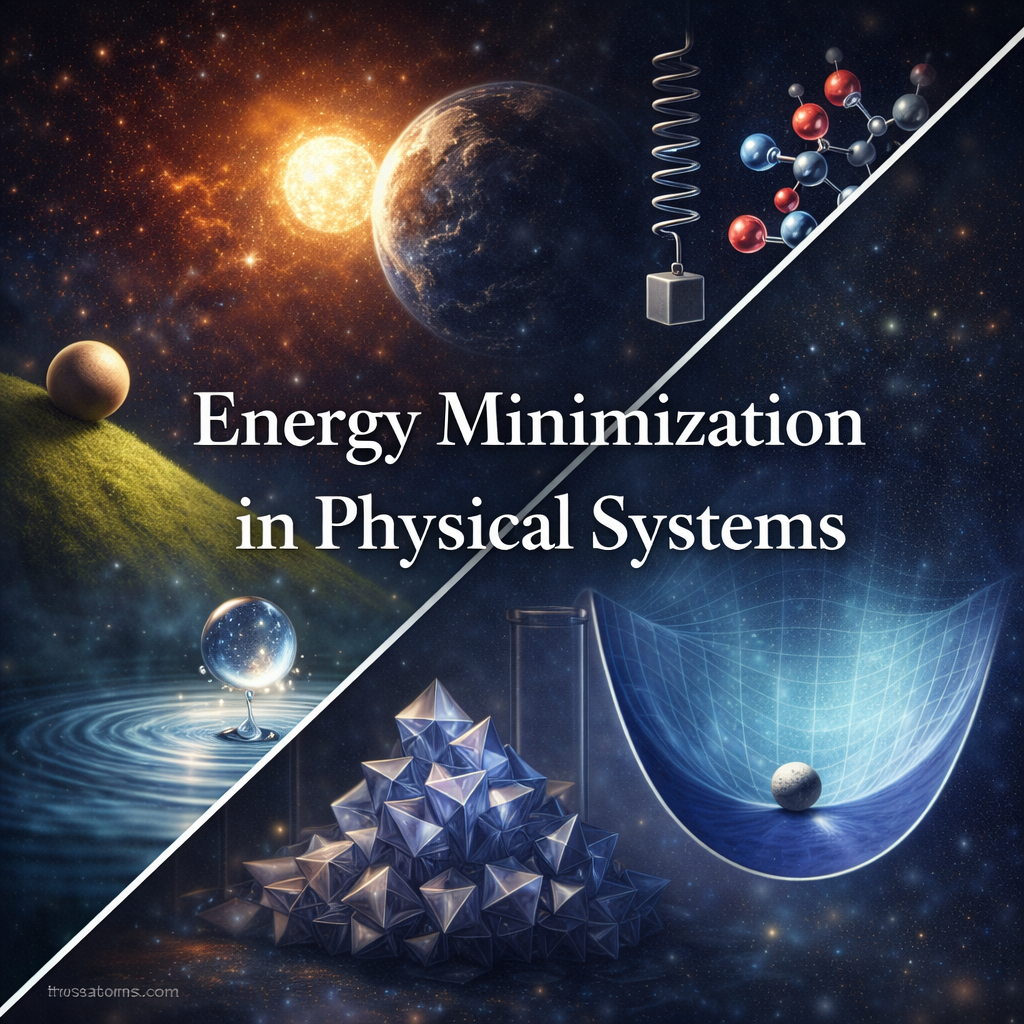
Illustration showing energy minimization in physical systems with examples including a ball rolling downhill, a water droplet forming a sphere, crystal structures, and a potential energy landscape.
Conceptual illustration of energy minimization in physical systems across mechanics, thermodynamics, and materials science. trustatoms.com

Energy minimization is one of the most powerful unifying ideas in physics. From falling objects and planetary orbits to chemical bonds and crystal structures, physical systems tend to evolve toward states of lower energy.

This principle explains stability, equilibrium, and spontaneous change across nearly every branch of science.

In this article, we’ll explore what energy minimization means, why it occurs, how it relates to equilibrium, and where it appears in real-world physical systems.

Continue reading “Energy Minimization in Physical Systems”

Surface Tension in Fluid Interfaces

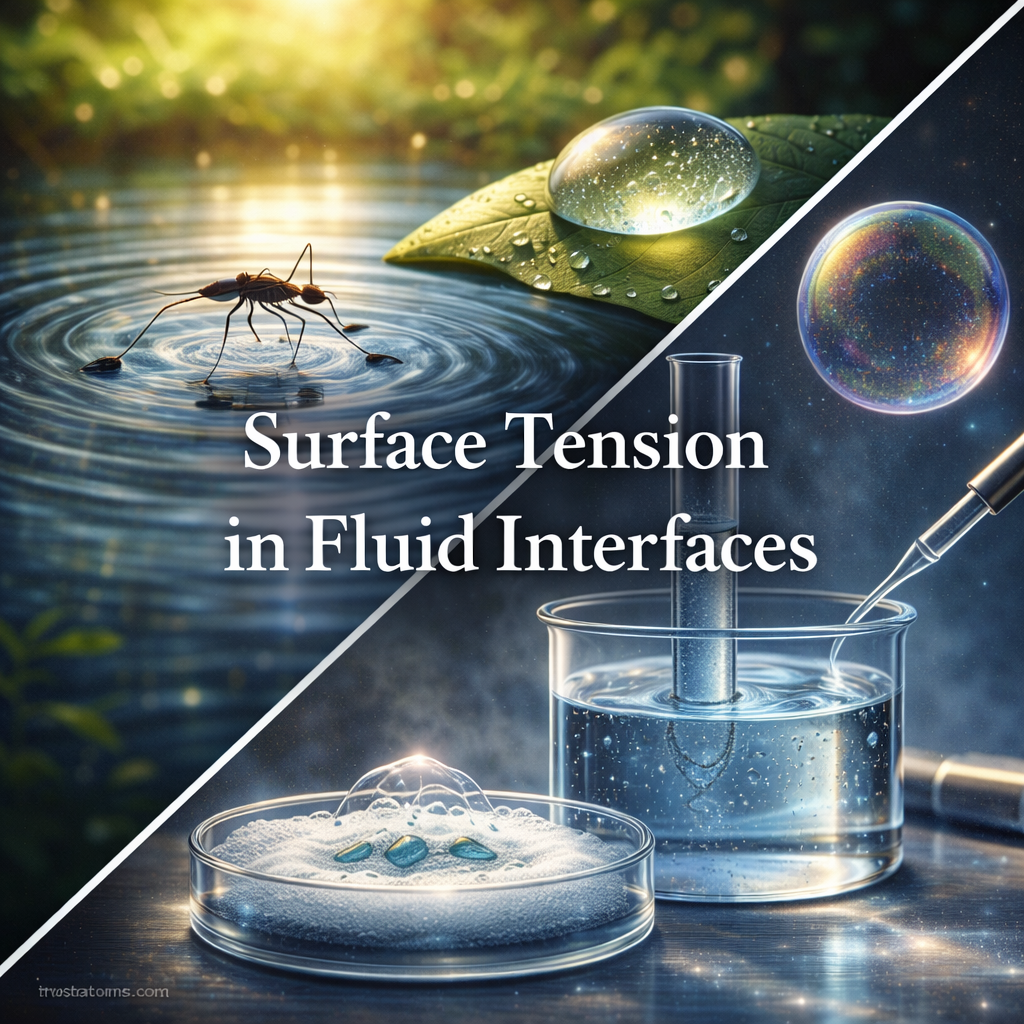
Illustration showing surface tension in fluid interfaces with a water strider on water, a droplet on a leaf, and laboratory examples including a capillary tube and soap bubble.
Illustration demonstrating surface tension in natural and laboratory fluid interfaces. trustatoms.com

Surface tension is one of the most fascinating and visually striking phenomena in physics. It explains why water forms droplets, why insects can walk on ponds, and why bubbles maintain their spherical shape.

At its core, surface tension arises from molecular forces acting at the boundary between fluids — most commonly between a liquid and air.

In this article, we’ll explore what surface tension is, why it occurs, how it’s measured, and why it plays a critical role in nature and technology.

Continue reading “Surface Tension in Fluid Interfaces”

Field Theory in Classical Physics

Illustration showing gravitational, electric, and magnetic fields in classical physics, including Earth’s gravitational field, electric field lines around a charge, and electromagnetic wave propagation.
Conceptual illustration of gravitational, electric, and magnetic fields in classical physics. trustatoms.com

Field theory in classical physics provides one of the most powerful ways to describe how forces act across space. Instead of imagining objects pulling or pushing each other directly, field theory describes how physical quantities exist at every point in space and influence matter locally.

From gravity shaping planetary motion to electric and magnetic forces guiding charged particles, classical field theory forms the foundation of modern physics.

This article explains what a field is, how classical field theory developed, and why it remains essential in science today.

Continue reading “Field Theory in Classical Physics”

Conservation of Angular Momentum in Astrophysical Systems

Illustration of conservation of angular momentum in astrophysical systems showing a spiral galaxy, pulsar beams, and a rotating black hole accretion disk in space.
Astrophysical illustration showing how angular momentum conservation shapes galaxies, neutron stars, and black holes. trustatoms.com

The conservation of angular momentum is one of the most powerful principles in physics. It explains why spinning ice skaters rotate faster when they pull in their arms — and on a much larger scale, why stars collapse into rapidly spinning neutron stars and why galaxies form rotating disks.

In astrophysics, angular momentum shapes the structure and evolution of planets, stars, black holes, and entire galaxies.

This article explores what angular momentum is, why it is conserved, and how it governs some of the most dramatic events in the universe.

Continue reading “Conservation of Angular Momentum in Astrophysical Systems”