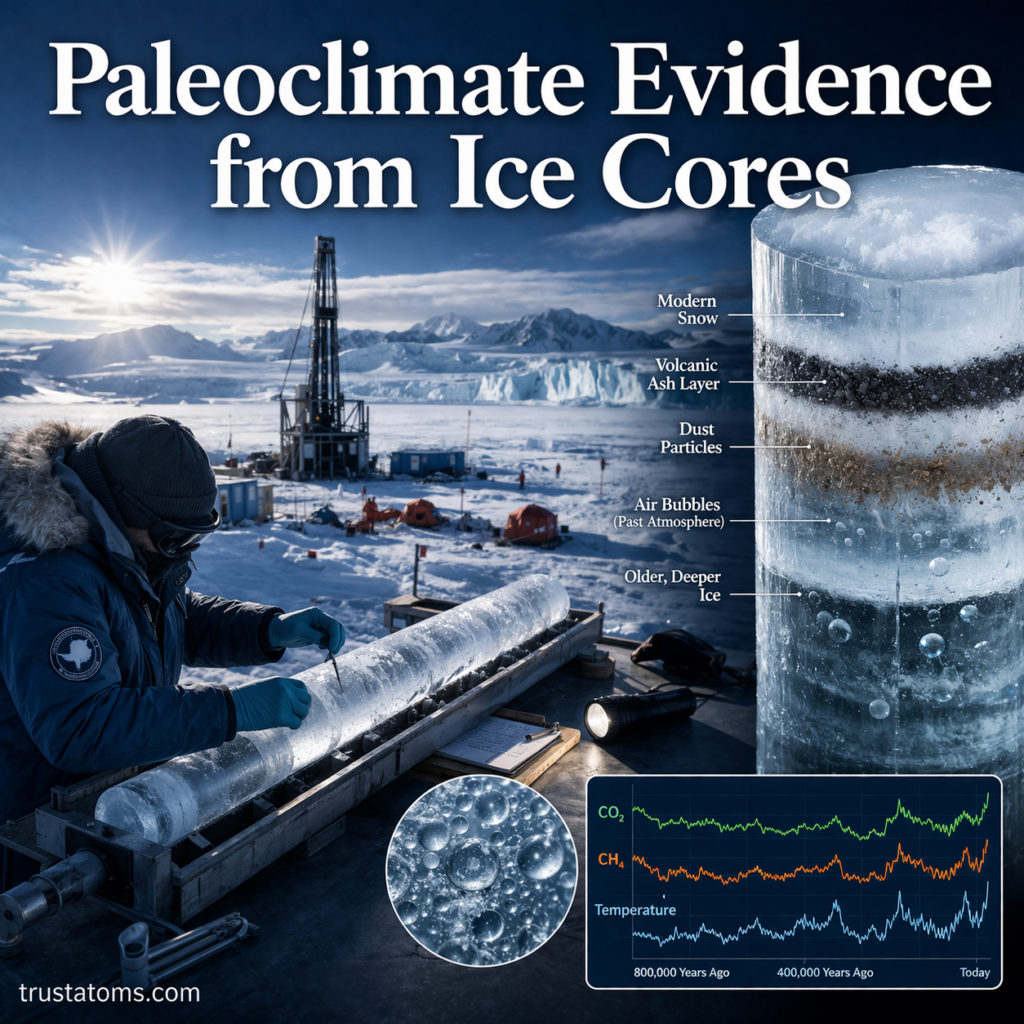
Ice cores are one of the most valuable tools scientists use to study Earth’s past climate. These long cylinders of ice, drilled from glaciers and ice sheets, contain layers that have built up over hundreds of thousands of years—preserving a detailed record of atmospheric conditions.
By analyzing ice cores, scientists can reconstruct ancient climates, track changes in greenhouse gases, and better understand how Earth’s climate system evolves over time.
What Are Ice Cores?
Ice cores are cylindrical samples extracted from ice sheets and glaciers, primarily in regions like Antarctica and Greenland.
How They Form
- Snow falls and accumulates year after year
- Over time, layers compress into solid ice
- Each layer traps tiny air bubbles and particles
These layers act like a natural archive, with deeper layers representing older time periods.
What Ice Cores Reveal
Ice cores provide a wide range of information about past climates.
1. Atmospheric Composition
Tiny air bubbles trapped in ice contain ancient samples of the atmosphere.
Scientists can measure:
- Carbon dioxide (CO₂) levels
- Methane (CH₄) concentrations
- Other greenhouse gases
This allows researchers to compare past and present atmospheric conditions.
2. Temperature Records
Ice cores indirectly reveal past temperatures through:
- Isotopes of oxygen and hydrogen
- Ratios that change depending on temperature
These measurements help reconstruct temperature variations over time.
3. Volcanic Activity
Ice layers often contain ash and chemical traces from volcanic eruptions.
These records help scientists:
- Identify major eruptions
- Understand their impact on climate
- Correlate events across different regions
4. Dust and Wind Patterns
Particles trapped in ice provide clues about:
- Wind strength and direction
- Desert expansion
- Dry or wet climate conditions
Higher dust levels often indicate colder, drier periods.
How Scientists Extract Ice Cores
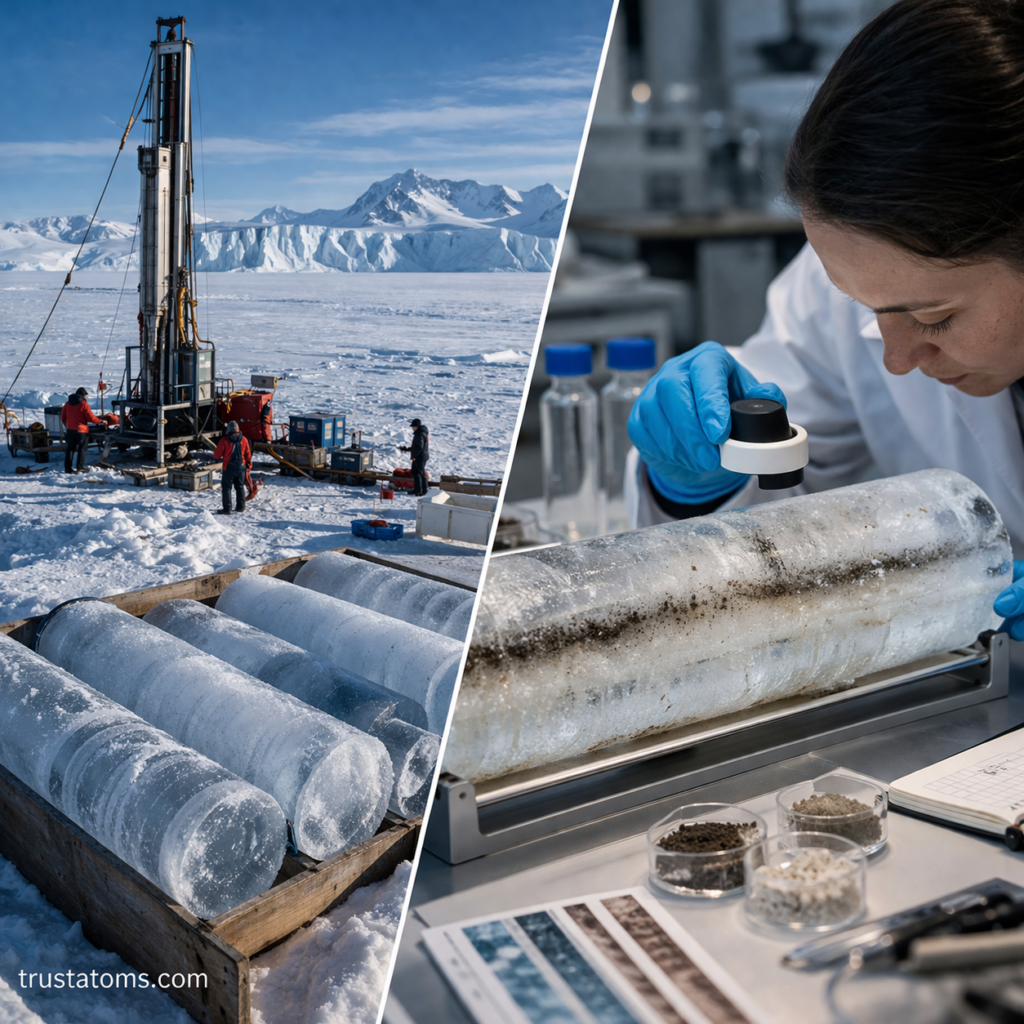
Ice core drilling is a complex and carefully controlled process.
Steps Involved
- Drill deep into ice sheets using specialized equipment
- Extract long cylindrical sections of ice
- Preserve samples in cold conditions
- Transport cores to laboratories for analysis
Some ice cores extend more than 3 kilometers deep and represent over 800,000 years of climate history.
Reading Ice Core Layers
Ice cores are analyzed layer by layer, similar to tree rings.
Key Features
- Annual layers can sometimes be counted
- Chemical composition varies by season
- Thicker layers may indicate higher snowfall
By studying these layers, scientists can build detailed timelines of climate change.
Ice Cores and Ice Age Cycles
Ice cores have been essential in understanding glacial and interglacial cycles.
Key Discoveries
- Strong correlation between greenhouse gases and temperature
- Repeating patterns of ice ages over hundreds of thousands of years
- Rapid climate shifts occurring over relatively short periods
These findings support theories about natural climate cycles and their drivers.
Why Ice Core Evidence Matters
Ice cores provide one of the most direct and reliable records of Earth’s past climate.
Key Benefits
- Long-term climate data spanning hundreds of thousands of years
- High-resolution records compared to other methods
- Direct samples of ancient atmospheres
This makes ice cores a cornerstone of climate science.
Limitations of Ice Core Data
While extremely valuable, ice cores have some limitations.
Challenges
- Limited to polar and glacial regions
- Older layers can become compressed and harder to interpret
- Dating uncertainties in very deep sections
Despite these challenges, ice cores remain one of the most trusted sources of paleoclimate data.
Ice Cores and Modern Climate Change
Ice core data provides important context for understanding current climate trends.
Key Insights
- Today’s CO₂ levels are higher than at any point in the past 800,000 years
- Current warming is occurring much faster than natural cycles
- Human activity is a major driver of recent changes
This comparison highlights how unusual modern climate change is relative to natural variability.
Final Thoughts
Ice cores act as frozen time capsules, preserving detailed records of Earth’s climate history. From ancient atmospheres to temperature shifts and volcanic events, these samples offer a powerful window into the past.
By studying ice cores, scientists can better understand how Earth’s climate has changed—and use that knowledge to predict and prepare for future changes.