The pancreas is a vital organ in the digestive system, playing a key role in breaking down food and regulating blood sugar. While often associated with insulin production, the pancreas also produces powerful digestive enzymes that are essential for processing carbohydrates, proteins, and fats.
Understanding how the pancreas functions in digestion helps explain how the body efficiently converts food into usable nutrients.
Overview of the Pancreas
The pancreas is a long, flat gland located behind the stomach. It has both exocrine and endocrine functions.
Two Main Roles:
- Exocrine function: Produces digestive enzymes
- Endocrine function: Releases hormones like insulin and glucagon
In digestion, the exocrine role is most important.
Exocrine Function of the Pancreas
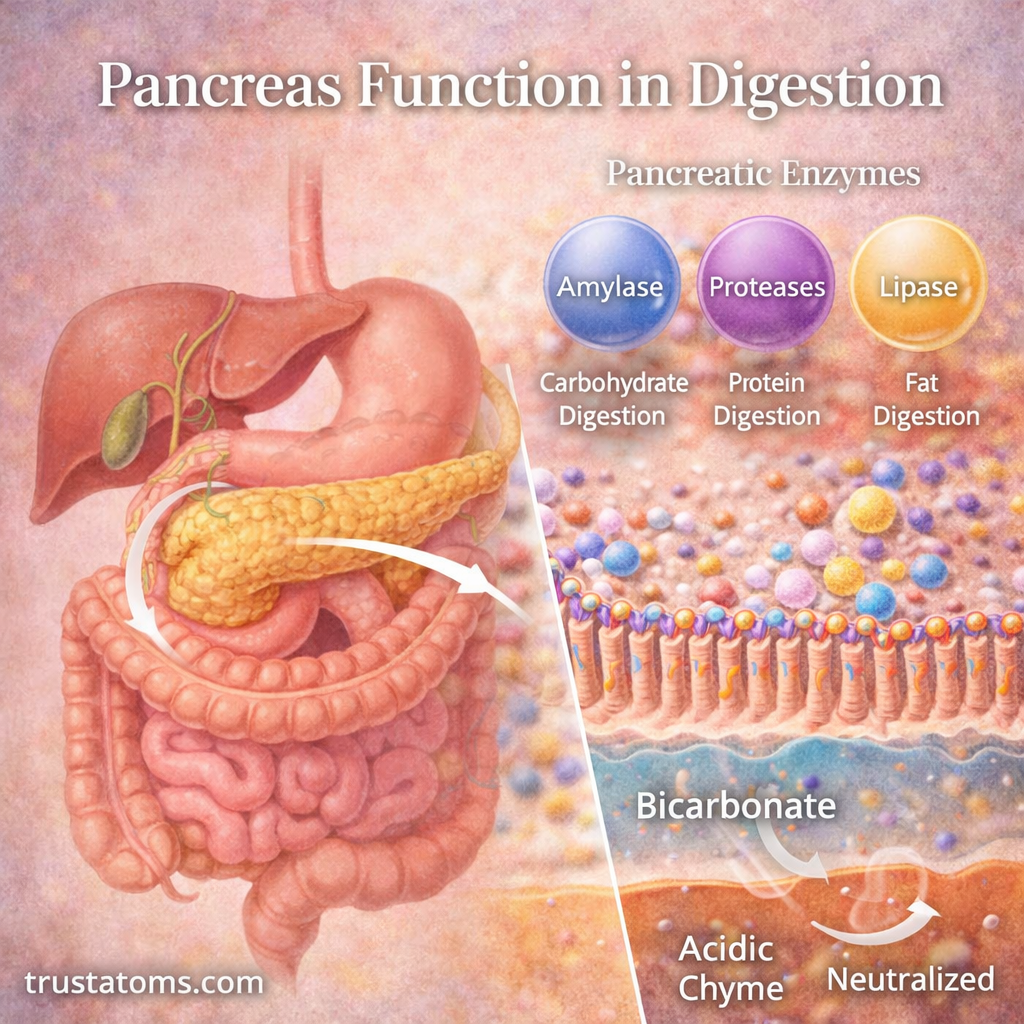
The pancreas produces digestive juices that are released into the small intestine.
What Pancreatic Juice Contains:
- Digestive enzymes
- Bicarbonate (a neutralizing substance)
These secretions travel through the pancreatic duct and enter the duodenum.
Key Digestive Enzymes Produced by the Pancreas
The pancreas produces enzymes that target all major types of nutrients.
1. Amylase (Carbohydrate Digestion)
- Breaks down starches into simple sugars
- Continues digestion that began in the mouth
2. Proteases (Protein Digestion)
- Includes enzymes like trypsin and chymotrypsin
- Break proteins into smaller peptides and amino acids
3. Lipase (Fat Digestion)
- Breaks fats into fatty acids and glycerol
- Works with bile to improve fat breakdown
Role of Bicarbonate in Digestion
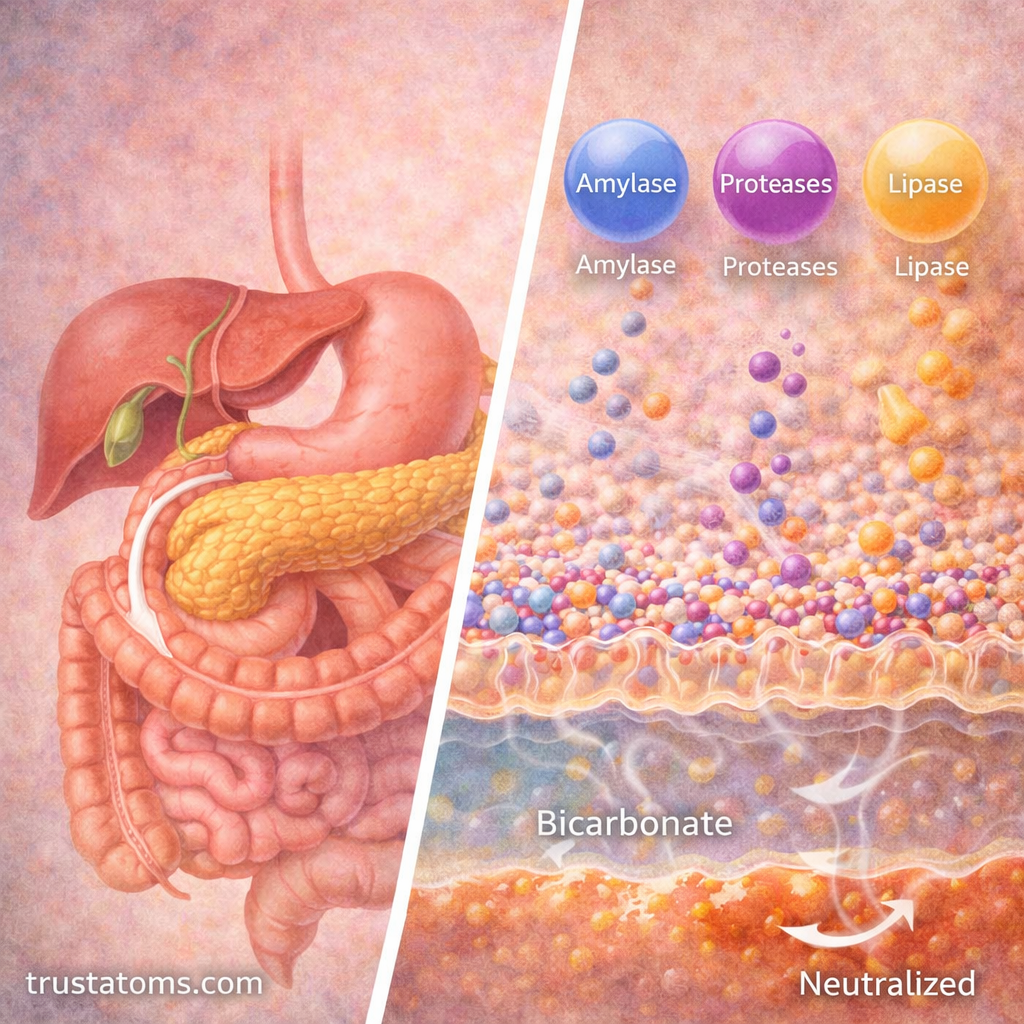
The pancreas also releases bicarbonate ions, which play a critical role in digestion.
Functions of Bicarbonate:
- Neutralizes acidic chyme from the stomach
- Raises pH to a level suitable for enzyme activity
- Protects the lining of the small intestine
Without bicarbonate, digestive enzymes would not function effectively.
How the Pancreas Works with Other Organs
The pancreas does not work alone—it coordinates closely with other digestive organs.
Interaction with the Liver and Gallbladder
- The liver produces bile
- The gallbladder stores and releases bile
- Bile and pancreatic enzymes enter the duodenum together
Interaction with the Small Intestine
- Hormones from the intestine (like secretin and cholecystokinin) signal the pancreas
- These signals regulate enzyme and bicarbonate release
Step-by-Step Digestive Process Involving the Pancreas
- Chyme enters the duodenum from the stomach
- The small intestine detects acidity and nutrients
- Hormones signal the pancreas to release enzymes and bicarbonate
- Pancreatic juice enters the duodenum
- Enzymes break down carbohydrates, proteins, and fats
- Nutrients become ready for absorption
Regulation of Pancreatic Secretion
The release of pancreatic juice is carefully controlled.
Hormonal Control:
- Secretin: Stimulates bicarbonate release
- Cholecystokinin (CCK): Stimulates enzyme release
Nervous System Control:
- Signals from the brain and digestive tract help coordinate secretion
This ensures enzymes are released only when needed.
Why Pancreatic Function Is Essential
The pancreas is critical for proper digestion.
It ensures:
- Complete breakdown of all major nutrients
- Optimal conditions for enzyme activity
- Efficient nutrient absorption in the small intestine
Without pancreatic enzymes, digestion would be severely impaired.
Common Pancreatic Disorders Affecting Digestion
Problems with the pancreas can disrupt digestion and nutrient absorption.
Examples Include:
- Pancreatitis (inflammation of the pancreas)
- Pancreatic insufficiency (reduced enzyme production)
- Cystic fibrosis (affects enzyme delivery)
These conditions can lead to malabsorption and nutritional deficiencies.
Key Takeaways
- The pancreas has both digestive and hormonal roles.
- Its exocrine function produces enzymes and bicarbonate.
- Enzymes break down carbohydrates, proteins, and fats.
- Bicarbonate neutralizes stomach acid for proper digestion.
- The pancreas works closely with the liver and small intestine.
The pancreas is essential for transforming food into nutrients the body can absorb and use.