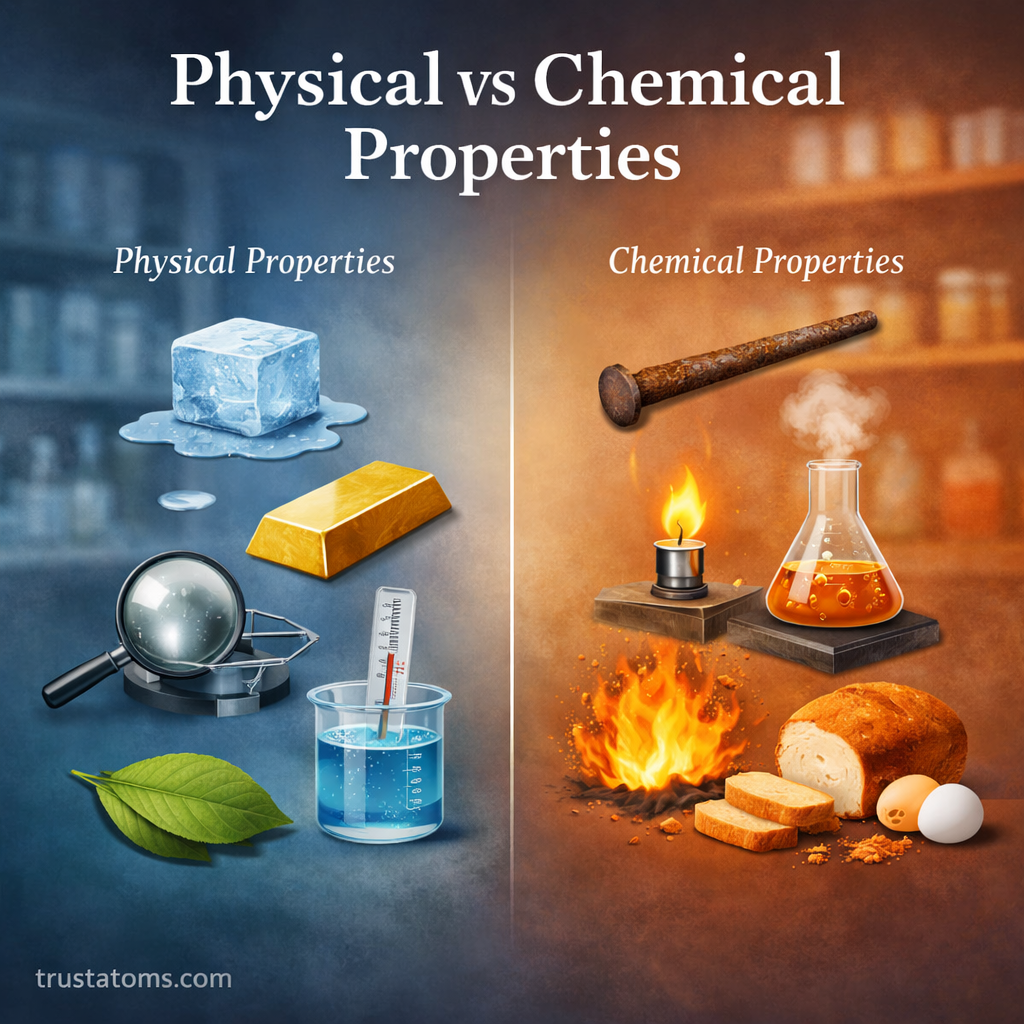
Understanding the difference between physical and chemical properties is essential in chemistry. These properties describe how substances behave and how scientists identify, classify, and use different materials.
Some properties can be observed without changing a substance’s identity, while others describe how a substance reacts to form entirely new substances. Learning to distinguish between these two types of properties helps explain everything from cooking food to designing industrial materials.
What Are Physical Properties?
Physical properties are characteristics of a substance that can be observed or measured without changing the substance’s chemical composition.
In other words, the substance remains the same material even after the property is observed.
Common Examples of Physical Properties
Scientists frequently use the following physical properties to describe matter:
- Color
- Shape
- Size
- Density
- Mass
- Volume
- Melting point
- Boiling point
- Solubility
- Electrical conductivity
- Thermal conductivity
- Hardness
- Texture
For example, when ice melts into liquid water, the substance is still H₂O. Only the physical state changes, not the chemical identity.
Everyday Examples of Physical Properties
You observe physical properties constantly in daily life:
- The shine of a metal spoon
- The boiling point of water
- The density of oil compared to water
- The hardness of a diamond
- The texture of sand
Because these observations do not create a new substance, they are classified as physical properties.
What Are Chemical Properties?
Chemical properties describe how a substance changes into a different substance through a chemical reaction.
These properties can only be observed when a chemical change occurs.
Common Examples of Chemical Properties
Some common chemical properties include:
- Flammability
- Reactivity with oxygen
- Reactivity with acids or bases
- Corrosiveness
- Ability to oxidize (rust)
- Toxicity
- Stability or decomposition
For example, iron’s ability to rust when exposed to oxygen and moisture is a chemical property because iron reacts with oxygen to form iron oxide.
Everyday Examples of Chemical Properties
Chemical properties appear in many familiar processes:
- Wood burning in a fireplace
- Iron rusting outdoors
- Food spoiling over time
- Baking ingredients reacting to create bread
- Battery chemicals producing electricity
In each case, a new substance forms through a chemical reaction.
Key Differences Between Physical and Chemical Properties
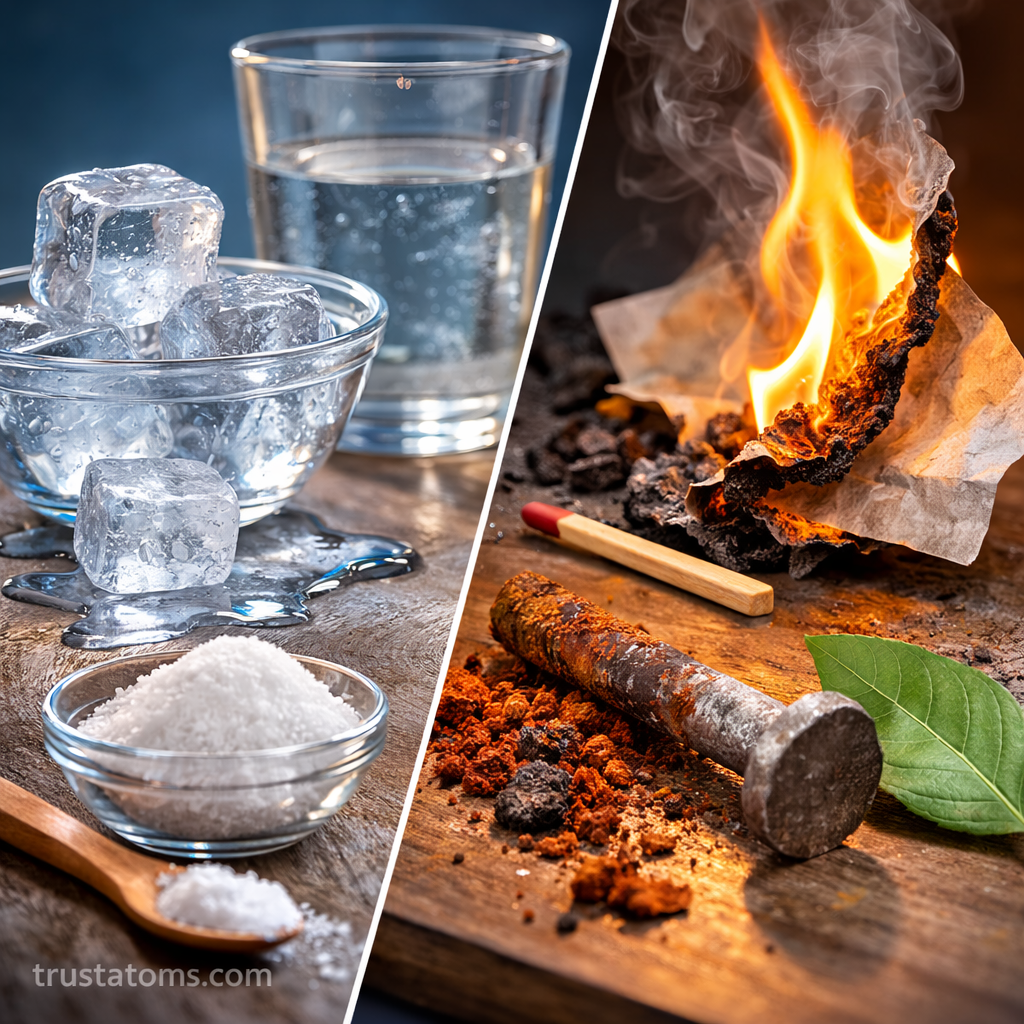
Although both describe matter, they differ in how the substance behaves during observation.
Physical Properties
- Observed without changing chemical identity
- Often measured directly
- Reversible in many cases
- Do not produce new substances
Examples:
- Melting ice
- Cutting paper
- Dissolving sugar in water
Chemical Properties
- Observed only during chemical reactions
- Involve rearrangement of atoms
- Usually irreversible under normal conditions
- Produce new substances
Examples:
- Burning gasoline
- Rusting iron
- Digesting food
How Scientists Identify Substances Using Properties
Scientists rely on both types of properties to identify and classify materials.
Physical Identification
Physical properties help determine what a substance might be by measuring:
- Density
- Melting point
- Boiling point
- Electrical conductivity
For example, pure gold has a specific density and melting point that help distinguish it from other metals.
Chemical Identification
Chemical properties help scientists understand how substances behave during reactions.
This knowledge allows chemists to:
- Predict reactions
- Design new materials
- Develop medicines
- Create industrial chemicals
For instance, knowing that sodium reacts violently with water helps chemists store it safely.
Why These Properties Matter in Real Life
Physical and chemical properties are used in nearly every field of science and engineering.
Medicine
Chemists study how drugs chemically react with the body.
Engineering
Engineers choose materials based on physical properties such as strength, conductivity, and durability.
Environmental Science
Understanding chemical properties helps scientists predict pollution reactions in air, soil, and water.
Food Science
Cooking relies heavily on chemical properties, such as proteins denaturing and sugars caramelizing.
Quick Comparison Summary
Physical and chemical properties describe different ways matter behaves.
Physical properties describe what a substance is like, while chemical properties describe how a substance changes.
Physical Properties
- Observed without chemical change
- Examples: density, color, melting point
Chemical Properties
- Observed during chemical reactions
- Examples: flammability, corrosion, oxidation
Understanding both helps scientists better explain how the world works at the molecular level.
Final Thoughts
Every material around us has both physical and chemical properties that define how it behaves and interacts with other substances.
Physical properties allow scientists to observe and measure matter without altering its identity, while chemical properties reveal how substances transform during reactions.
Together, these two categories form a foundation for studying chemistry, enabling scientists to analyze matter, predict reactions, and design the materials that shape modern life.