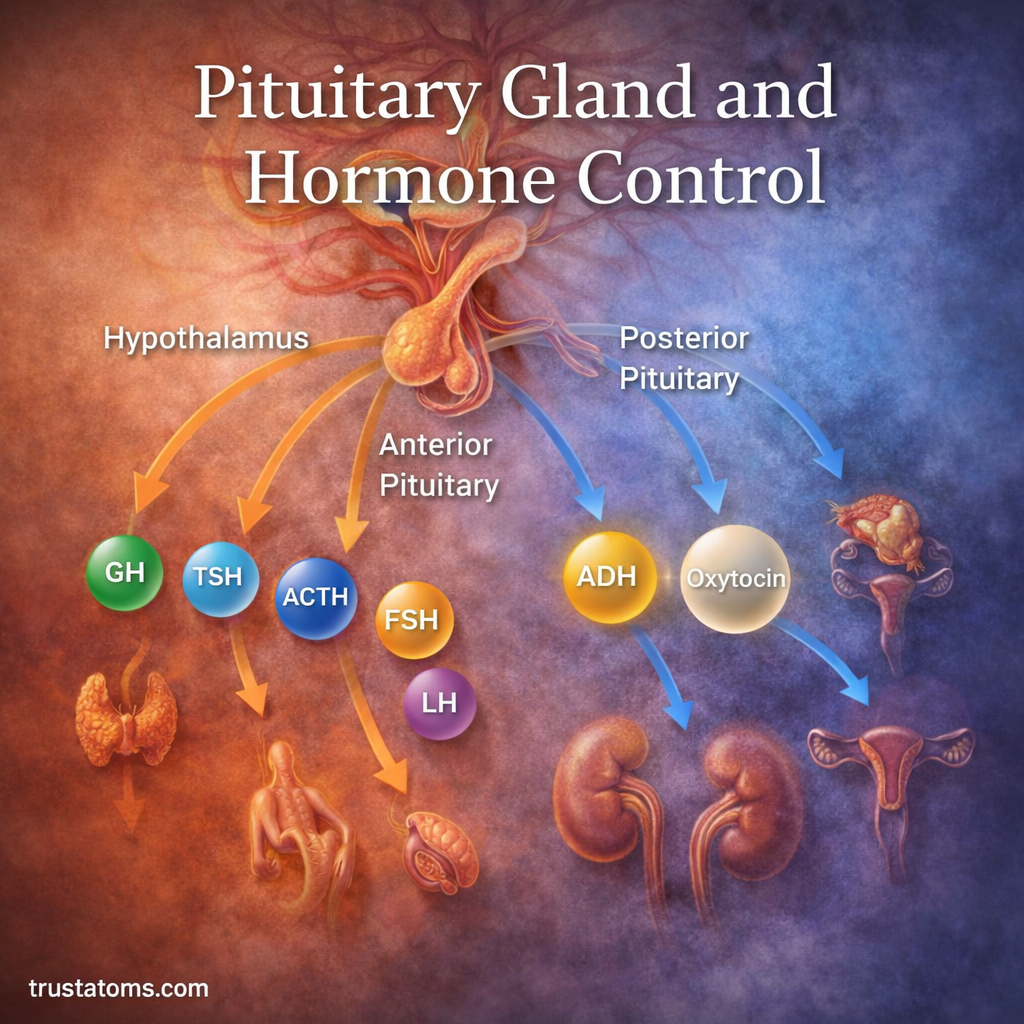
The pituitary gland is one of the most important structures in the endocrine system. Often called the “master gland,” it plays a central role in controlling hormone production throughout the body.
Despite its small size—about the size of a pea—the pituitary gland influences growth, metabolism, reproduction, and stress responses by directing other glands to release hormones.
What Is the Pituitary Gland?
The pituitary gland is located at the base of the brain, just below the hypothalamus. It is connected to the hypothalamus by a thin structure called the pituitary stalk.
This positioning allows it to receive signals from the brain and translate them into hormonal instructions for the rest of the body.
Key Characteristics
- Small, pea-sized gland
- Located beneath the hypothalamus
- Connected to the nervous system
- Controls multiple endocrine glands
Why It’s Called the “Master Gland”
The pituitary gland earns its nickname because it regulates other endocrine glands, including:
- Thyroid gland
- Adrenal glands
- Ovaries and testes
It does this by releasing hormones that either stimulate or inhibit these glands, ensuring proper hormone levels throughout the body.
Structure of the Pituitary Gland
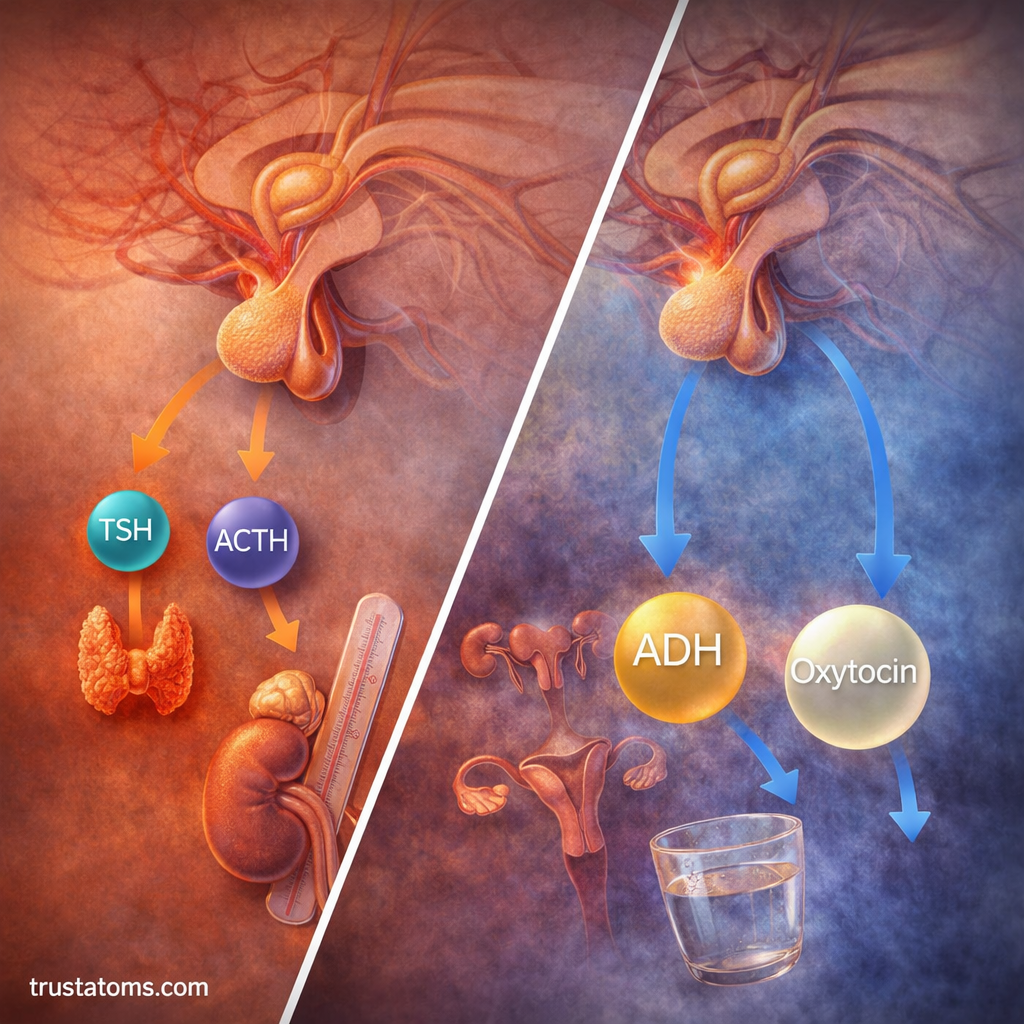
The pituitary gland has two main parts, each with distinct roles in hormone control.
Anterior Pituitary (Front Lobe)
The anterior pituitary produces and releases several key hormones that regulate other glands.
Major Hormones of the Anterior Pituitary
- Growth hormone (GH) – controls growth and metabolism
- Thyroid-stimulating hormone (TSH) – regulates thyroid activity
- Adrenocorticotropic hormone (ACTH) – stimulates cortisol release from adrenal glands
- Follicle-stimulating hormone (FSH) – supports reproductive processes
- Luteinizing hormone (LH) – regulates ovulation and testosterone production
- Prolactin – promotes milk production
These hormones are produced in response to signals from the hypothalamus.
Posterior Pituitary (Back Lobe)
The posterior pituitary does not produce hormones itself. Instead, it stores and releases hormones made by the hypothalamus.
Key Hormones of the Posterior Pituitary
- Antidiuretic hormone (ADH) – controls water balance and kidney function
- Oxytocin – involved in childbirth, bonding, and social behaviors
How the Pituitary Controls Hormones
The pituitary gland works closely with the hypothalamus to regulate hormone release.
Step-by-Step Hormone Control
- The hypothalamus detects changes in the body
- It sends releasing or inhibiting signals to the pituitary
- The pituitary releases hormones into the bloodstream
- Target glands respond by producing their own hormones
- Feedback signals help adjust production levels
This system ensures precise control over hormone levels.
Hormonal Feedback Loops
Hormone regulation relies heavily on feedback loops, especially negative feedback.
Negative Feedback Explained
- Hormone levels rise in the body
- The hypothalamus and pituitary detect this increase
- They reduce or stop hormone production
- Balance is restored
This mechanism prevents overproduction and keeps the body stable.
Key Functions of the Pituitary Gland
The pituitary gland influences a wide range of essential processes.
Major Functions
- Regulating body growth and development
- Controlling metabolism through thyroid hormones
- Managing stress responses via adrenal hormones
- Supporting reproductive health
- Maintaining water balance
- Assisting in childbirth and lactation
Because it affects so many systems, the pituitary gland is vital for overall health.
Common Pituitary Disorders
When the pituitary gland malfunctions, it can disrupt multiple body systems.
Examples of Disorders
- Hypopituitarism – reduced hormone production
- Gigantism or acromegaly – excess growth hormone
- Pituitary tumors – may affect hormone secretion
- Diabetes insipidus – caused by ADH imbalance
Symptoms vary depending on which hormones are affected.
Everyday Example of Pituitary Control
A simple example of pituitary function is growth during childhood:
- The pituitary releases growth hormone
- Bones and tissues respond by increasing in size
- Feedback signals regulate how much hormone is released
This process ensures controlled and balanced development.
Why the Pituitary Gland Is Essential
Without the pituitary gland, the body would lose its ability to regulate key endocrine functions.
It acts as a central coordinator, ensuring that:
- Hormones are released in the correct amounts
- Different glands work together efficiently
- The body adapts to internal and external changes
Final Thoughts
The pituitary gland plays a critical role in hormone control and overall body regulation. By working closely with the hypothalamus, it ensures that essential processes like growth, metabolism, and reproduction stay balanced.
Understanding how the pituitary gland functions provides valuable insight into how the endocrine system maintains stability and supports long-term health.