The term “polar vortex” often makes headlines during extreme winter weather—but what does it actually mean?
Despite how it’s portrayed, the polar vortex isn’t a sudden storm or a new phenomenon. It’s a large-scale atmospheric feature that plays a major role in how cold air moves across the Northern Hemisphere.
Understanding how it works helps explain why some winters bring mild conditions while others deliver intense cold outbreaks.
What Is the Polar Vortex?
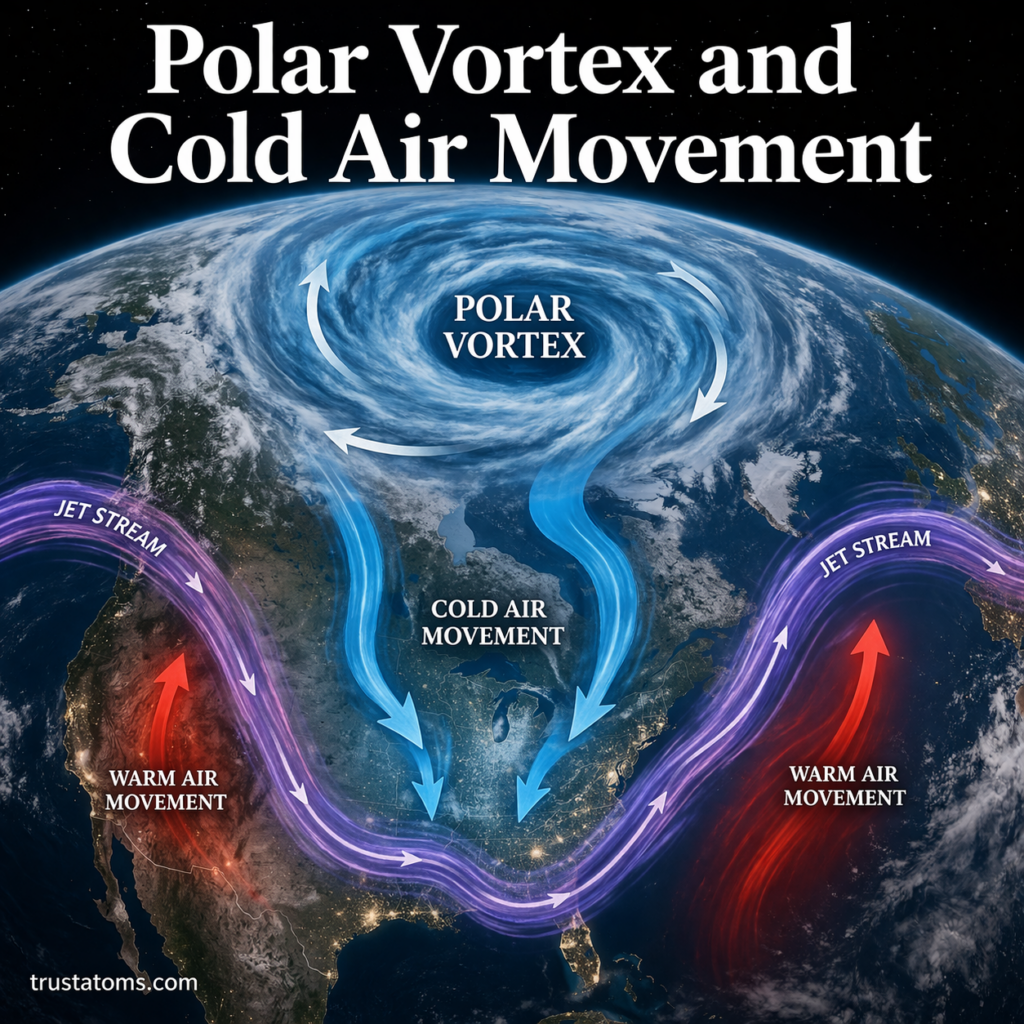
The polar vortex is a mass of cold, low-pressure air that sits over the Earth’s poles, primarily in the upper atmosphere (the stratosphere).
Key characteristics include:
- Located over the Arctic (Northern Hemisphere) and Antarctica (Southern Hemisphere)
- Strongest during winter months
- Surrounded by powerful west-to-east winds
Think of it as a giant spinning dome of cold air that usually stays locked near the poles.
How the Polar Vortex Normally Behaves
Under typical conditions, the polar vortex remains stable and contained.
Stable Polar Vortex Conditions
- Strong winds keep cold air confined near the Arctic
- The jet stream flows in a relatively straight path
- Mid-latitude regions (like the U.S.) experience more moderate winter temperatures
This stability prevents frigid Arctic air from spilling southward.
What Causes the Polar Vortex to Weaken?
Sometimes, the polar vortex becomes unstable or weakens, allowing cold air to escape.
Main Causes of Disruption
- Sudden Stratospheric Warming (SSW)
- Rapid warming in the stratosphere weakens the vortex
- Winds slow down or even reverse direction
- Atmospheric Wave Activity
- Large-scale waves from the lower atmosphere disrupt circulation
- Jet Stream Distortion
- The jet stream becomes wavier, creating deep dips (troughs)
When these factors occur, the polar vortex can stretch, split, or shift away from the pole.
How Cold Air Moves South
When the polar vortex weakens, it no longer holds cold air in place effectively.
Step-by-Step Process
- The vortex weakens or splits
- The jet stream becomes highly wavy
- Cold Arctic air plunges southward in lobes
- Warmer air moves northward in other regions
This creates dramatic temperature contrasts across continents.
The Role of the Jet Stream
The jet stream is a fast-moving ribbon of air in the upper atmosphere that guides weather patterns.
Jet Stream Patterns
- Straight flow → stable weather, cold air stays north
- Wavy flow → increased mixing of cold and warm air
When the jet stream dips south, it acts like a pathway for Arctic air to move into lower latitudes.
Why Polar Vortex Events Cause Extreme Cold
When Arctic air masses move south, they bring:
- Extremely low temperatures
- Wind chills far below freezing
- Snowstorms and ice events
These outbreaks can impact large portions of North America, Europe, and Asia.
Common Effects
- Frozen infrastructure (pipes, roads)
- Increased energy demand
- Travel disruptions
- Health risks from extreme cold
Polar Vortex vs. Cold Snap
It’s important to distinguish between these terms:
- Polar Vortex → a large atmospheric system
- Cold Snap → a short period of unusually cold weather
A disrupted polar vortex can lead to a cold snap, but they are not the same thing.
Is Climate Change Affecting the Polar Vortex?
This is an active area of scientific research.
Some scientists suggest:
- Arctic warming may weaken temperature differences between the poles and mid-latitudes
- This could lead to a more unstable jet stream
- Potentially increasing the frequency of cold air outbreaks
However, the relationship is complex and still being studied.
Key Takeaways
- The polar vortex is a persistent, large-scale circulation of cold air near the poles
- It becomes dangerous when it weakens or shifts
- A disrupted vortex allows cold Arctic air to move southward
- The jet stream plays a critical role in directing this movement
- These events can cause extreme winter weather far from the Arctic
Final Thoughts
The polar vortex isn’t something new—it’s a natural part of Earth’s atmospheric system. What makes it impactful is how it interacts with other atmospheric patterns, especially the jet stream.
By understanding the mechanics behind it, we can better interpret winter weather patterns and prepare for sudden cold outbreaks.