The human body depends on precise signaling systems to regulate functions and respond to change. While many processes rely on stabilizing mechanisms, some situations require rapid amplification. This is where positive feedback comes into play.
Positive feedback is a powerful biological mechanism that enhances a response, driving a process forward until a specific outcome is achieved.
What Is Positive Feedback?
Positive feedback is a process in which the output of a system increases or amplifies the original stimulus.
Instead of maintaining balance like negative feedback, positive feedback:
- Strengthens the initial signal
- Accelerates physiological processes
- Continues until a clear endpoint is reached
This makes it especially useful for time-sensitive biological events.
How Positive Feedback Works

Positive feedback loops follow a reinforcing cycle:
- A stimulus triggers a biological response
- The response amplifies the original stimulus
- This leads to even greater activation
- The cycle continues until a specific event stops it
Unlike negative feedback, there is no gradual stabilization during the process—it builds momentum.
Key Characteristics of Positive Feedback
Positive feedback systems share several defining features:
- Amplify rather than reduce a response
- Operate over a short time frame
- Require a clear stopping point
- Often involve hormones or chemical signals
- Used in critical, event-driven processes
These characteristics ensure the body can act quickly when needed.
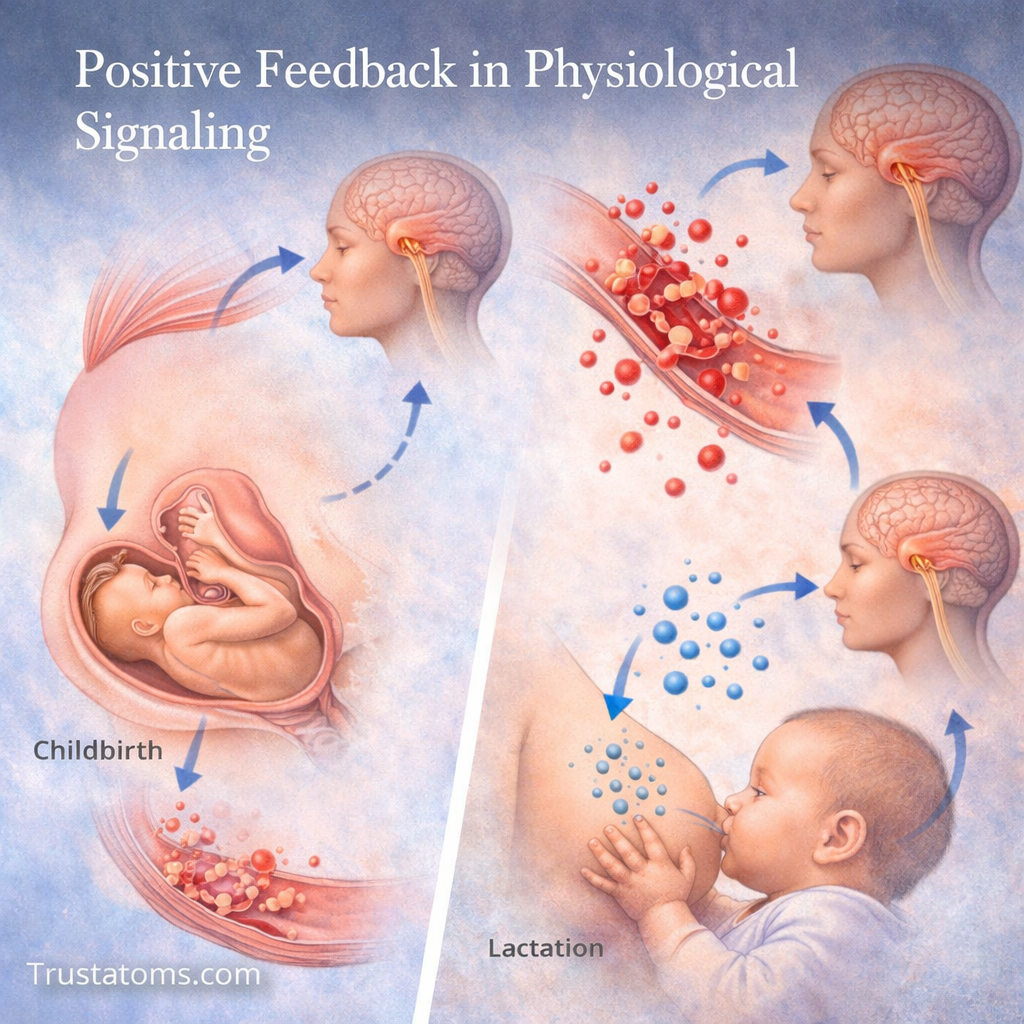
Example: Childbirth and Oxytocin
One of the most well-known examples of positive feedback occurs during labor.
The Process
- The baby’s head presses against the cervix
- The brain signals the release of oxytocin
- Oxytocin increases uterine contractions
- Stronger contractions push the baby further down
The Feedback Loop
- Increased pressure → more oxytocin release
- More oxytocin → stronger contractions
- Stronger contractions → even more pressure
This cycle continues until childbirth is complete, at which point the loop stops.
Example: Blood Clotting
Positive feedback also plays a crucial role in stopping bleeding.
How It Works
- A blood vessel is damaged
- Platelets gather at the injury site
- Platelets release chemicals that attract more platelets
- The clot rapidly grows
Why It’s Effective
- Ensures quick sealing of wounds
- Prevents excessive blood loss
- Stops once the vessel is repaired
This rapid amplification is essential for survival.
Example: Lactation and Milk Let-Down
Another example of positive feedback occurs during breastfeeding.
The Process
- A baby suckles at the breast
- Nerve signals stimulate the release of oxytocin
- Oxytocin causes milk ejection (let-down reflex)
- Continued suckling increases oxytocin release
The Feedback Cycle
- More suckling → more oxytocin
- More oxytocin → increased milk flow
- Increased milk flow → continued suckling
The loop continues as long as the stimulus remains.
Why Positive Feedback Is Important
Although less common than negative feedback, positive feedback is essential for specific physiological functions.
It helps:
- Drive processes to completion quickly
- Amplify signals when rapid action is needed
- Coordinate complex biological events
- Ensure efficiency in critical situations
Without positive feedback, some processes would be too slow or ineffective.
How Positive Feedback Is Controlled
Because positive feedback amplifies signals, it must be carefully regulated to avoid excessive responses.
Control mechanisms include:
- A clear endpoint (e.g., childbirth, clot formation)
- External signals that stop the loop
- Hormonal regulation that reduces stimulation
- Physical completion of the process
Once the goal is achieved, the feedback loop naturally ends.
Positive vs Negative Feedback
Understanding the difference between these two systems helps clarify their roles in the body.
Positive feedback:
- Amplifies responses
- Drives processes forward
- Occurs in short bursts
- Requires a defined stopping point
Negative feedback:
- Reduces or stabilizes responses
- Maintains homeostasis
- Operates continuously
- Prevents imbalance
Both systems are essential, working together to maintain balance and respond to change.
What Happens If Positive Feedback Goes Unchecked?
If positive feedback is not properly controlled, it can lead to harmful effects.
Potential risks:
- Excessive clotting (thrombosis)
- Prolonged or abnormal contractions
- Hormonal imbalances
- Overactivation of signaling pathways
This highlights the importance of built-in regulatory mechanisms.
Final Thoughts
Positive feedback in physiological signaling is a specialized but vital mechanism. It allows the body to amplify responses and complete important processes efficiently.
From childbirth to blood clotting and lactation, positive feedback ensures that critical biological events occur quickly and effectively. When properly regulated, it complements negative feedback systems to keep the body functioning smoothly.