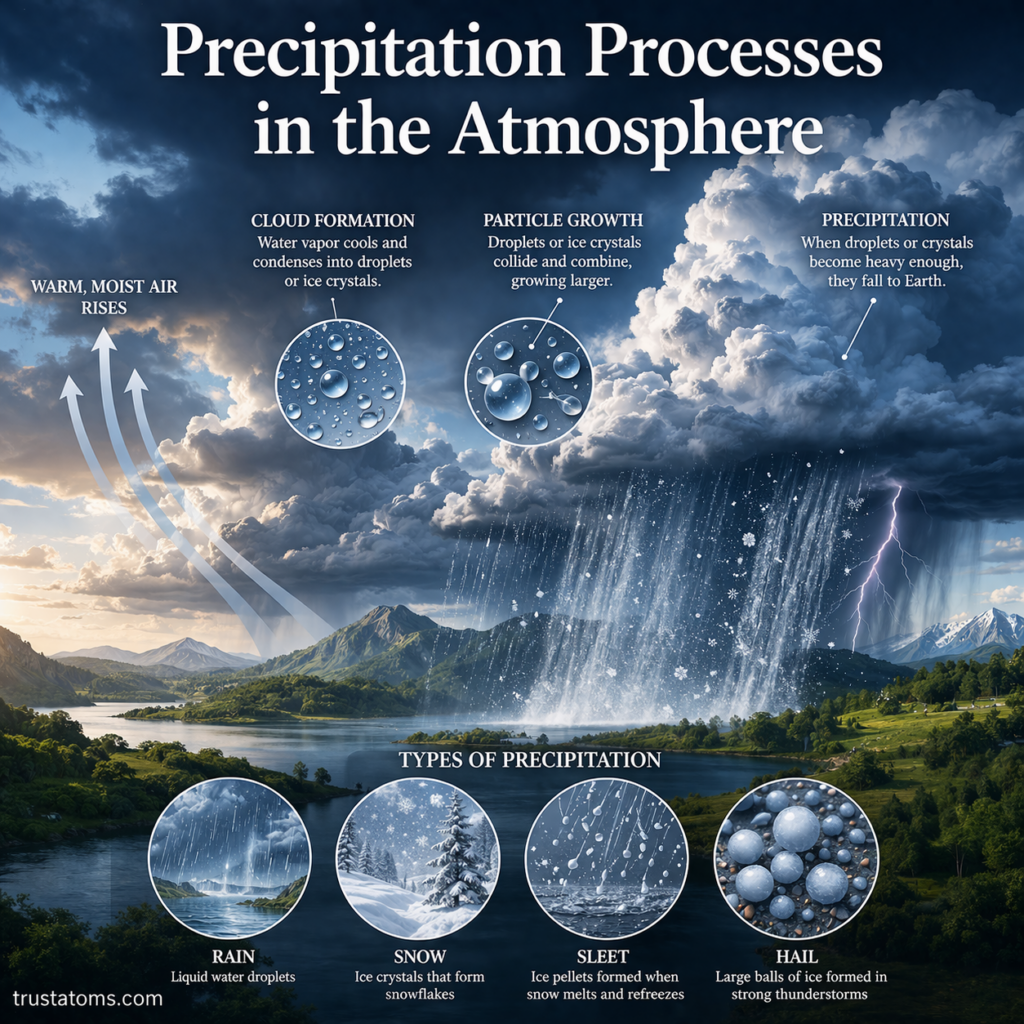
Precipitation is a key part of Earth’s water cycle, delivering water from the atmosphere back to the surface. It plays a vital role in sustaining ecosystems, regulating climate, and supporting life.
Understanding how precipitation forms helps explain weather patterns, storm systems, and seasonal changes around the world.
What Is Precipitation?
Precipitation refers to any form of water—liquid or solid—that falls from clouds to Earth’s surface.
Common Types of Precipitation
- Rain
- Snow
- Sleet
- Hail
All precipitation begins with cloud formation and the growth of water droplets or ice crystals.
How Precipitation Forms
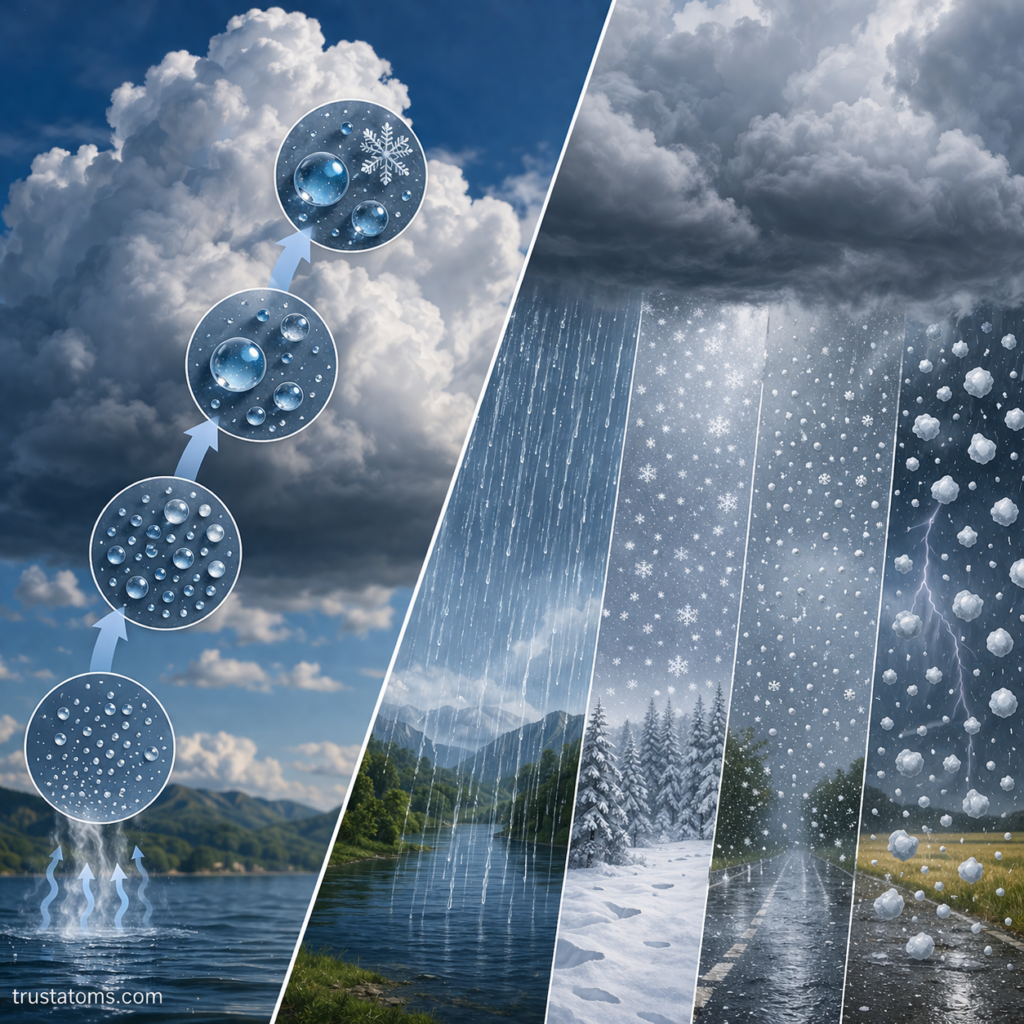
Precipitation occurs when tiny cloud particles grow large enough to fall under gravity.
Basic Process
- Water vapor condenses into droplets or ice crystals
- Particles collide and combine, becoming larger
- Gravity pulls them downward
- If they survive the fall, they reach the ground as precipitation
Two Main Precipitation Processes
There are two primary mechanisms that lead to precipitation formation.
1. Collision-Coalescence Process
This process occurs mainly in warm clouds (above freezing).
How It Works
- Larger droplets fall faster than smaller ones
- As they fall, they collide with smaller droplets
- Droplets merge (coalesce) and grow in size
Key Features
- Common in tropical regions
- Produces rain
- Requires a range of droplet sizes
2. Bergeron Process (Ice-Crystal Process)
This process occurs in cold clouds where both ice crystals and supercooled water droplets exist.
How It Works
- Ice crystals grow by collecting water vapor
- Supercooled droplets evaporate and feed the ice crystals
- Ice crystals become heavy and fall
Key Features
- Common in mid- and high-latitude regions
- Produces snow or ice
- Can lead to rain if melting occurs during descent
Types of Precipitation Explained
Different atmospheric conditions determine the type of precipitation that reaches the ground.
Rain
- Liquid water droplets
- Forms when temperatures are above freezing
- Most common type of precipitation
Snow
- Ice crystals that form flakes
- Occurs when temperatures remain below freezing
- Can vary in size and shape
Sleet
- Small ice pellets
- Forms when snow melts and then refreezes before reaching the ground
Hail
- Large balls or lumps of ice
- Forms in strong thunderstorms with powerful updrafts
- Can grow in layers before falling
The Role of Temperature in Precipitation
Temperature plays a critical role in determining precipitation type.
Key Factors
- Temperature inside the cloud
- Temperature of air layers below the cloud
- Surface temperature
Example Scenarios
- Warm air throughout → rain
- Cold air throughout → snow
- Warm layer above cold surface → sleet or freezing rain
The Role of Updrafts and Downdrafts
Air movement within clouds influences precipitation development.
Updrafts
- Carry droplets upward
- Allow particles to grow larger
- Essential for hail formation
Downdrafts
- Bring precipitation downward
- Help determine intensity and distribution
Precipitation and Weather Systems
Precipitation is closely linked to weather systems and atmospheric conditions.
Common Situations
- Low-pressure systems → rising air and precipitation
- Fronts → interaction of warm and cold air masses
- Tropical systems → heavy rainfall
Why Precipitation Matters
Precipitation is essential for Earth’s environmental balance.
Key Roles
- Supplies freshwater for ecosystems and human use
- Supports agriculture
- Regulates temperature and climate
- Maintains rivers, lakes, and groundwater
Common Misconceptions
Myth: All clouds produce precipitation
- Many clouds do not have particles large enough to fall
Myth: Snow only occurs in very cold climates
- Snow can occur in relatively mild regions if conditions are right
Real-World Examples
You can observe precipitation processes in everyday weather:
- Afternoon rain showers from warm rising air
- Snowstorms from cold air masses
- Thunderstorms producing heavy rain and hail
Final Thoughts
Precipitation processes in the atmosphere are complex but essential for life on Earth. From tiny droplets forming in clouds to large storm systems delivering rain and snow, these processes connect the atmosphere to the surface in a continuous cycle.
By understanding how precipitation forms, you gain a clearer picture of how weather systems develop and how water moves through the environment.