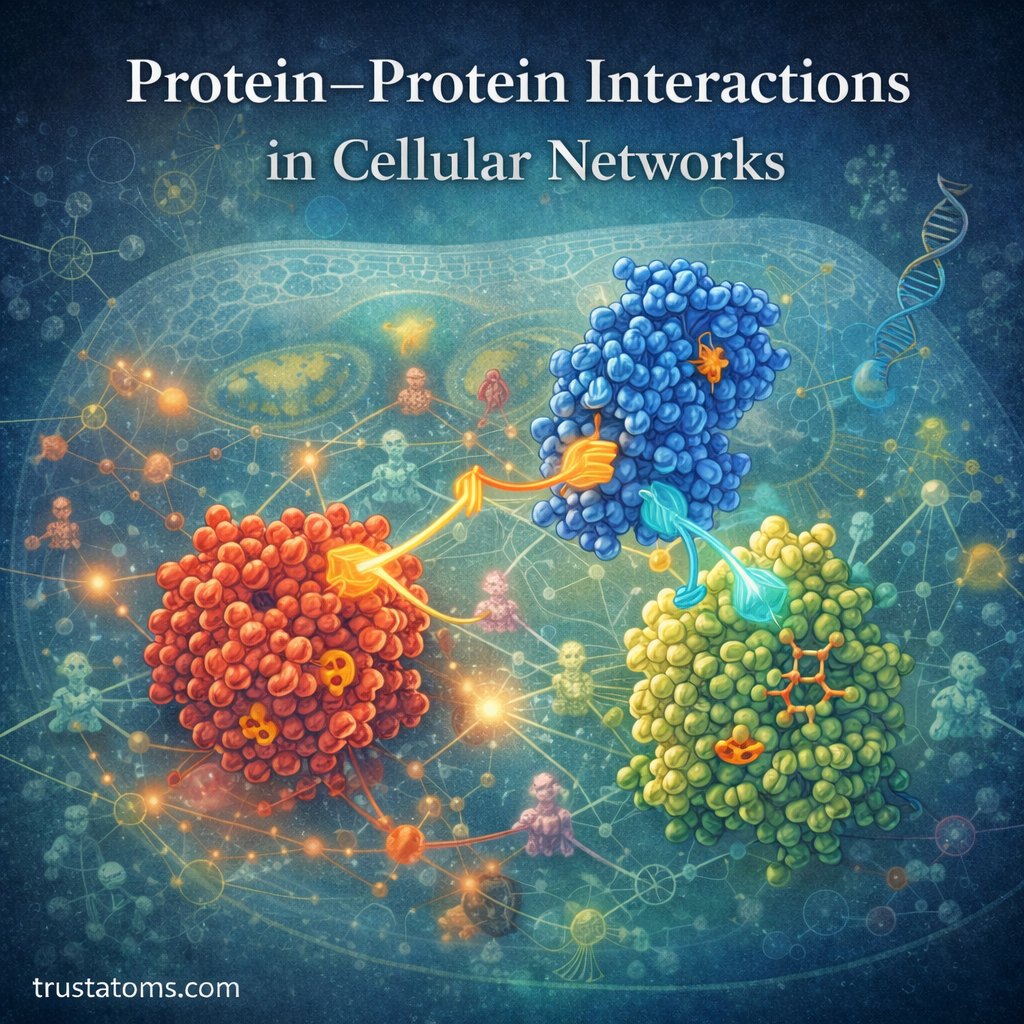
Inside every living cell, thousands of proteins work together to carry out essential biological processes. Rarely does a protein function alone. Instead, proteins interact with other proteins to form complex networks that regulate cellular activity.
These protein–protein interactions (PPIs) allow cells to coordinate signaling pathways, metabolic reactions, immune responses, and structural organization. Understanding how proteins interact within these networks is essential for studying cellular behavior, disease mechanisms, and modern drug development.
This article explores how protein–protein interactions function, how scientists study them, and why they are fundamental to cellular networks.
What Are Protein–Protein Interactions?
Protein–protein interactions occur when two or more protein molecules bind together to perform a biological function.
These interactions can be:
- Temporary, such as signaling events that occur briefly
- Stable, forming long-lasting molecular complexes
Proteins interact through specific regions on their surfaces, often called binding interfaces. These interfaces allow proteins to recognize and attach to compatible partners.
When proteins bind together, they can:
- Activate or deactivate enzymes
- Transfer signals within a cell
- Form structural complexes
- Regulate gene expression
Because proteins carry out most cellular functions, their interactions form the basis of many biological systems.
Why Protein–Protein Interactions Matter
Protein interactions play a critical role in organizing cellular processes.
Cellular Communication
Cells rely on signaling pathways to respond to environmental changes and internal signals. These pathways often involve chains of interacting proteins that pass signals from one molecule to another.
For example:
- A receptor protein detects a signal outside the cell.
- It activates another protein inside the cell.
- That protein activates additional downstream molecules.
This chain of interactions allows the signal to travel through the cell.
Formation of Molecular Complexes
Many cellular functions require groups of proteins working together in complexes.
Examples include:
- Ribosomes, which produce proteins
- DNA replication machinery
- Enzyme complexes involved in metabolism
These complexes allow multiple proteins to coordinate tasks efficiently.
Regulation of Cellular Processes
Protein interactions help regulate when and how biological processes occur.
Cells control protein activity through mechanisms such as:
- Binding inhibitors or activators
- Changing protein conformation
- Forming temporary signaling complexes
This regulation ensures that cellular processes occur at the correct time and location.
Types of Protein–Protein Interactions
Protein interactions vary depending on their duration and biological role.
Transient Interactions
Transient interactions are short-lived and reversible.
They often occur during:
- Signal transduction
- Enzyme-substrate binding
- Cellular communication events
Because these interactions are temporary, they allow cells to quickly respond to changing conditions.
Stable Interactions
Stable interactions form long-lasting protein complexes.
These interactions are common in structures such as:
- Cytoskeletal assemblies
- Ribosomes
- Multi-protein enzyme complexes
Stable interactions help maintain structural and functional organization inside the cell.
Regulatory Interactions
Some interactions regulate protein function by controlling activity levels.
For example:
- A regulatory protein may bind to an enzyme and deactivate it.
- A transcription factor may bind to another protein to activate gene expression.
These interactions allow cells to finely tune biological processes.
Protein Interaction Networks
When scientists map all the interactions between proteins in a cell, they create a protein interaction network.
These networks reveal how proteins cooperate to perform complex biological tasks.
In a protein interaction network:
- Nodes represent proteins.
- Edges represent interactions between proteins.
By studying these networks, scientists can identify:
- Key regulatory proteins
- Critical signaling pathways
- Network hubs that coordinate cellular activity
Network analysis helps reveal how biological systems operate as integrated systems rather than isolated components.
Methods Used to Study Protein–Protein Interactions
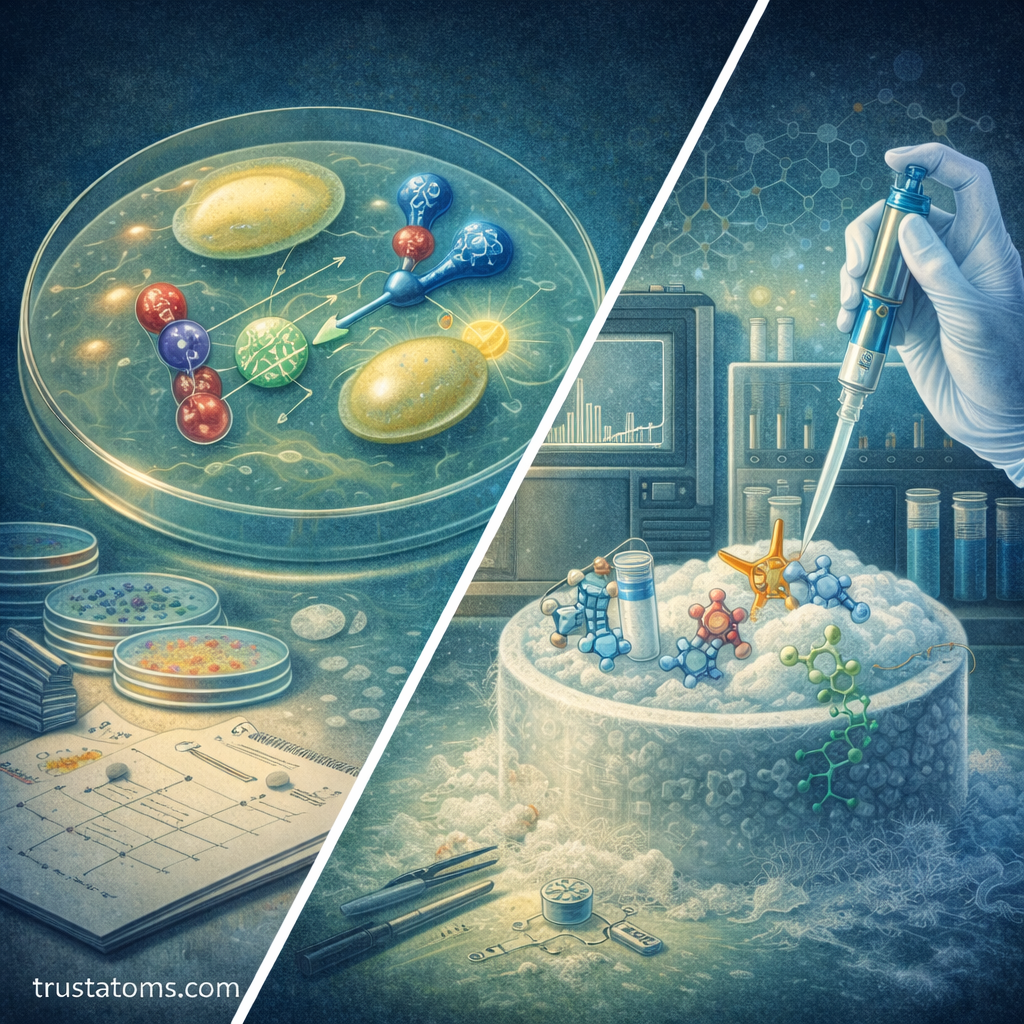
Researchers use several experimental techniques to detect and analyze protein interactions.
Yeast Two-Hybrid Screening
The yeast two-hybrid system is a widely used genetic method for identifying protein interactions.
The method works by:
- Attaching two proteins of interest to separate regulatory components in yeast cells.
- Observing whether the proteins interact.
- Detecting interaction through gene activation signals.
This approach allows researchers to screen many potential protein interactions at once.
Co-Immunoprecipitation
Co-immunoprecipitation is a biochemical method used to isolate interacting proteins.
The technique involves:
- Using antibodies to bind a specific protein
- Pulling that protein out of a cell extract
- Identifying other proteins that are attached to it
This method confirms interactions occurring within real biological samples.
Mass Spectrometry
Mass spectrometry helps identify proteins within large molecular complexes.
After isolating protein complexes, scientists analyze them to determine:
- Which proteins are present
- How they interact within the complex
This approach provides detailed information about interaction networks.
Fluorescence-Based Imaging
Advanced microscopy techniques allow scientists to observe protein interactions inside living cells.
Fluorescent tagging enables researchers to:
- Track proteins in real time
- Observe interactions inside cellular compartments
- Study how interactions change during cellular activity
Protein–Protein Interactions in Disease
Many diseases arise when protein interactions are disrupted.
Cancer
Cancer often involves abnormal signaling pathways caused by altered protein interactions.
Mutations may cause proteins to:
- Remain permanently activated
- Lose regulatory binding partners
- Trigger uncontrolled cell growth
Understanding these interactions helps researchers develop targeted therapies.
Neurodegenerative Disorders
Diseases such as Alzheimer’s and Parkinson’s involve abnormal protein aggregation and disrupted interactions.
Misfolded proteins may:
- Form toxic clusters
- Interfere with normal protein networks
- Damage neurons
Studying these interaction patterns helps researchers understand disease progression.
Infectious Diseases
Viruses and bacteria often manipulate host protein networks.
Pathogens produce proteins that interact with host proteins to:
- Disable immune responses
- Hijack cellular machinery
- Promote viral replication
Mapping these interactions helps identify new treatment strategies.
Protein Interaction Networks in Drug Discovery
Protein interaction networks have become an important focus in pharmaceutical research.
Traditional drug development often targeted individual proteins, but modern research increasingly considers entire interaction networks.
Scientists now aim to:
- Identify network hubs that regulate multiple pathways
- Design drugs that disrupt harmful protein interactions
- Restore normal interaction networks in diseased cells
This network-based approach improves treatment effectiveness and reduces unintended side effects.
Challenges in Studying Protein Interactions
Despite major advances, studying protein networks remains complex.
Dynamic Interactions
Many protein interactions occur briefly and are difficult to detect using traditional methods.
Capturing these transient interactions requires advanced imaging and biochemical techniques.
Network Complexity
Cells contain thousands of proteins interacting in overlapping pathways.
Understanding these large networks requires sophisticated computational analysis and systems biology approaches.
Experimental Limitations
Different detection methods may produce false positives or miss weak interactions.
Scientists often combine multiple techniques to confirm results.
Future Directions in Protein Interaction Research
The study of protein–protein interactions continues to expand with advances in technology.
Important emerging areas include:
- Artificial intelligence for predicting protein interaction networks
- High-resolution imaging of molecular complexes
- Integration with systems biology and multi-omics data
- Large-scale protein interaction databases
These developments will help scientists build more accurate maps of cellular interaction networks.
Understanding how proteins cooperate within these networks will deepen our knowledge of biology and improve treatments for many diseases.
Final Thoughts
Protein–protein interactions form the foundation of cellular networks. Through these interactions, proteins coordinate signaling pathways, regulate biological processes, and maintain cellular structure.
By studying protein interaction networks, scientists gain valuable insights into how cells function and how diseases disrupt normal biological systems. Advances in experimental techniques and computational analysis continue to reveal the intricate web of interactions that sustain life.
As research progresses, understanding protein–protein interactions will remain central to biology, medicine, and biotechnology.