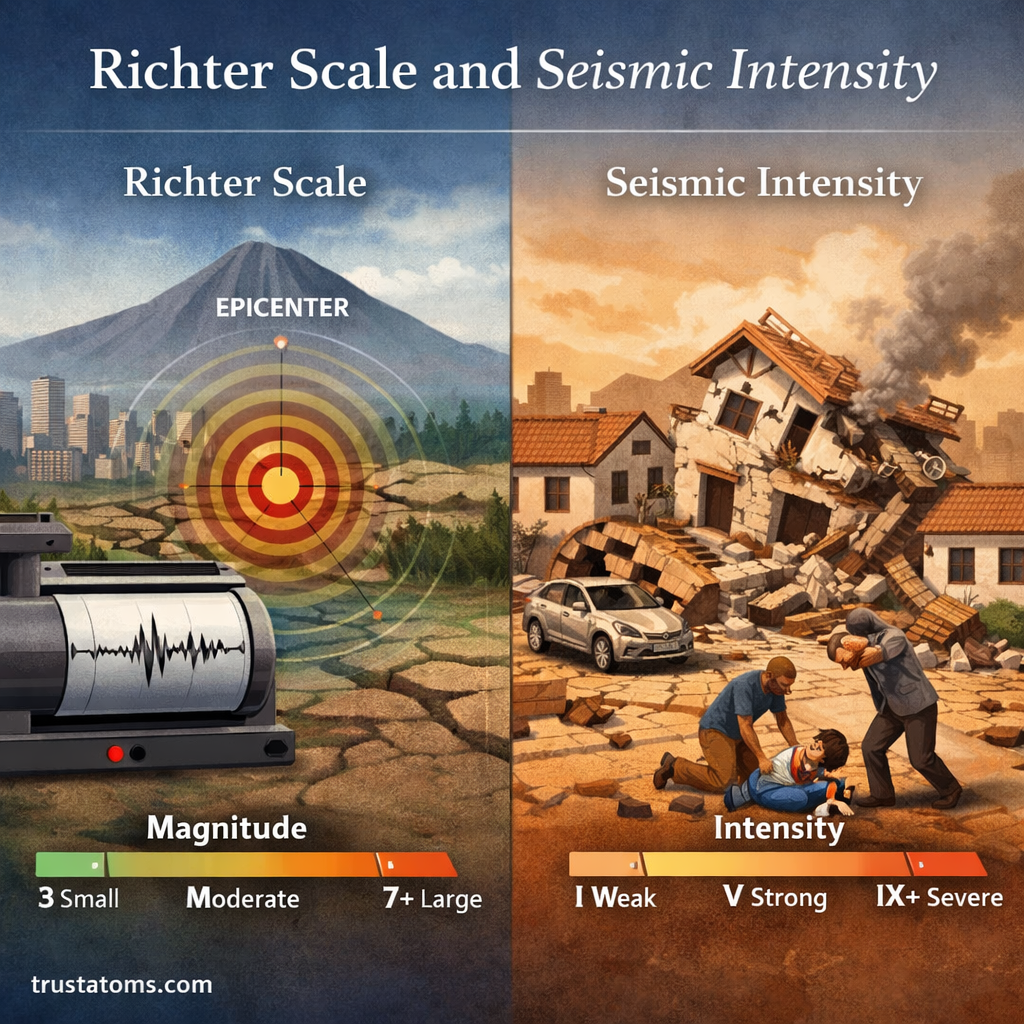
Earthquakes vary widely in strength and impact, from barely noticeable tremors to devastating events. To understand and compare these events, scientists use measurement systems that describe both the energy released and the effects felt on the ground.
Two key concepts are the Richter Scale and seismic intensity. While they are often confused, they measure very different aspects of an earthquake.
What Is the Richter Scale?
The Richter Scale was developed in 1935 by seismologist Charles F. Richter to quantify the magnitude of earthquakes.
Key Features
- Measures the energy released at the source of an earthquake
- Based on seismic wave amplitude recorded by seismographs
- Uses a logarithmic scale
This means each whole number increase represents a significant jump in strength.
Understanding the Logarithmic Nature
The Richter Scale is not linear—it increases exponentially.
What This Means
- A magnitude 6 earthquake is 10 times stronger in wave amplitude than a magnitude 5
- It releases about 32 times more energy
- A magnitude 7 releases roughly 1,000 times more energy than a magnitude 5
This exponential growth explains why higher-magnitude earthquakes are much more destructive.
Limitations of the Richter Scale
Although historically important, the Richter Scale has limitations.
Key Limitations
- Less accurate for very large earthquakes
- Designed for specific types of seismic waves
- Not ideal for global comparisons
Because of these issues, scientists now often use the Moment Magnitude Scale for more precise measurements.
What Is Seismic Intensity?
Seismic intensity measures the effects of an earthquake at a specific location.
Unlike magnitude, which is a single value, intensity can vary from place to place depending on distance from the epicenter and local conditions.
The Modified Mercalli Intensity Scale
The most commonly used intensity scale is the Modified Mercalli Intensity Scale.
Scale Overview
- Ranges from I (not felt) to XII (total destruction)
- Based on observations, not instrument readings
- Considers human perception and structural damage
Example Levels
- I–III: Barely felt or not noticed
- IV–VI: Noticeable shaking, minor damage
- VII–IX: Strong shaking, moderate to heavy damage
- X–XII: Severe destruction, ground movement
Magnitude vs. Intensity: Key Differences
Understanding the difference between magnitude and intensity is essential.
Magnitude (Richter Scale)
- Measures energy released
- Single value for the entire earthquake
- Recorded by instruments
Intensity (Mercalli Scale)
- Measures observed effects
- Varies by location
- Based on human reports and damage
Why Intensity Varies
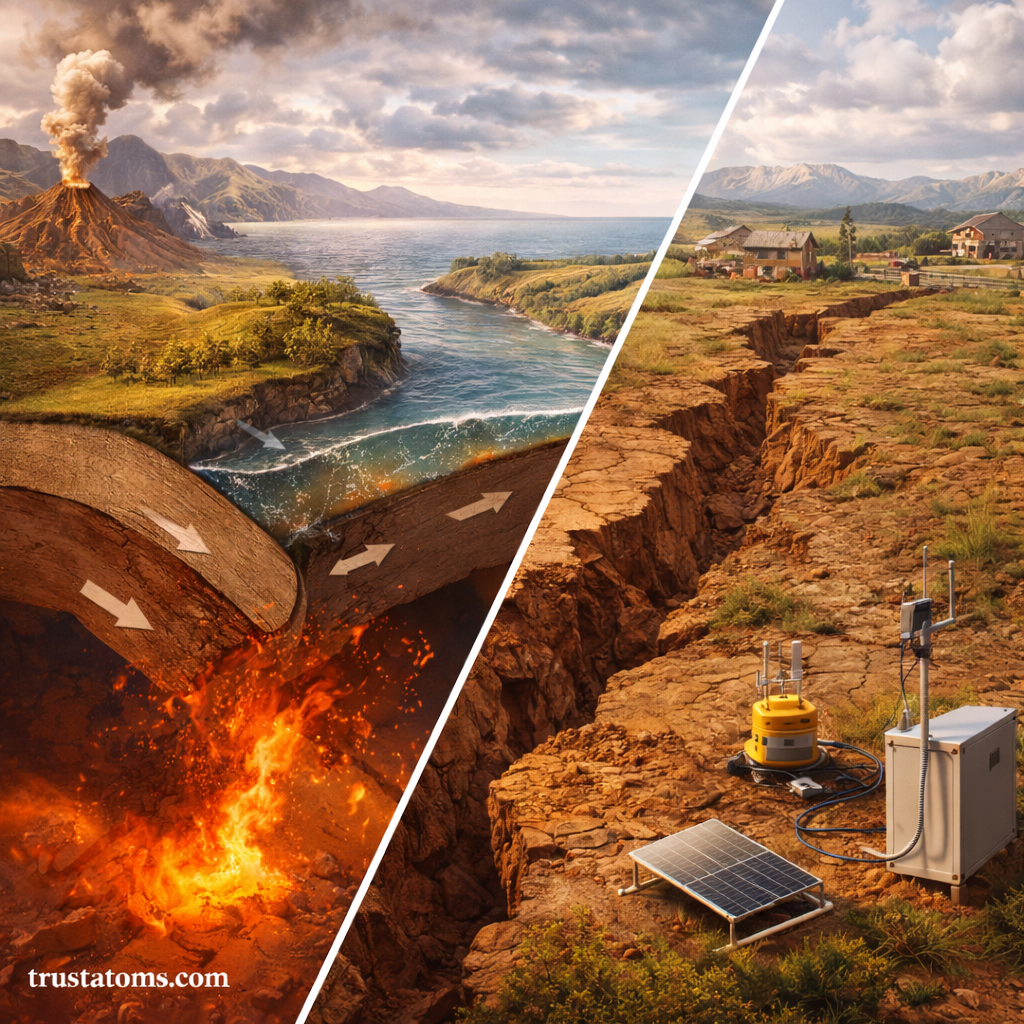
Even with the same magnitude, different areas can experience different levels of shaking.
Factors That Influence Intensity
- Distance from the epicenter
- Depth of the earthquake
- Local geology (soft soil vs. solid rock)
- Building design and construction quality
For example, cities built on soft sediment may experience stronger shaking than those on bedrock.
How Scientists Use Both Measurements
Magnitude and intensity complement each other in earthquake analysis.
Combined Use
- Magnitude helps estimate total energy and compare earthquakes globally
- Intensity helps assess local damage and emergency response needs
Together, they provide a complete understanding of an earthquake’s impact.
Real-World Example
Consider a magnitude 7 earthquake:
- Near the epicenter: Intensity may reach VIII or IX (severe damage)
- Farther away: Intensity may drop to III or IV (light shaking)
This demonstrates how one earthquake can produce very different experiences depending on location.
Importance in Disaster Preparedness
Understanding these scales is critical for safety and planning.
Practical Applications
- Designing earthquake-resistant buildings
- Creating hazard maps
- Planning emergency response strategies
- Educating the public about risks
Accurate measurement helps reduce damage and save lives.
Modern Advances in Earthquake Measurement
Technology continues to improve how earthquakes are measured and analyzed.
Recent Developments
- Digital seismographs with higher precision
- Real-time data sharing across global networks
- Improved modeling of ground motion
These advancements enhance both magnitude calculations and intensity mapping.
Why This Topic Matters
Earthquakes are unpredictable, but understanding how they are measured helps reduce uncertainty.
- Provides insight into Earth’s internal processes
- Improves risk assessment
- Supports safer infrastructure development
- Enhances emergency preparedness
Final Thoughts
The Richter Scale and seismic intensity are both essential tools for understanding earthquakes. While one measures the energy released and the other describes the effects experienced, together they offer a complete picture of seismic events.
As technology advances, our ability to measure and interpret earthquakes continues to improve—helping communities better prepare for and respond to these powerful natural forces.