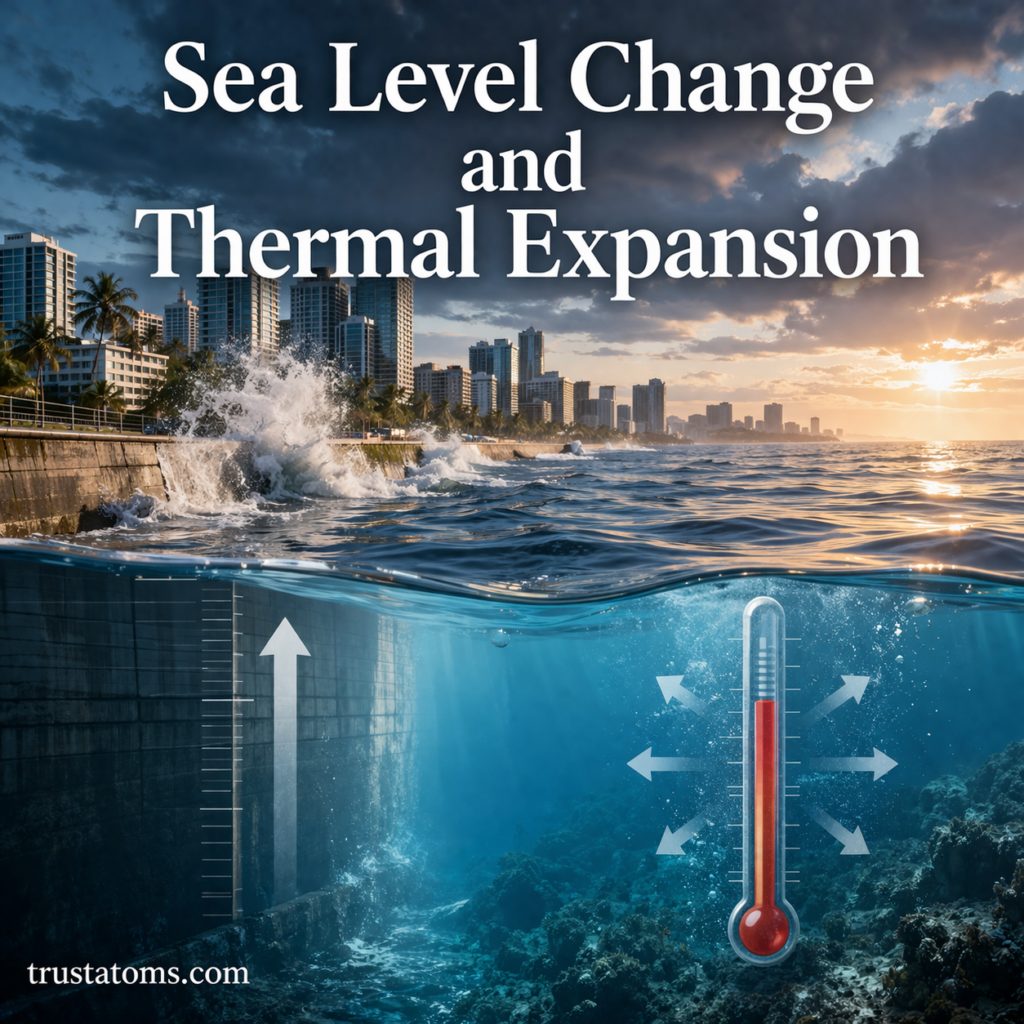
Sea level change is one of the most visible and impactful consequences of a warming planet. While melting glaciers and ice sheets often get the most attention, a major contributor to rising sea levels is something less obvious: thermal expansion.
As oceans absorb heat, water expands—causing sea levels to rise even without adding extra water. Understanding this process is essential for grasping how climate change affects coastal environments and global systems.
What Is Sea Level Change?
Sea level change refers to the increase or decrease in the average height of the ocean’s surface over time.
Two Main Types
- Global (eustatic) sea level rise: Changes affecting oceans worldwide
- Local (relative) sea level change: Varies by region due to land movement and ocean conditions
Sea level rise is measured using satellites and tide gauges over long periods.
What Is Thermal Expansion?
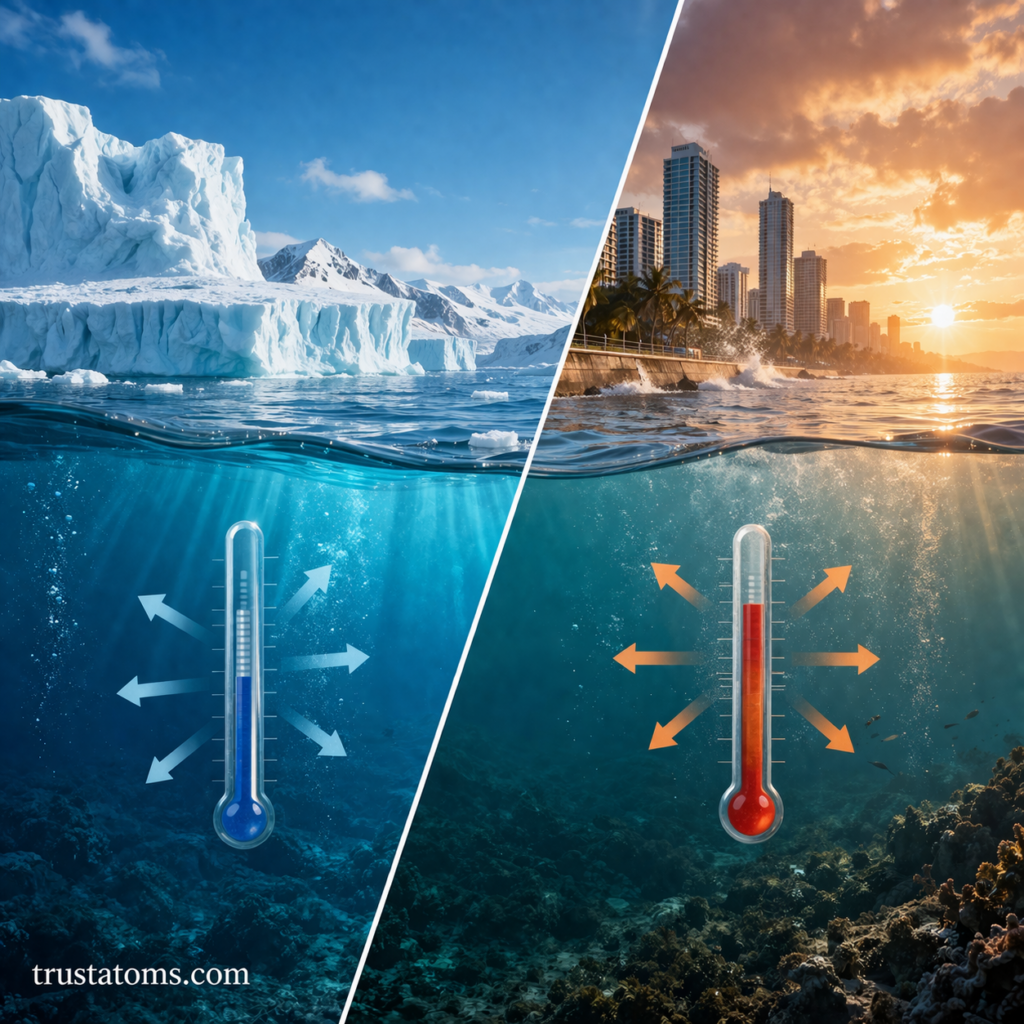
Thermal expansion occurs when water increases in volume as it warms.
How It Works
- Heat causes water molecules to move faster
- Faster movement increases the space between molecules
- This leads to an overall increase in volume
Even small temperature increases can cause significant expansion across the vast volume of the oceans.
Why Oceans Absorb Heat
Oceans act as Earth’s largest heat reservoir.
Key Reasons
- Water has a high heat capacity
- Oceans cover over 70% of Earth’s surface
- They absorb more than 90% of excess heat from global warming
This makes oceans a major driver of thermal expansion.
Contribution of Thermal Expansion to Sea Level Rise
Thermal expansion is one of the leading causes of modern sea level rise.
Key Facts
- Accounts for roughly 30–50% of observed sea level rise
- Occurs throughout ocean depths, not just the surface
- Continues even if ice melt slows down
This means sea levels can keep rising as long as oceans continue to warm.
Other Causes of Sea Level Rise
While thermal expansion is significant, it works alongside other factors.
1. Melting Glaciers
- Mountain glaciers add freshwater to oceans
- Accelerated melting increases sea levels
2. Ice Sheet Loss
- Greenland and Antarctica store vast amounts of ice
- Melting contributes large volumes of water
3. Land Water Storage Changes
- Groundwater extraction and reservoir storage can alter sea levels
Together, these factors amplify overall sea level rise.
Measuring Sea Level and Ocean Temperature
Scientists use advanced tools to track changes in sea level and thermal expansion.
Satellite Altimetry
- Measures the height of the ocean surface globally
- Provides consistent long-term data
Argo Floats
- Autonomous devices that measure ocean temperature and salinity
- Collect data from surface to deep ocean
Tide Gauges
- Coastal instruments that track local sea level changes over time
These tools help scientists understand both global trends and regional variations.
Regional Differences in Sea Level Rise
Sea level rise is not uniform across the globe.
Factors That Influence Variation
- Ocean currents and wind patterns
- Gravitational effects from ice loss
- Land subsidence or uplift
Some regions may experience higher-than-average sea level rise, increasing local risk.
Impacts of Rising Sea Levels
Sea level rise has wide-ranging consequences for ecosystems and human populations.
Coastal Flooding
- Increased frequency of high-tide flooding
- Greater impact from storm surges
Erosion
- Loss of beaches and coastal land
- Damage to infrastructure
Saltwater Intrusion
- Contamination of freshwater supplies
- Impact on agriculture and drinking water
Ecosystem Disruption
- Loss of wetlands and mangroves
- Threats to marine and coastal species
Long-Term Effects of Thermal Expansion
Thermal expansion has long-lasting impacts because ocean warming is slow to reverse.
Key Characteristics
- Oceans retain heat for decades or centuries
- Even if emissions stop, expansion may continue
- Deep ocean warming contributes to delayed sea level rise
This creates a long-term commitment to rising seas.
Future Projections
Climate models predict continued sea level rise throughout the 21st century.
Possible Scenarios
- Moderate rise with reduced emissions
- Accelerated rise with continued high emissions
- Increased risk for low-lying coastal regions
Thermal expansion will remain a major contributor in all scenarios.
Mitigation and Adaptation Strategies
Addressing sea level rise requires both reducing causes and preparing for impacts.
Mitigation (Reducing Causes)
- Lower greenhouse gas emissions
- Transition to renewable energy
- Improve energy efficiency
Adaptation (Managing Impacts)
- Building sea walls and flood defenses
- Restoring natural barriers like wetlands
- Planning coastal development carefully
Combining both approaches is essential for long-term resilience.
Key Takeaways
- Thermal expansion occurs when ocean water warms and expands
- Oceans absorb most of Earth’s excess heat, driving this process
- Thermal expansion contributes significantly to sea level rise
- Sea level rise varies by region due to multiple factors
- Long-term ocean warming means continued sea level increases
Conclusion
Sea level change is a complex process influenced by multiple factors, but thermal expansion plays a central role. As the oceans continue to absorb heat, their expansion contributes steadily to rising sea levels—impacting coastlines, ecosystems, and human communities worldwide.
Understanding thermal expansion highlights the importance of addressing climate change at its source while also preparing for its long-term effects.