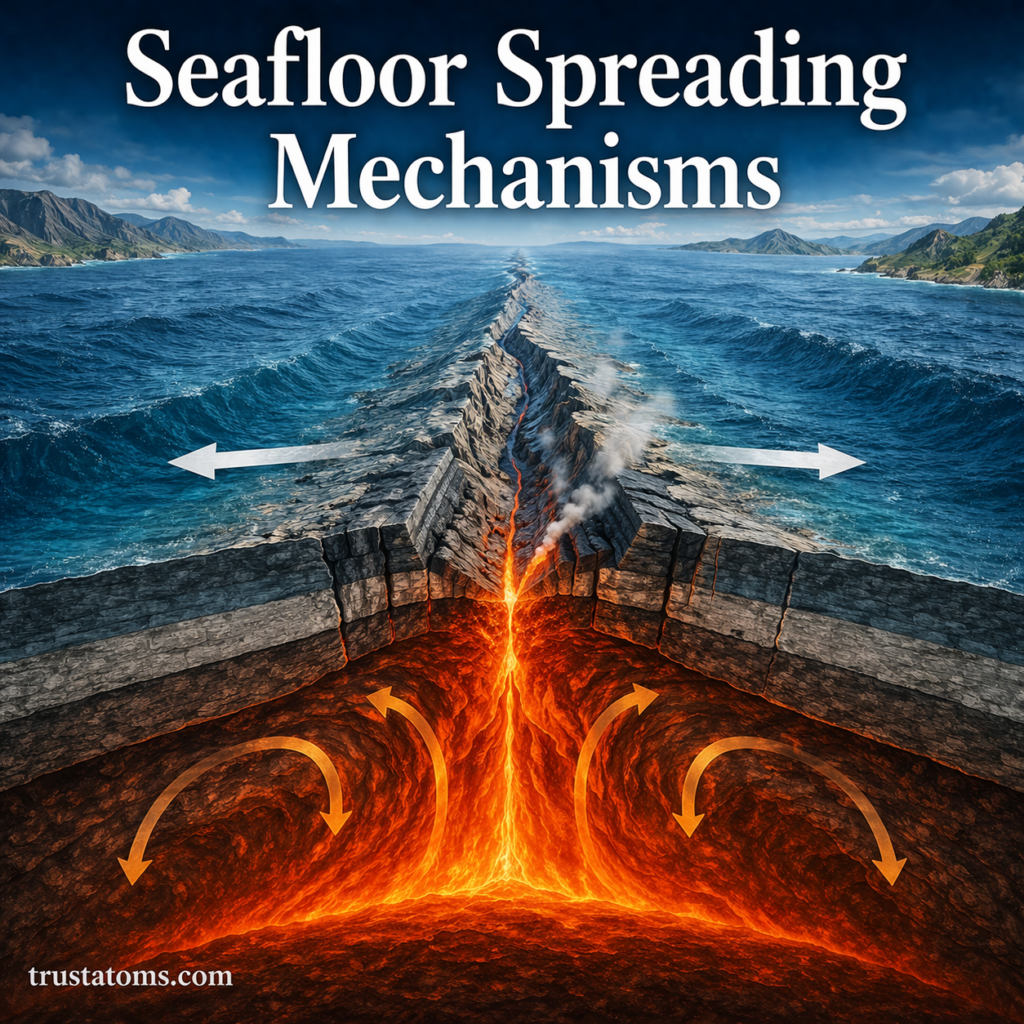
Seafloor spreading is one of the most important processes shaping Earth’s surface. It explains how new oceanic crust is created, how continents move, and how oceans expand over time.
First proposed in the mid-20th century, seafloor spreading became a key piece of evidence supporting plate tectonics. Today, it helps scientists understand everything from ocean formation to earthquakes and volcanic activity beneath the sea.
What Is Seafloor Spreading?
Seafloor spreading is the process by which new oceanic crust forms at mid-ocean ridges and gradually moves away from them.
This occurs when molten material from beneath Earth’s crust rises, cools, and solidifies, creating new rock.
Key characteristics:
- Occurs at divergent plate boundaries
- Creates new ocean floor
- Pushes older crust away from the ridge
- Happens continuously over millions of years
The Role of Mid-Ocean Ridges
Mid-ocean ridges are underwater mountain chains where seafloor spreading takes place.
These ridges:
- Form where tectonic plates move apart
- Contain central rift valleys
- Are sites of frequent volcanic activity
Some of the most extensive mountain ranges on Earth are actually underwater, formed by this process.
How Seafloor Spreading Works
The mechanism of seafloor spreading involves several interconnected steps.
Step-by-Step Process
- Mantle material rises due to convection currents
- Pressure decreases as material approaches the surface
- Partial melting produces magma
- Magma rises through cracks in the crust
- Lava cools and solidifies into new oceanic crust
- Newly formed crust moves away from the ridge
This continuous cycle gradually widens ocean basins.
Mantle Convection: The Driving Force
Seafloor spreading is powered by convection currents within Earth’s mantle.
How Convection Works
- Hot material rises from deep within the mantle
- Cooler, denser material sinks
- This creates a circular flow pattern
These movements generate the forces needed to pull tectonic plates apart.
Evidence for Seafloor Spreading
Scientists rely on multiple lines of evidence to support seafloor spreading.
Magnetic Striping
One of the strongest pieces of evidence is magnetic striping on the ocean floor.
- As magma cools, minerals align with Earth’s magnetic field
- Earth’s magnetic field reverses over time
- This creates symmetrical полосы of magnetic patterns on either side of ridges
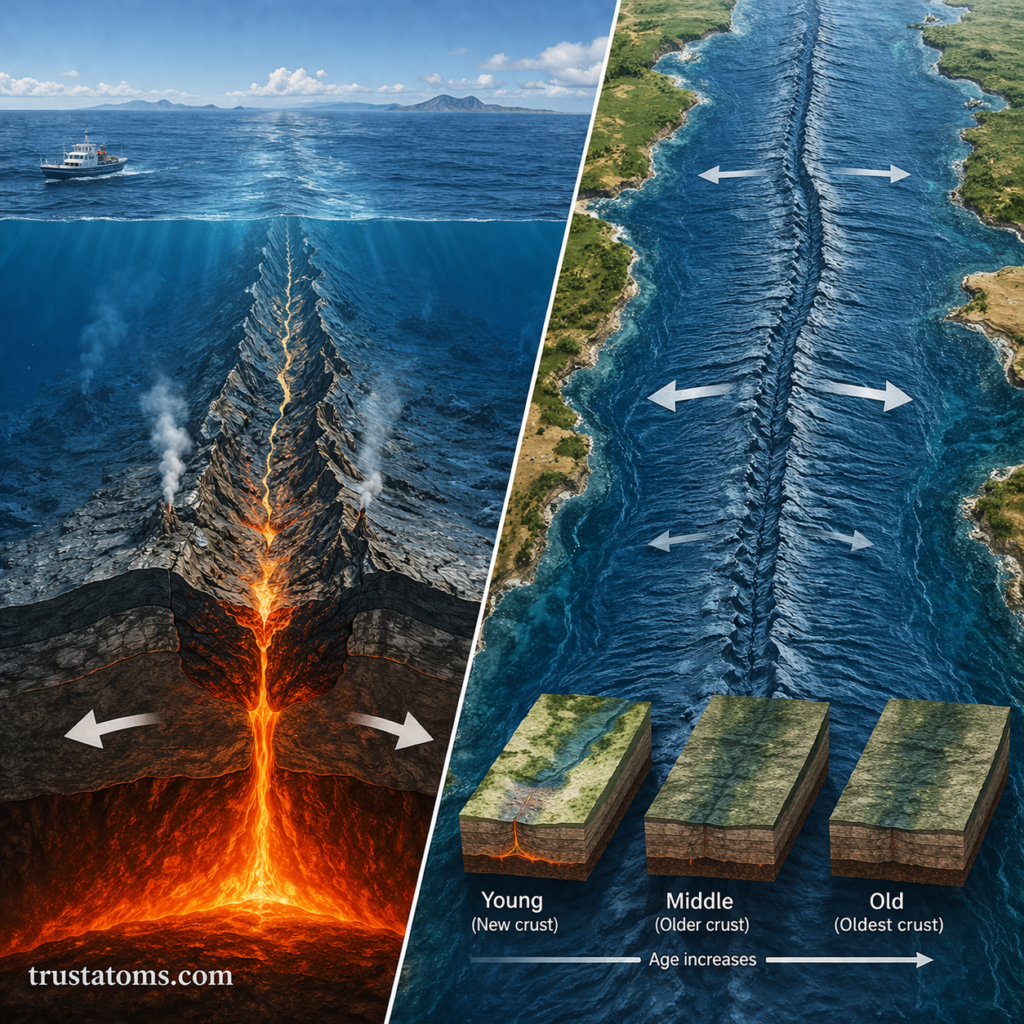
Age of Oceanic Crust
- Youngest crust is found at mid-ocean ridges
- Older crust is located farther away
- This pattern confirms outward movement
Sediment Thickness
- Thin sediment near ridges
- Thicker sediment farther away
- Indicates older crust has had more time to accumulate deposits
Types of Seafloor Spreading Rates
Seafloor spreading does not occur at the same speed everywhere.
Fast-Spreading Ridges
- Smooth, broad ridges
- Less pronounced rift valleys
- Example: East Pacific Rise
Slow-Spreading Ridges
- Rough, uneven terrain
- Deep rift valleys
- Example: Mid-Atlantic Ridge
Spreading rates can influence the shape and features of the ocean floor.
Interaction with Other Geological Processes
Seafloor spreading is closely connected to other tectonic processes.
Subduction
- Old oceanic crust is recycled back into the mantle
- Occurs at convergent boundaries
Earthquakes
- Movement along plate boundaries causes seismic activity
Volcanism
- Continuous volcanic activity forms new crust
Together, these processes maintain the balance of Earth’s surface.
Why Seafloor Spreading Matters
Seafloor spreading plays a crucial role in shaping our planet.
Ocean Formation
- Creates and expands ocean basins
- Separates continents over time
Plate Movement
- Drives continental drift
- Influences global geography
Natural Resources
- Associated with hydrothermal vents
- Supports unique ecosystems and mineral deposits
Climate Influence
- Affects ocean circulation patterns
- Impacts long-term climate cycles
The Life Cycle of Oceanic Crust
Oceanic crust follows a continuous cycle:
- Formation at mid-ocean ridges
- Movement across the ocean floor
- Cooling and thickening
- Subduction back into the mantle
This cycle can take hundreds of millions of years.
Key Takeaways
- Seafloor spreading creates new oceanic crust at mid-ocean ridges
- Mantle convection drives the process
- Magnetic striping and crust age provide strong evidence
- Spreading rates affect ocean floor features
- The process is essential to plate tectonics and Earth’s evolution
Final Thoughts
Seafloor spreading reveals a planet in constant motion. Beneath the oceans, new crust is continuously forming, pushing continents apart and reshaping Earth’s surface.
By understanding these mechanisms, scientists gain valuable insight into the forces that have shaped our world—and those that continue to shape it today.