Soil is one of Earth’s most important natural resources. It supports plant life, regulates water flow, and plays a key role in ecosystems. But soil doesn’t just appear—it forms slowly over time through the breakdown of rocks and the interaction of environmental factors.
Understanding soil formation and weathering processes helps explain how landscapes develop and how ecosystems are sustained.
What Is Soil?
Soil is a mixture of:
- Mineral particles (from broken-down rock)
- Organic matter (decayed plants and animals)
- Water
- Air
It forms a thin layer over Earth’s surface and varies widely depending on location, climate, and geological history.
What Is Weathering?
Weathering is the process by which rocks are broken down into smaller pieces. This is the first step in soil formation.
There are three main types of weathering:
- Physical (mechanical) weathering
- Chemical weathering
- Biological weathering
Each type contributes differently to the breakdown of rock material.
Physical Weathering
Physical weathering breaks rocks into smaller fragments without changing their chemical composition.
Common causes include:
- Temperature changes (expansion and contraction)
- Freeze-thaw cycles (water freezing in cracks)
- Wind and water abrasion
- Pressure release (unloading of rock layers)
This process increases the surface area of rocks, making them more vulnerable to other forms of weathering.
Chemical Weathering
Chemical weathering changes the composition of rocks through chemical reactions.
Key processes include:
- Oxidation (reaction with oxygen, often forming rust-like compounds)
- Hydrolysis (reaction with water altering minerals)
- Dissolution (minerals dissolving in water, especially acidic water)
Chemical weathering is especially effective in warm, moist climates.
Biological Weathering
Biological weathering involves living organisms breaking down rocks.
Examples include:
- Plant roots growing into cracks and widening them
- Microorganisms producing acids that dissolve minerals
- Burrowing animals disturbing and breaking apart soil and rock
This type of weathering often works alongside physical and chemical processes.
Factors That Influence Soil Formation
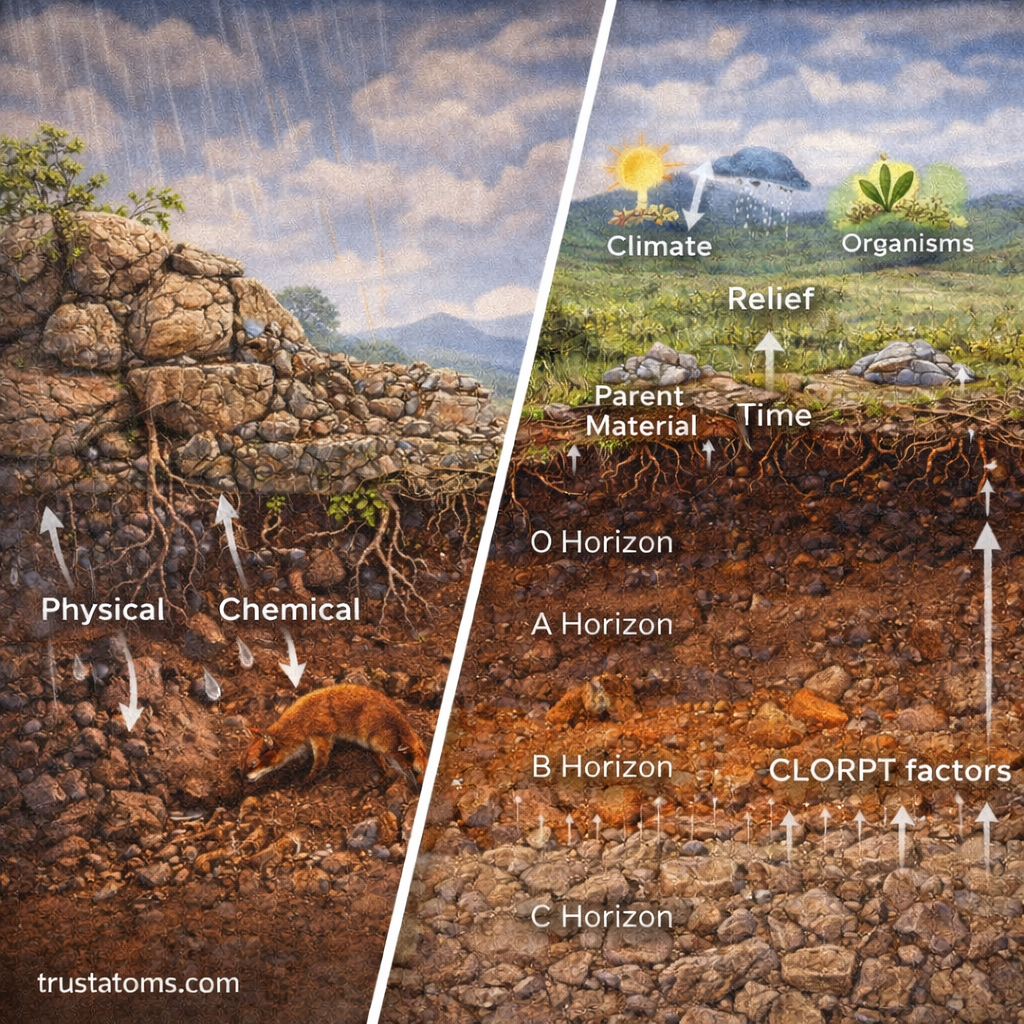
Soil formation depends on several interacting factors, often summarized as CLORPT:
Climate
- Temperature and rainfall influence weathering rates
- Warm, wet climates accelerate soil formation
Organisms
- Plants, animals, and microorganisms contribute organic matter
- Roots and biological activity enhance weathering
Relief (Topography)
- Slope affects water drainage and erosion
- Steeper slopes often have thinner soils
Parent Material
- The original rock or sediment from which soil forms
- Determines mineral composition and texture
Time
- Soil formation is a slow process
- Well-developed soils can take thousands of years to form
Soil Horizons (Layers)
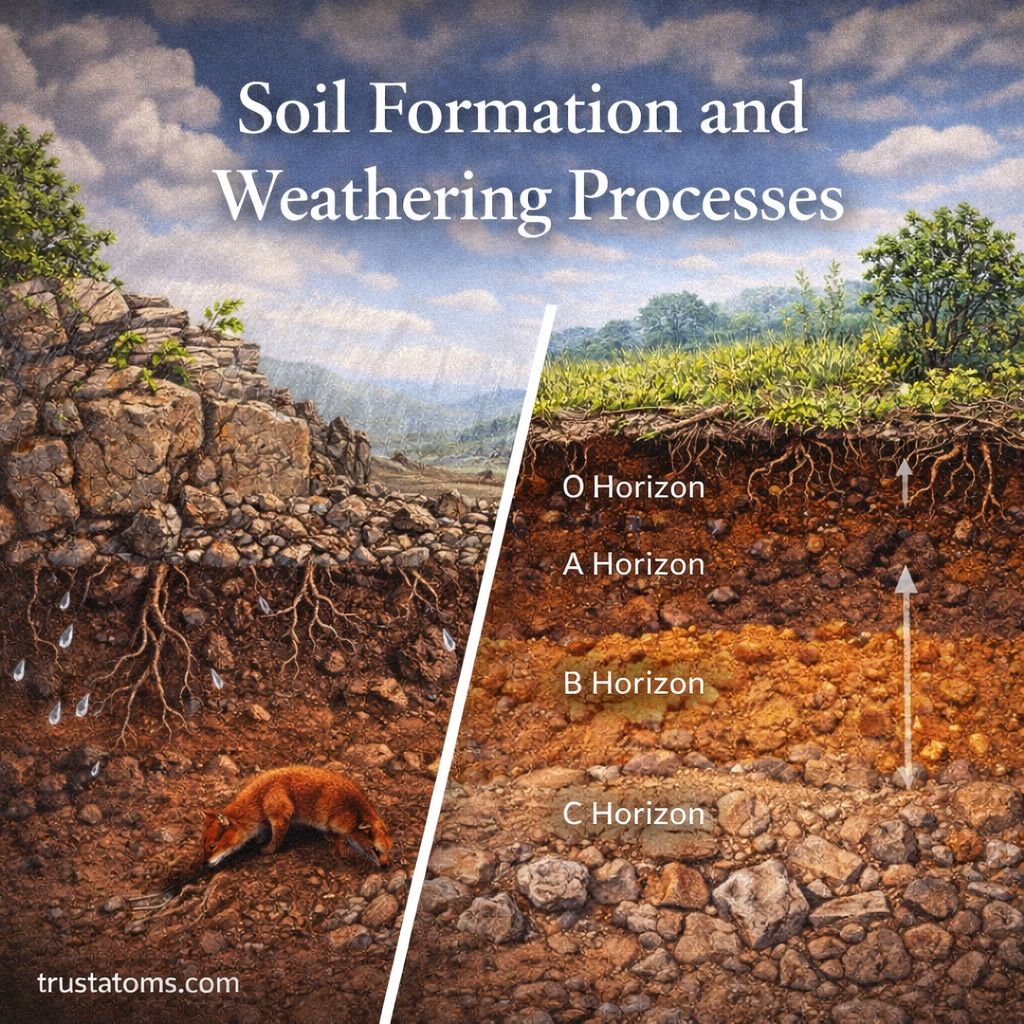
As soil develops, it forms distinct layers called horizons.
O Horizon
- Top layer rich in organic material (leaf litter, decomposed matter)
A Horizon (Topsoil)
- Dark, fertile layer
- Contains minerals mixed with organic matter
B Horizon (Subsoil)
- Accumulates minerals like clay and iron
- Less organic material than topsoil
C Horizon
- Partially weathered parent material
- Transition between soil and bedrock
R Horizon
- Solid bedrock beneath the soil
From Rock to Soil: The Formation Process
Soil formation follows a gradual sequence:
- Rock is exposed at Earth’s surface
- Weathering breaks it into smaller particles
- Organic matter begins to accumulate
- Water moves minerals through the soil
- Distinct soil layers develop over time
This process can take hundreds to thousands of years depending on conditions.
Why Soil Formation Matters
Soil is essential for life on Earth. It supports:
- Plant growth and agriculture
- Water filtration and storage
- Nutrient cycling in ecosystems
- Habitats for organisms
Healthy soils are critical for food production and environmental stability.
Key Takeaways
- Soil forms through the breakdown of rock and accumulation of organic matter
- Weathering includes physical, chemical, and biological processes
- Climate, organisms, topography, parent material, and time all influence soil formation
- Soil develops distinct layers called horizons
- Soil formation is slow but essential for ecosystems and human life
Final Thoughts
Soil formation and weathering processes are fundamental to Earth’s surface systems. These processes transform solid rock into a life-supporting resource that sustains ecosystems and human activity.
By understanding how soil forms and evolves, we gain insight into environmental health, land use, and the delicate balance that supports life on our planet.