The stomach plays a central role in digestion, acting as both a storage chamber and a powerful mixing organ. While it may seem like a simple sac, the stomach is a highly specialized structure designed to break down food mechanically and chemically before it enters the small intestine.
Understanding how the stomach is built—and how it mixes and processes food—reveals how the body efficiently prepares nutrients for absorption.
Overview of the Stomach
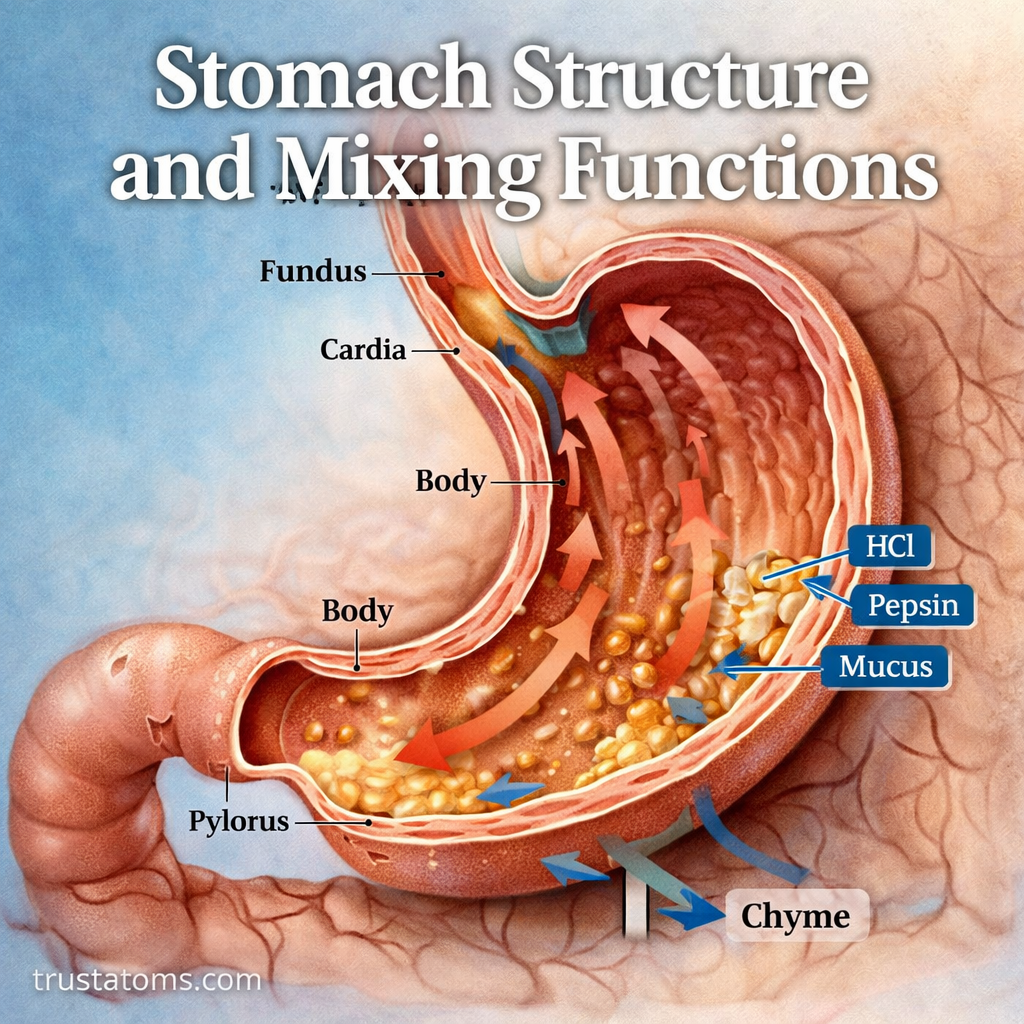
The stomach is a J-shaped muscular organ located in the upper abdomen, just below the diaphragm. It connects the esophagus to the small intestine.
Its primary functions include:
- Storing food after swallowing
- Mixing food with digestive juices
- Breaking food down into a semi-liquid form called chyme
- Regulating the release of food into the small intestine
Regions of the Stomach
The stomach is divided into several distinct regions, each with specific roles in digestion.
Cardia
- The entry point where the esophagus connects to the stomach
- Helps prevent backflow of stomach contents
Fundus
- The upper, dome-shaped portion
- Stores undigested food and gases released during digestion
Body (Corpus)
- The largest central region
- Responsible for most mixing and chemical digestion
Pylorus
- The lower section leading to the small intestine
- Controls the release of chyme through the pyloric sphincter
Layers of the Stomach Wall
The stomach wall is uniquely structured to support both strength and flexibility.
1. Mucosa (Inner Layer)
- Contains gastric glands that secrete:
- Hydrochloric acid (HCl)
- Digestive enzymes like pepsin
- Mucus to protect the lining
2. Submucosa
- Contains blood vessels, nerves, and connective tissue
- Supports the mucosa and regulates secretions
3. Muscularis
- Made up of three muscle layers:
- Longitudinal (outer)
- Circular (middle)
- Oblique (inner)
This extra oblique layer is unique to the stomach and allows for powerful churning movements.
4. Serosa (Outer Layer)
- A protective covering that reduces friction with surrounding organs
How the Stomach Mixes Food
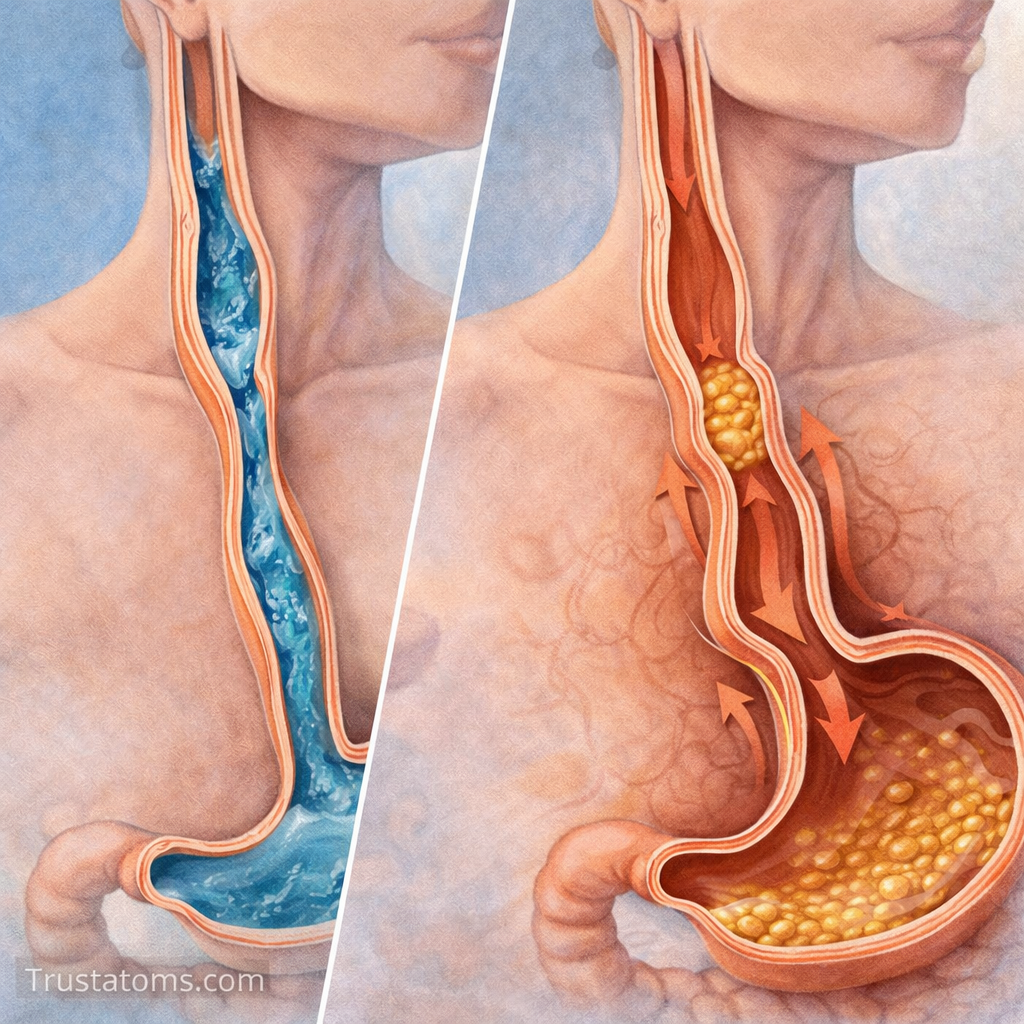
One of the stomach’s most important roles is mechanical digestion—physically breaking down food.
Mixing Movements
The stomach uses rhythmic contractions to:
- Crush food particles
- Blend food with gastric juices
- Turn solid food into chyme
These movements are often called mixing waves.
Step-by-Step Mixing Process
- Food enters the stomach and is stored in the fundus
- Strong contractions begin in the body of the stomach
- Food is pushed toward the pylorus
- The pyloric sphincter partially closes, causing food to be pushed back
- This back-and-forth motion thoroughly mixes the contents
This process ensures that food is evenly exposed to digestive enzymes.
Chemical Digestion in the Stomach
While mixing occurs, chemical digestion is happening simultaneously.
Key Components of Gastric Juice
- Hydrochloric acid (HCl)
- Creates an acidic environment (pH 1.5–3.5)
- Kills bacteria and denatures proteins
- Pepsin
- Breaks down proteins into smaller peptides
- Mucus
- Protects the stomach lining from acid damage
Formation of Chyme
As food is mixed and broken down, it becomes a thick, semi-liquid substance called chyme.
Characteristics of chyme:
- Smooth and partially digested
- Acidic in nature
- Ready for further digestion in the small intestine
The stomach does not release all chyme at once. Instead, it gradually empties it into the duodenum.
Regulation of Stomach Emptying
The release of chyme is carefully controlled to ensure efficient digestion.
Pyloric Sphincter Function
- Opens slightly to allow small amounts of chyme to pass
- Prevents overload of the small intestine
Factors That Influence Emptying
- Composition of food (fat slows emptying)
- Volume of stomach contents
- Hormonal signals (e.g., gastrin)
Why Stomach Mixing Is Important
Proper mixing in the stomach is essential for:
- Efficient breakdown of food
- Optimal enzyme activity
- Smooth transition to intestinal digestion
Without adequate mixing, digestion would be incomplete, and nutrient absorption would be less effective.
Common Issues Related to Stomach Function
Disruptions in stomach structure or function can lead to digestive problems.
Examples include:
- Gastritis (inflammation of the stomach lining)
- Ulcers (damage to the mucosa)
- Delayed gastric emptying (gastroparesis)
These conditions can interfere with normal mixing and digestion.
Key Takeaways
- The stomach is a muscular organ specialized for storage and mixing.
- It contains multiple regions, each with specific functions.
- Three muscle layers enable powerful churning movements.
- Mechanical and chemical digestion occur simultaneously.
- Chyme formation and controlled emptying are essential for efficient digestion.
Understanding the stomach’s structure and mixing functions highlights its critical role in preparing food for nutrient absorption.