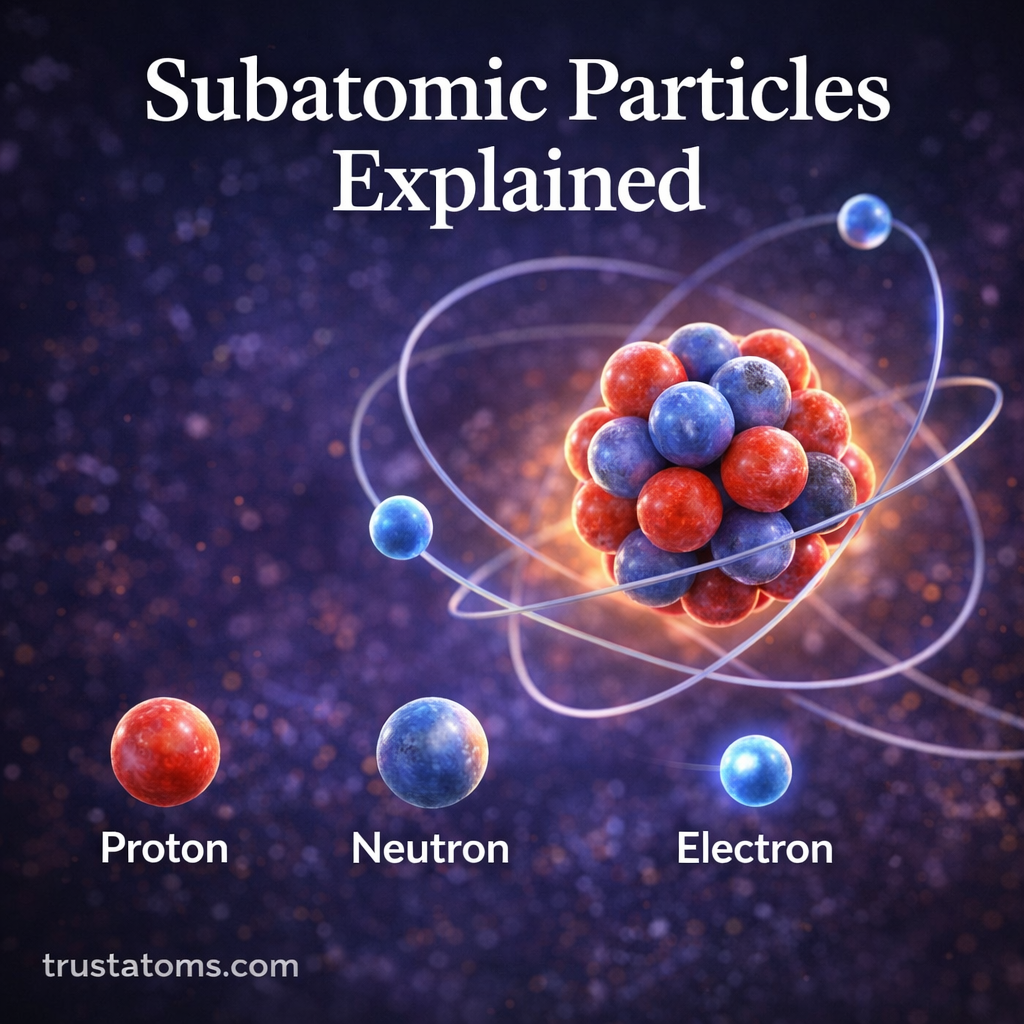
Everything in the universe—from the air we breathe to the stars in distant galaxies—is made of atoms. But atoms themselves are not the smallest units of matter. Inside every atom are even smaller components called subatomic particles.
Subatomic particles determine how atoms behave, how elements interact, and how chemical reactions occur. Understanding these particles is essential for studying chemistry, physics, and the structure of matter.
This guide explains the three main subatomic particles, their properties, and how they work together to form atoms.
What Are Subatomic Particles?
Subatomic particles are particles that exist inside an atom. These particles are smaller than atoms and make up the fundamental structure of matter.
The three primary subatomic particles found in atoms are:
- Protons
- Neutrons
- Electrons
Each particle has unique properties, including different charges, masses, and locations within the atom.
Together, they determine:
- The identity of elements
- Atomic mass
- Chemical behavior
- Electrical properties
The Three Main Subatomic Particles
Atoms contain three main types of subatomic particles. Each one plays a different role in atomic structure.
Protons
Protons are positively charged particles located in the nucleus of the atom.
Key characteristics of protons include:
- Positive electric charge
- Located in the atomic nucleus
- Significant mass compared to electrons
- Determine the atomic number of an element
The number of protons in an atom defines the element. For example:
- Hydrogen has 1 proton
- Carbon has 6 protons
- Oxygen has 8 protons
If the number of protons changes, the element becomes something entirely different.
Neutrons
Neutrons are neutral particles found in the nucleus alongside protons.
Their main characteristics include:
- No electrical charge
- Nearly the same mass as protons
- Help stabilize the atomic nucleus
- Influence the mass of the atom
Neutrons are important because they reduce the repulsion between positively charged protons in the nucleus.
Different numbers of neutrons create isotopes, which are different forms of the same element.
Electrons
Electrons are negatively charged particles that move in regions surrounding the nucleus.
Important properties of electrons include:
- Negative electric charge
- Extremely small mass
- Found in orbitals around the nucleus
- Responsible for chemical bonding
Electrons determine how atoms interact with each other, making them essential for chemical reactions and molecular formation.
Where Subatomic Particles Are Located
Subatomic particles occupy different parts of the atom.
Inside the Nucleus
The nucleus contains:
- Protons
- Neutrons
The nucleus is extremely small but contains most of the atom’s mass.
Surrounding the Nucleus
Electrons occupy regions around the nucleus called electron clouds or orbitals.
These orbitals represent areas where electrons are most likely to be found rather than fixed circular paths.
Comparing Subatomic Particles
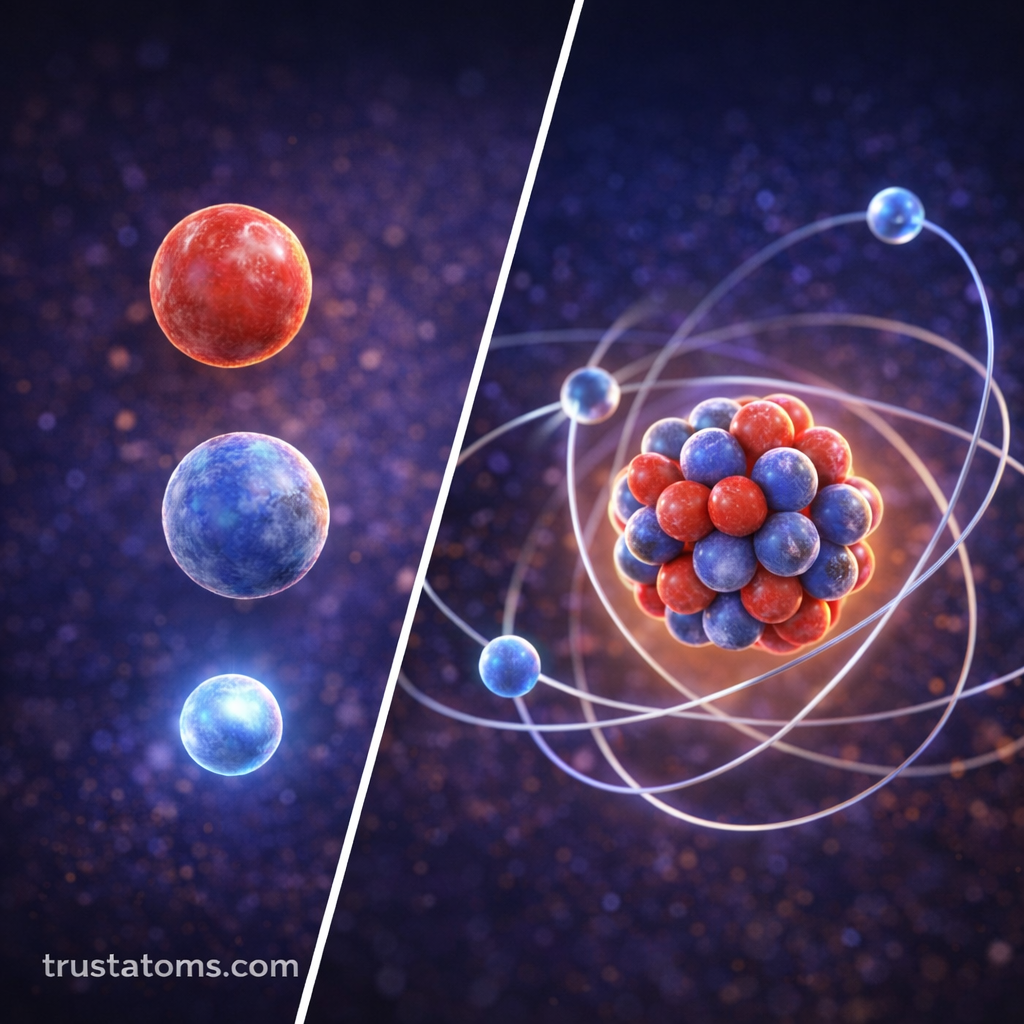
Although all three particles are part of atoms, they differ in charge, mass, and location.
Charge
- Proton → positive charge
- Neutron → neutral (no charge)
- Electron → negative charge
Location
- Protons → nucleus
- Neutrons → nucleus
- Electrons → electron orbitals around the nucleus
Relative Mass
- Protons and neutrons have similar mass
- Electrons are much lighter
Because electrons are so light, almost all of an atom’s mass comes from protons and neutrons.
How Subatomic Particles Work Together
The interactions between subatomic particles create the structure and behavior of atoms.
Electrical Balance
Atoms usually contain equal numbers of protons and electrons. This balance keeps the atom electrically neutral.
If electrons are gained or lost, the atom becomes an ion, which carries an electrical charge.
Nuclear Stability
Neutrons help maintain stability in the nucleus by reducing repulsion between positively charged protons.
Without neutrons, many atomic nuclei would not remain stable.
Chemical Behavior
Electrons determine how atoms bond with other atoms.
The arrangement of electrons in the outer energy levels influences:
- Chemical reactions
- Bond formation
- Molecular structure
Subatomic Particles and the Periodic Table
The periodic table organizes elements based on their atomic number, which corresponds to the number of protons in the nucleus.
From this number, scientists can determine:
- The element’s identity
- The typical number of electrons
- The element’s chemical behavior
Neutron numbers can vary within the same element, creating isotopes, but the number of protons always remains constant for a specific element.
Why Subatomic Particles Matter in Science
Understanding subatomic particles is essential for many scientific fields.
Chemistry
Chemists study electrons and protons to understand chemical reactions and bonding.
Physics
Physicists examine subatomic particles to understand the fundamental structure of matter and energy.
Medicine
Subatomic particles are used in medical imaging, radiation therapy, and nuclear medicine.
Technology
Electrons power modern electronics, including computers, phones, and electrical systems.
Key Takeaways
Subatomic particles are the tiny components that make up atoms and determine how matter behaves.
Important points to remember:
- Atoms contain three main subatomic particles: protons, neutrons, and electrons
- Protons and neutrons are located in the atomic nucleus
- Electrons move in orbitals around the nucleus
- Protons determine the identity of an element
- Neutrons contribute to atomic stability and isotopes
- Electrons control chemical reactions and bonding
By studying subatomic particles, scientists gain insight into the fundamental structure of matter and the forces that shape the universe.