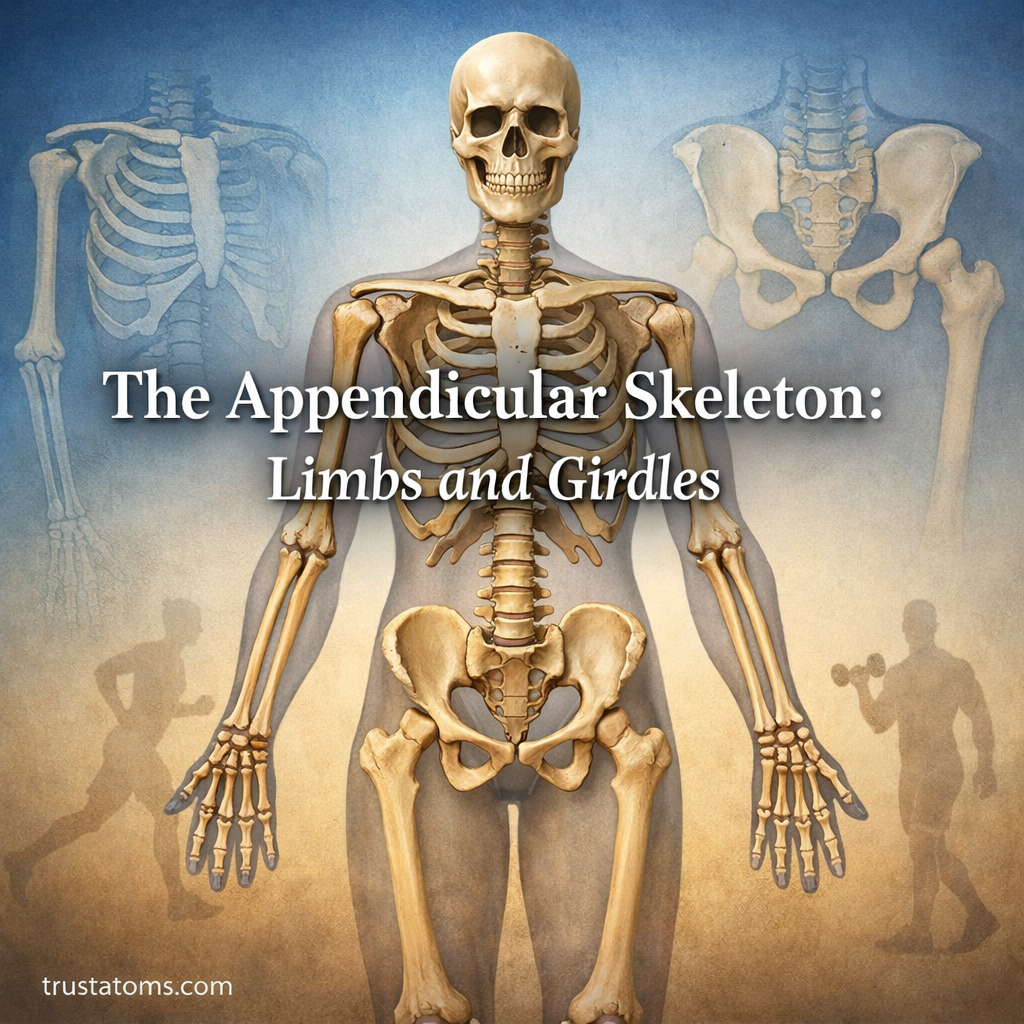
The appendicular skeleton is the part of the human skeletal system that enables movement, interaction with the environment, and physical activity. While the axial skeleton forms the body’s central structure, the appendicular skeleton includes the limbs and the girdles that attach them to the core.
Understanding how the appendicular skeleton works helps explain how we walk, lift, run, and perform everyday tasks.
What Is the Appendicular Skeleton?
The appendicular skeleton consists of 126 bones that make up the upper and lower limbs, along with the structures that connect them to the torso.
Main Components
- Upper limbs (arms)
- Lower limbs (legs)
- Pectoral girdle (shoulder region)
- Pelvic girdle (hip region)
Core Functions
- Enables movement and mobility
- Provides leverage for muscles
- Allows manipulation of objects
- Supports body weight (especially in the lower limbs)
The Pectoral Girdle (Shoulder Region)
The pectoral girdle connects the upper limbs to the axial skeleton and allows a wide range of motion in the arms.
Bones of the Pectoral Girdle
- Clavicle (collarbone)
- Scapula (shoulder blade)
Key Features
- Lightweight and flexible structure
- Not as tightly attached to the axial skeleton as the pelvis
- Allows extensive arm mobility (lifting, rotating, reaching)
Why It Matters
The flexibility of the shoulder joint enables complex movements like throwing, pushing, and pulling. However, this mobility comes at the cost of stability, making the shoulder more prone to dislocations.
The Upper Limbs (Arms and Hands)
The upper limbs are designed for precision and versatility, allowing humans to perform detailed tasks.
Bones of the Upper Limb
- Humerus (upper arm)
- Radius (forearm, thumb side)
- Ulna (forearm, pinky side)
- Carpals (wrist bones)
- Metacarpals (palm bones)
- Phalanges (finger bones)
Functional Advantages
- Highly mobile joints (especially the shoulder and wrist)
- Ability to rotate the forearm (pronation and supination)
- Fine motor control in the fingers
Everyday Examples
- Typing on a keyboard
- Writing with a pen
- Gripping and lifting objects
The Pelvic Girdle (Hip Region)
The pelvic girdle connects the lower limbs to the axial skeleton and provides a strong, stable base for movement.
Bones of the Pelvic Girdle
- Two hip bones (coxal bones), each made of:
- Ilium
- Ischium
- Pubis
Key Features
- Strong and weight-bearing structure
- Firmly attached to the spine
- Forms a protective basin for internal organs
Why It Matters
Unlike the shoulder, the pelvis prioritizes stability over mobility, supporting the body’s weight during standing, walking, and running.
The Lower Limbs (Legs and Feet)
The lower limbs are built for support, balance, and locomotion.
Bones of the Lower Limb
- Femur (thigh bone – the longest bone in the body)
- Patella (kneecap)
- Tibia (shinbone, weight-bearing)
- Fibula (supports stability)
- Tarsals (ankle bones)
- Metatarsals (foot bones)
- Phalanges (toe bones)
Functional Advantages
- Strong joints for weight-bearing
- Shock absorption during walking and running
- Balance and posture control
Everyday Examples
- Walking and running
- Jumping
- Standing for extended periods
How the Appendicular Skeleton Enables Movement

Movement occurs through the interaction of bones, joints, and muscles.
Key Mechanisms
- Joints act as pivot points
- Muscles pull on bones via tendons
- Bones act as levers to amplify force and motion
Types of Joints in the Appendicular Skeleton
- Ball-and-socket joints (shoulder, hip) – allow rotation and multi-directional movement
- Hinge joints (elbow, knee) – allow bending and straightening
- Pivot joints (forearm) – allow rotation
This coordinated system allows everything from powerful movements like sprinting to delicate actions like buttoning a shirt.
Upper vs Lower Limbs: Key Differences
Although both sets of limbs are part of the appendicular skeleton, they serve different purposes.
Upper Limbs
- Focus on flexibility and precision
- Greater range of motion
- Less weight-bearing
Lower Limbs
- Focus on strength and stability
- Built for weight support
- More limited range of motion
Common Injuries and Conditions
Because the appendicular skeleton is heavily involved in movement, it is also prone to injuries.
Common Issues
- Fractures (broken bones)
- Dislocations (especially in the shoulder)
- Sprains and ligament injuries
- Arthritis in joints (knees, hips, hands)
Why Injuries Occur
- Repetitive stress
- High-impact activities
- Poor posture or biomechanics
- Aging and wear over time
Why the Appendicular Skeleton Is Essential
Without the appendicular skeleton, the body would not be able to move or interact with the environment effectively.
Key Takeaways
- It includes 126 bones in the limbs and girdles
- The pectoral girdle allows mobility for the arms
- The pelvic girdle provides stability for the legs
- Upper limbs specialize in precision, while lower limbs focus on strength
- Movement is made possible through joints, muscles, and bone leverage
The appendicular skeleton works together with the axial skeleton to create a complete system that supports both structure and motion.
Final Thoughts
The appendicular skeleton is what turns the human body into a dynamic, functional system capable of movement, balance, and coordination. From simple daily activities to complex athletic performance, every motion depends on the seamless interaction of limbs and girdles.
By understanding how these components work together, it becomes easier to appreciate the design of the human body and the importance of maintaining bone and joint health.