The thyroid axis is one of the most important hormonal systems in the human body, responsible for regulating metabolism, energy production, and overall physiological balance. Also known as the hypothalamic-pituitary-thyroid (HPT) axis, this system coordinates communication between the brain and the thyroid gland to maintain stable hormone levels.
Understanding how this axis works helps explain how the body controls energy use, body temperature, and even heart rate.
What Is the Thyroid Axis?
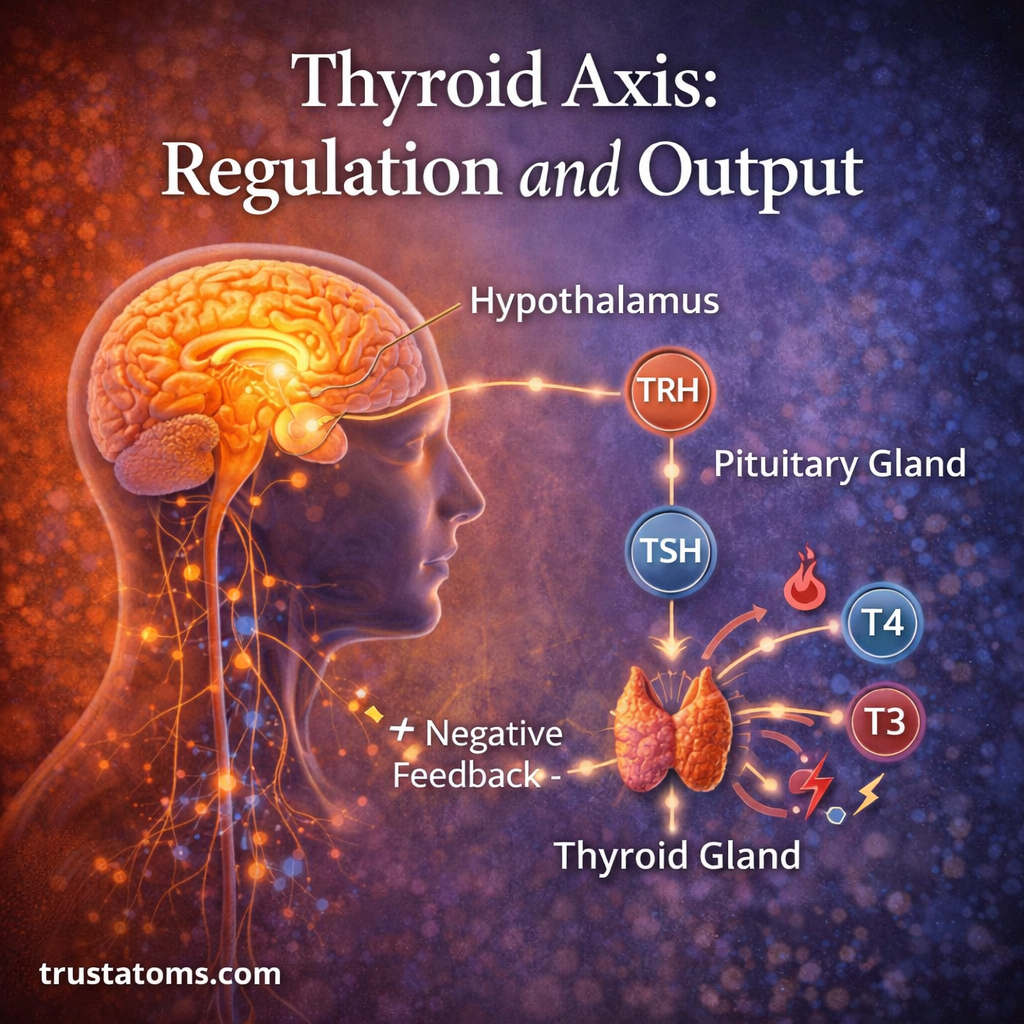
The thyroid axis is a feedback loop involving three key components:
- Hypothalamus
- Pituitary gland
- Thyroid gland
Together, these structures regulate the production and release of thyroid hormones.
Primary Hormones Involved
- Thyrotropin-releasing hormone (TRH)
- Thyroid-stimulating hormone (TSH)
- Thyroxine (T4)
- Triiodothyronine (T3)
These hormones work in sequence to control metabolism throughout the body.
Step-by-Step Regulation of the Thyroid Axis
The thyroid axis operates through a clear signaling pathway.
Step 1: Hypothalamus Initiates the Process
- Detects low levels of thyroid hormones
- Releases TRH
TRH travels to the pituitary gland to stimulate the next step.
Step 2: Pituitary Gland Responds
- Receives TRH from the hypothalamus
- Releases TSH into the bloodstream
TSH acts directly on the thyroid gland.
Step 3: Thyroid Gland Produces Hormones
- Stimulated by TSH
- Produces T4 (inactive form)
- Produces T3 (active form)
Most hormone released is T4, which is later converted into T3 in tissues.
Step 4: Hormones Affect Target Cells
T3 and T4 regulate:
- Metabolic rate
- Oxygen consumption
- Heat production
- Heart rate
- Growth and development
These effects are widespread across nearly all body systems.
Negative Feedback Mechanism
The thyroid axis is tightly controlled by negative feedback.
How Feedback Works
- High levels of T3 and T4 inhibit:
- Hypothalamus (reduces TRH)
- Pituitary gland (reduces TSH)
- Low levels of T3 and T4 stimulate:
- Increased TRH and TSH production
This loop ensures hormone levels remain stable.
T3 vs T4: Understanding Thyroid Output
Although both hormones are essential, they serve different roles.
Thyroxine (T4)
- Produced in larger amounts
- Considered a prohormone (inactive form)
- Converted into T3 in tissues
Triiodothyronine (T3)
- More biologically active
- Binds to receptors in cells
- Directly influences metabolism
Why Conversion Matters
The body regulates thyroid activity not just by hormone release, but also by how much T4 is converted into T3.
Functions of Thyroid Hormones
Thyroid hormones affect nearly every system in the body.
Key Functions
- Increase metabolic rate
- Regulate body temperature
- Support brain development
- Control heart function
- Influence digestion
- Maintain energy levels
Factors That Influence the Thyroid Axis

Several internal and external factors can affect thyroid regulation.
Common Influences
- Iodine intake: Essential for hormone production
- Stress: Can alter hypothalamic signaling
- Illness: May suppress thyroid function
- Medications: Can impact hormone levels
- Age: Hormone production may decline over time
Disorders of the Thyroid Axis
Disruptions in the thyroid axis can lead to metabolic imbalances.
Hypothyroidism (Underactive Thyroid)
- Low T3 and T4 levels
- High TSH (in many cases)
Symptoms:
- Fatigue
- Weight gain
- Cold sensitivity
- Slow heart rate
Hyperthyroidism (Overactive Thyroid)
- High T3 and T4 levels
- Low TSH
Symptoms:
- Weight loss
- Rapid heartbeat
- Heat intolerance
- Anxiety
Thyroid Axis Imbalance Causes
- Autoimmune conditions (e.g., Hashimoto’s, Graves’ disease)
- Pituitary dysfunction
- Iodine deficiency or excess
Clinical Importance of TSH
TSH is commonly used as a primary marker for thyroid function.
Why TSH Matters
- Sensitive to small changes in hormone levels
- Reflects overall axis activity
- Helps diagnose thyroid disorders
Doctors often measure TSH alongside T3 and T4 for a complete picture.
Key Takeaways
- The thyroid axis is a three-part system: hypothalamus, pituitary, and thyroid
- TRH, TSH, T3, and T4 regulate hormone production
- Negative feedback maintains hormonal balance
- T3 is the active hormone; T4 is a precursor
- Thyroid hormones control metabolism and energy use
- Disruptions can lead to hypo- or hyperthyroidism
Final Thoughts
The thyroid axis is essential for maintaining metabolic stability and overall health. Through precise regulation and feedback, this system ensures that the body adapts to changing energy demands while keeping internal conditions balanced.
When this system functions properly, it supports everything from energy levels to organ function. When disrupted, it highlights just how critical hormonal balance is to human physiology.