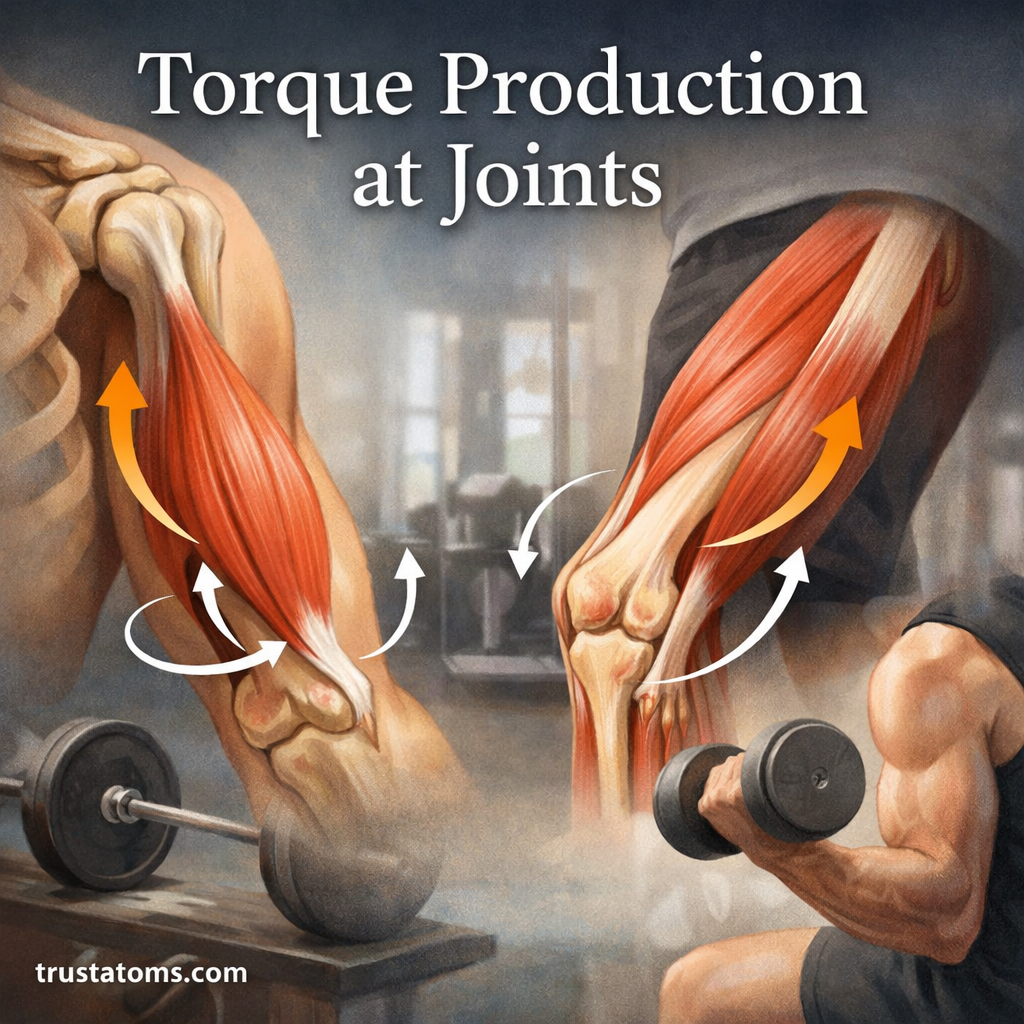
Torque production at joints is a fundamental concept in human movement, explaining how muscles generate rotational force to move bones around joints. Whether you’re lifting a weight, walking up stairs, or throwing a ball, torque is the key mechanical principle that allows your body to create motion.
Understanding how torque works in the body helps explain strength, efficiency, injury risk, and performance in both everyday activities and athletic movements.
What Is Torque in Human Anatomy?
In biomechanics, torque refers to the rotational force applied around a joint. It determines how effectively a muscle can cause a bone to rotate.
Torque depends on three main factors:
- Force: The amount of pull generated by a muscle
- Moment arm: The distance between the joint axis and the line of force
- Angle of force application: The direction the force is applied relative to the bone
In simple terms:
- More force = more torque
- Longer moment arm = more torque
- Optimal angle = more efficient torque production
How Muscles Produce Torque
Muscles create torque by pulling on bones via tendons. Since joints act as pivot points, this pulling force creates rotation.
Step-by-Step Process
- A muscle contracts and shortens
- The tendon transmits force to the bone
- The bone rotates around the joint
- Movement occurs
For example:
- The biceps brachii produces torque at the elbow joint to flex the arm
- The quadriceps generate torque at the knee to extend the leg
The Role of the Moment Arm
The moment arm is one of the most important factors in torque production.
What Is a Moment Arm?
It is the perpendicular distance between:
- The joint axis (pivot point)
- The line of action of the muscle force
Why It Matters
- A longer moment arm allows a muscle to produce more torque with the same force
- A shorter moment arm requires more force to produce the same torque
Real-World Example
At the elbow:
- When your forearm is at about 90 degrees, the biceps has its largest moment arm
- This is why lifting feels easiest at mid-range and harder near full extension or full flexion
Joint Angle and Torque Production
Torque production is not constant throughout a movement. It changes depending on joint angle.
Length-Tension Relationship
Muscles generate different levels of force depending on their length:
- Too stretched → less force
- Too shortened → less force
- Optimal length → maximum force
Combined Effect
Torque is highest when:
- The muscle is at an optimal length
- The moment arm is largest
- The angle of pull is efficient
This is why strength varies across a range of motion.
Internal vs External Torque
Understanding torque at joints involves both internal and external forces.
Internal Torque
- Generated by muscles, tendons, and ligaments
- Responsible for producing movement
External Torque
- Comes from outside forces such as gravity or resistance
- Opposes or assists movement
Example
During a bicep curl:
- Internal torque: produced by the biceps
- External torque: created by the weight and gravity pulling the arm downward
Movement occurs when internal torque exceeds external torque.
Types of Muscle Contractions and Torque
Different types of muscle contractions influence how torque is produced.
Concentric Contraction
- Muscle shortens
- Produces torque to create movement
- Example: lifting a dumbbell
Eccentric Contraction
- Muscle lengthens under tension
- Produces torque to control or resist movement
- Example: lowering a dumbbell
Isometric Contraction
- Muscle length remains constant
- Produces torque without visible movement
- Example: holding a weight steady
Factors That Affect Torque Production
Several anatomical and mechanical factors influence how much torque a joint can produce:
1. Muscle Size (Cross-Sectional Area)
- Larger muscles generate more force
- More force leads to greater torque
2. Lever System of the Body
- Bones act as levers
- Most joints function as third-class levers, favoring speed over force
3. Tendon Insertion Point
- A tendon inserted farther from the joint increases the moment arm
- This improves torque but may reduce speed
4. Neural Activation
- The nervous system controls how many muscle fibers are recruited
- More recruitment = greater force and torque
5. Fatigue
- Reduces force output
- Leads to decreased torque production over time
Torque in Everyday Movements
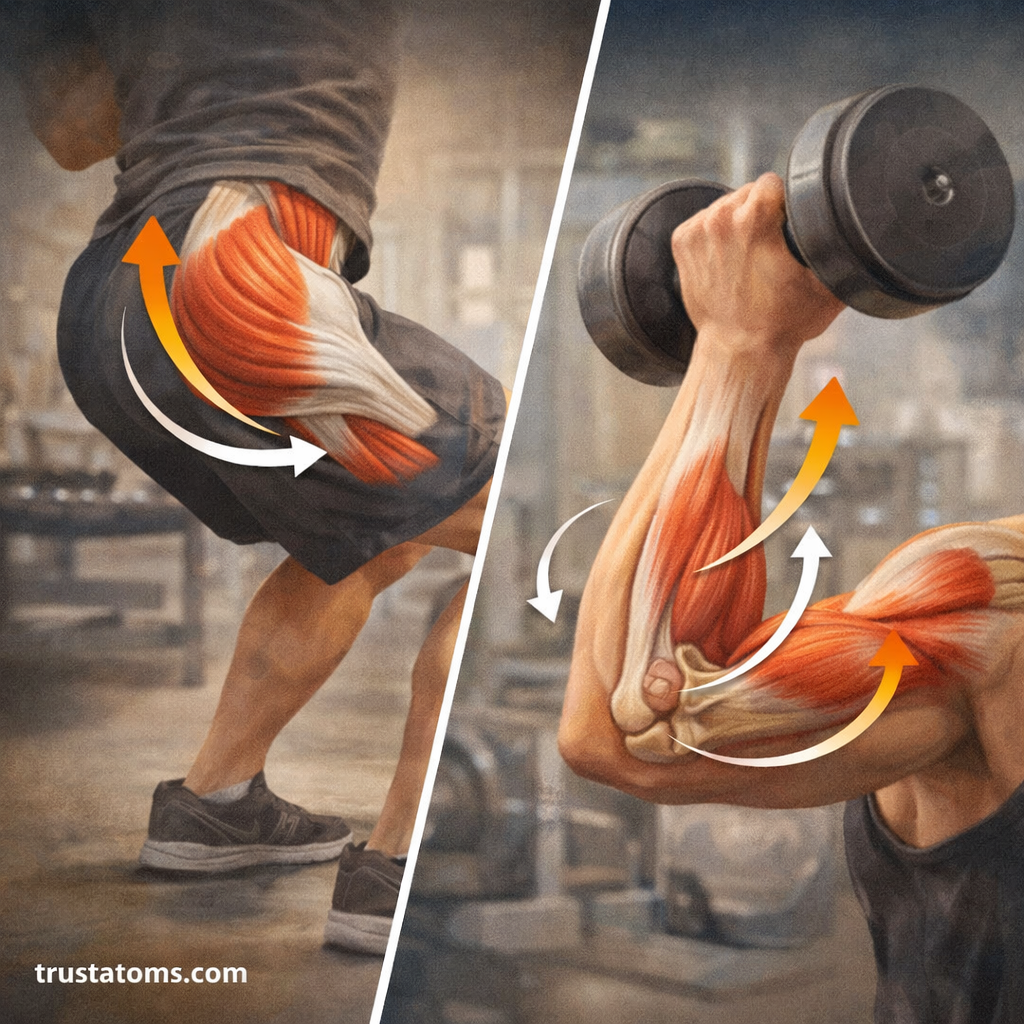
Torque production is involved in nearly every movement you perform.
Common Examples
- Standing up from a chair: Knee and hip torque extend the body
- Walking or running: Alternating torque at hip, knee, and ankle joints
- Lifting objects: Torque at the elbow, shoulder, and spine
- Jumping: Powerful torque generation in the lower body
Efficient torque production allows for smoother, stronger, and safer movements.
Torque and Injury Risk
Improper torque production can increase the risk of injury.
Common Issues
- Excess external torque: Overloads joints (e.g., lifting too heavy)
- Weak internal torque: Muscles cannot stabilize joints
- Poor joint alignment: Leads to uneven force distribution
Injury Examples
- Knee injuries from poor torque control during landing
- Shoulder strain from excessive rotational force
- Lower back injuries from improper lifting mechanics
Improving Torque Production
Enhancing torque production can improve both performance and injury prevention.
Practical Strategies
- Strength training: Increases muscle force capacity
- Full range of motion exercises: Improves torque across all angles
- Technique refinement: Optimizes moment arms and joint alignment
- Core stability training: Supports efficient force transfer
- Progressive overload: Gradually increases torque demands
Final Thoughts
Torque production at joints is the foundation of all human movement. It explains how muscles generate rotational force, how strength varies across joint angles, and why proper mechanics are essential for performance and safety.
By understanding torque, you gain deeper insight into how the body moves, adapts, and responds to physical demands—whether in daily life, exercise, or athletic performance.