Tsunamis are among the most powerful and destructive natural events on Earth. Unlike regular ocean waves caused by wind, tsunamis are triggered by sudden movements of the seafloor, displacing massive amounts of water in a short time.
Understanding how tsunamis form—and how seafloor movement drives them—helps explain why these waves can travel across entire oceans and cause devastating coastal impacts.
What Is a Tsunami?
A tsunami is a series of long-wavelength ocean waves caused by a sudden displacement of water. This displacement typically occurs due to geological activity beneath the ocean.
Key characteristics of tsunamis include:
- Extremely long wavelengths (often over 100 km)
- High speeds (up to 500–800 km/h in deep water)
- Low wave height in the open ocean (often less than 1 meter)
- Dramatic increase in height near coastlines
The Role of Seafloor Movement
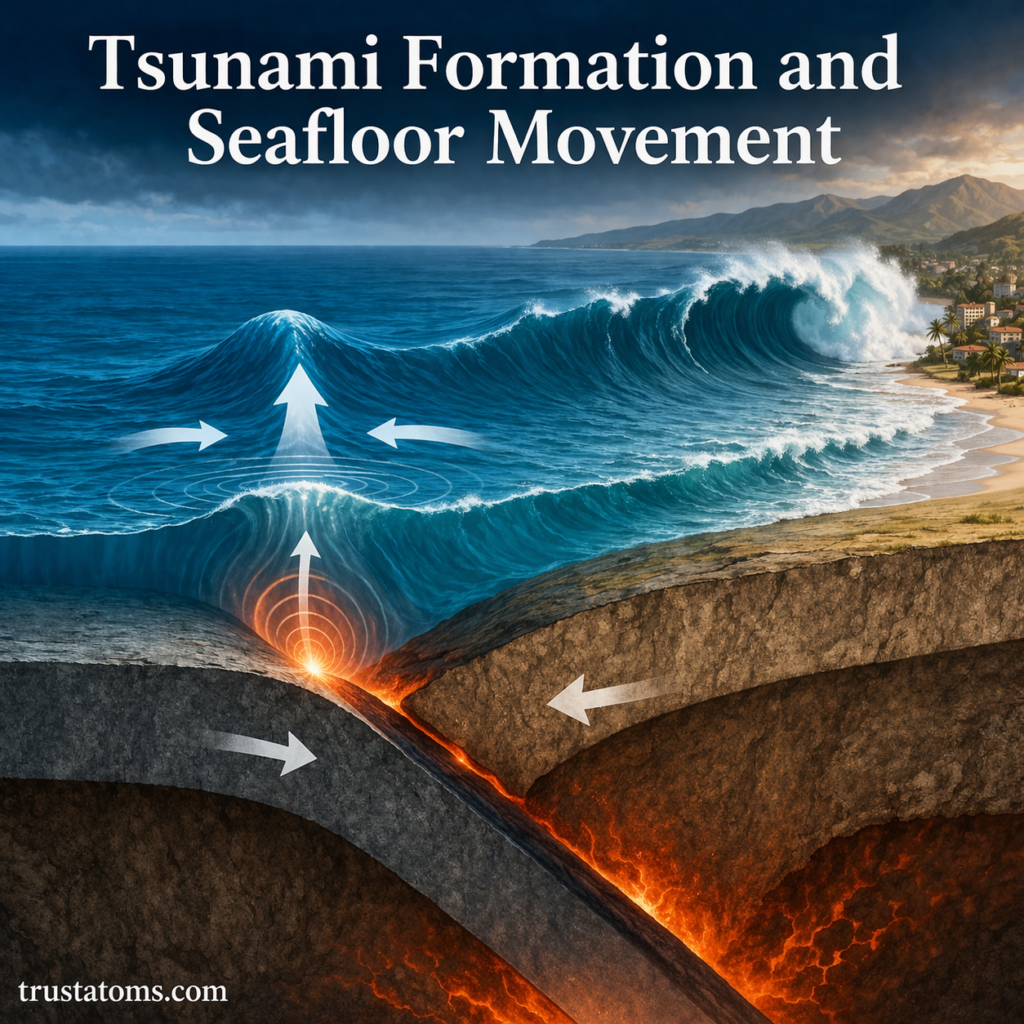
The primary cause of most tsunamis is vertical movement of the seafloor. This movement is usually associated with tectonic plate boundaries.
How It Happens
- Stress builds up between tectonic plates.
- Plates suddenly slip during an underwater earthquake.
- The seafloor either rises or falls abruptly.
- Water above the seafloor is displaced upward or downward.
- This displacement generates waves that radiate outward in all directions.
Even a few meters of vertical displacement across a large area can move billions of tons of water.
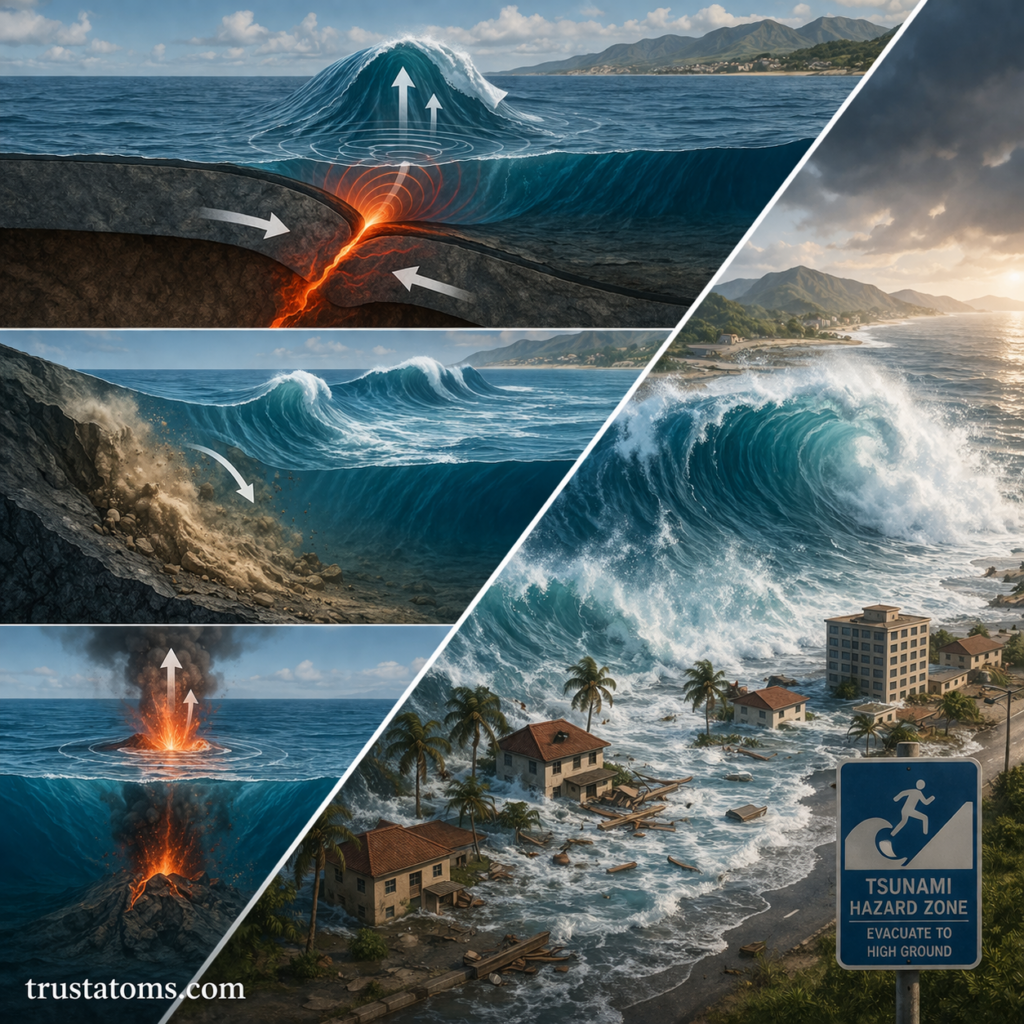
Types of Seafloor Movements That Cause Tsunamis
Subduction Zone Earthquakes
The most common cause of tsunamis occurs at subduction zones, where one tectonic plate is forced beneath another.
- The overriding plate can become “locked”
- Pressure builds over time
- When released, the seafloor snaps upward or downward
This sudden shift displaces the ocean above it, creating a tsunami.
Underwater Landslides
Seafloor sediments can collapse due to earthquakes or instability.
- Large volumes of material slide down slopes
- Water is pushed aside rapidly
- Can create localized but powerful tsunamis
Volcanic Activity
Volcanoes can trigger tsunamis through:
- Explosive eruptions
- Collapse of volcanic islands
- Movement of magma beneath the ocean floor
Meteor Impacts (Rare)
A large object striking the ocean can displace water instantly, producing massive waves.
How Tsunami Waves Travel
Once generated, tsunami waves behave differently from normal waves.
In Deep Ocean
- Waves spread outward in all directions
- Travel at very high speeds
- Low amplitude (barely noticeable to ships)
As Waves Approach Shore
- Water depth decreases
- Wave speed slows down
- Wave height increases dramatically (shoaling effect)
This is why tsunamis can appear suddenly as towering walls of water near coastlines.
The Shoaling Effect Explained
Shoaling occurs when tsunami waves move from deep to shallow water.
- The bottom of the wave drags along the seafloor
- Energy compresses into a smaller vertical space
- Wave height increases significantly
This process can transform a barely noticeable wave into one that reaches heights of 10–30 meters or more.
Why Tsunamis Come in Series
Tsunamis are not a single wave but a series of waves.
- The first wave is not always the largest
- Waves can arrive minutes to hours apart
- Dangerous conditions may last for several hours
This makes it critical for coastal areas to remain alert even after the initial wave passes.
Warning Signs of a Tsunami
Natural warning signs often occur before a tsunami arrives:
- Strong or long-lasting earthquake near the coast
- Sudden retreat of ocean water (exposing the seafloor)
- Unusual roaring sound from the ocean
If any of these occur, immediate evacuation to higher ground is essential.
Real-World Examples
2004 Indian Ocean Tsunami
- Triggered by a massive undersea earthquake
- Caused widespread devastation across multiple countries
- Resulted in over 200,000 fatalities
2011 Japan Tsunami
- Caused by a powerful subduction zone earthquake
- Led to significant loss of life and infrastructure damage
- Triggered a nuclear crisis at Fukushima
These events highlight the importance of understanding tsunami formation and improving early warning systems.
How Scientists Monitor Tsunamis
Modern technology plays a key role in detecting and predicting tsunamis.
Monitoring Systems Include:
- Seismic sensors to detect underwater earthquakes
- Deep-ocean buoys (DART systems) that measure pressure changes
- Tide gauges along coastlines
- Satellite data for wave tracking
These systems allow authorities to issue warnings and reduce potential loss of life.
Key Takeaways
- Tsunamis are caused by sudden displacement of water, usually from seafloor movement
- Underwater earthquakes at subduction zones are the most common trigger
- Waves travel quickly across oceans but grow in height near coastlines
- Tsunamis occur in multiple waves, not just one
- Early detection and awareness are critical for safety
Final Thoughts
Tsunami formation is a powerful reminder of how dynamic Earth’s interior can be. A sudden shift in the seafloor can send energy across entire oceans, impacting coastlines thousands of miles away.
By understanding the connection between tectonic activity and ocean behavior, scientists and communities can better prepare for these rare but devastating events.