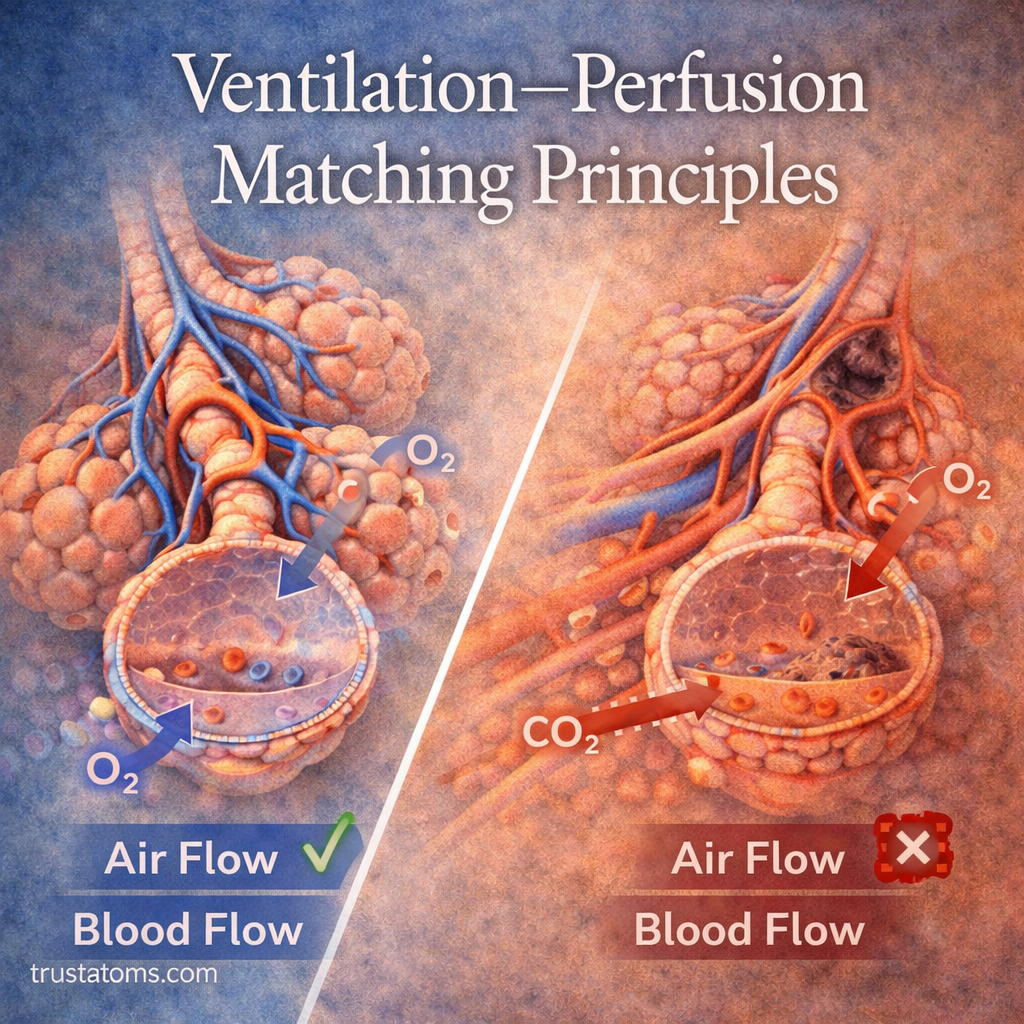
Ventilation–perfusion (V/Q) matching is a key principle of respiratory physiology that ensures oxygen enters the blood efficiently and carbon dioxide is removed effectively. It refers to the balance between airflow reaching the alveoli (ventilation) and blood flow reaching the lungs (perfusion).
When ventilation and perfusion are properly matched, gas exchange is optimized. When they are not, breathing becomes less efficient—even if the lungs themselves appear structurally normal.
What Is Ventilation?
Ventilation is the movement of air into and out of the lungs.
It involves:
- Inhalation (bringing oxygen into the lungs)
- Exhalation (removing carbon dioxide)
Ventilation ensures that fresh air reaches the alveoli, where gas exchange occurs.
What Is Perfusion?
Perfusion refers to the flow of blood through the pulmonary capillaries surrounding the alveoli.
It allows:
- Oxygen to enter the bloodstream
- Carbon dioxide to be carried away for removal
Without adequate perfusion, even well-ventilated alveoli cannot effectively exchange gases.
What Is Ventilation–Perfusion (V/Q) Matching?
V/Q matching describes how well ventilation and perfusion are aligned in different regions of the lungs.
Key Concept:
- Ideal condition: ventilation and perfusion are balanced
- Result: maximum gas exchange efficiency
The V/Q ratio is often used to describe this relationship:
- Normal average V/Q ratio ≈ 0.8
This means that perfusion is slightly greater than ventilation under normal conditions.
Why V/Q Matching Is Important
Efficient gas exchange depends on both air and blood being present in the same place at the same time.
When V/Q matching is optimal:
- Oxygen levels in the blood increase
- Carbon dioxide is effectively removed
- Breathing remains efficient
When mismatched:
- Oxygen delivery decreases
- Carbon dioxide removal may be impaired
- Symptoms like shortness of breath can occur
Regional Differences in the Lungs
V/Q ratios are not the same throughout the lungs due to gravity and lung structure.
Top of the Lungs (Apex)
- Lower blood flow
- Relatively higher ventilation
- High V/Q ratio
Bottom of the Lungs (Base)
- Higher blood flow
- Relatively lower ventilation
- Low V/Q ratio
Despite these differences, the body maintains an overall balance for effective gas exchange.
Types of V/Q Mismatch
There are two main types of ventilation–perfusion mismatch.
1. Low V/Q Ratio (Perfusion > Ventilation)
- Blood flow is adequate, but airflow is reduced
- Oxygen levels in blood decrease
Common causes:
- Airway obstruction
- Asthma
- Chronic bronchitis
2. High V/Q Ratio (Ventilation > Perfusion)
- Air reaches alveoli, but blood flow is limited
- Oxygen cannot be efficiently transferred
Common causes:
- Pulmonary embolism
- Reduced blood flow to parts of the lung
Shunt vs Dead Space
Two important extremes of V/Q mismatch are shunt and dead space.
Shunt (V/Q ≈ 0)
- No ventilation, but perfusion is present
- Blood passes through lungs without oxygenation
Examples:
- Collapsed alveoli
- Fluid-filled alveoli
Dead Space (V/Q → ∞)
- Ventilation occurs, but no perfusion
- Air does not participate in gas exchange
Examples:
- Blocked blood flow
- Pulmonary embolism
How the Body Adjusts V/Q Matching
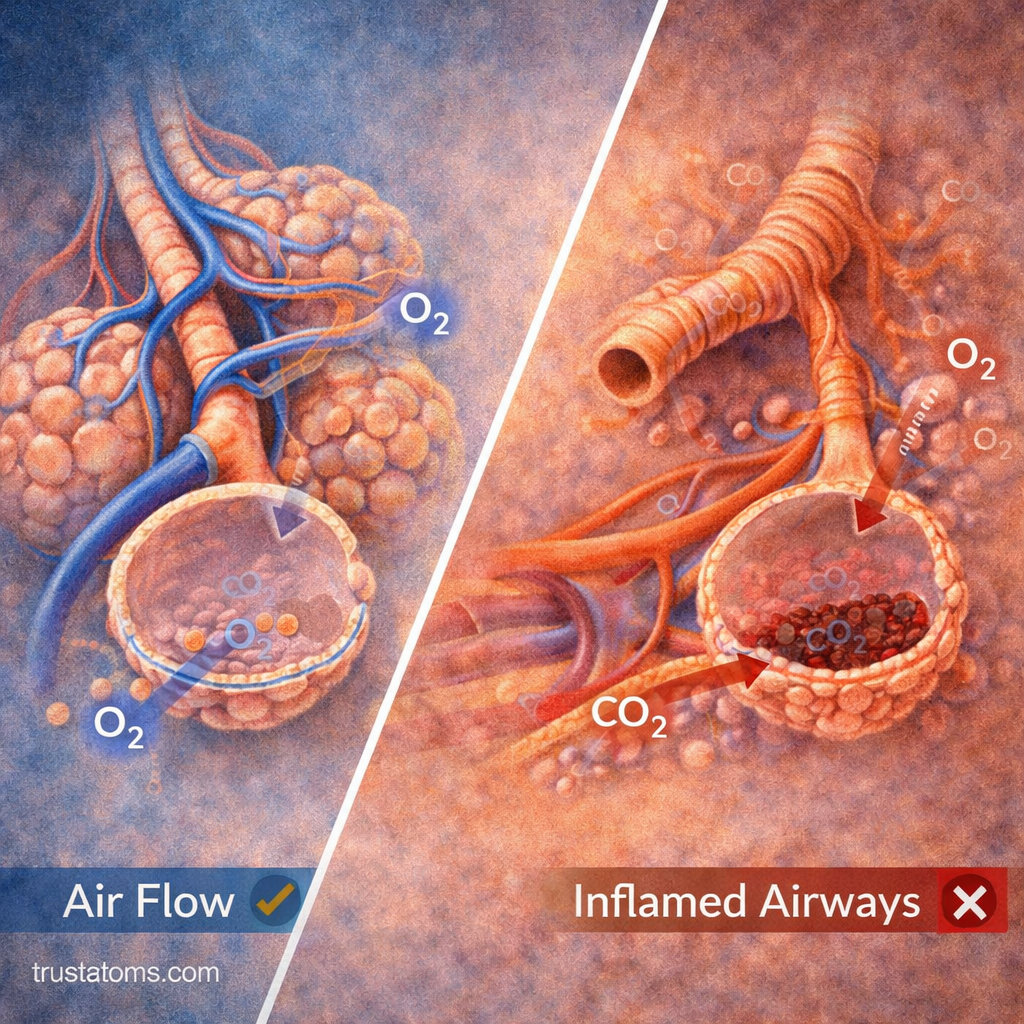
The body has mechanisms to improve V/Q balance.
Hypoxic Vasoconstriction
- Low oxygen levels in alveoli cause nearby blood vessels to constrict
- Redirects blood to better-ventilated areas
Bronchoconstriction and Dilation
- Airways adjust to direct airflow where it is most effective
These adjustments help maintain efficient gas exchange even under changing conditions.
Conditions That Affect V/Q Matching
Several medical conditions disrupt the balance between ventilation and perfusion.
1. Asthma
- Airway narrowing reduces ventilation
- Leads to low V/Q regions
2. Chronic Obstructive Pulmonary Disease (COPD)
- Combines airflow limitation and tissue damage
- Causes both high and low V/Q mismatches
3. Pulmonary Embolism
- Blocks blood flow
- Creates high V/Q (dead space)
4. Pneumonia
- Fluid-filled alveoli reduce ventilation
- Leads to shunt-like conditions
Why V/Q Matching Is Essential
Ventilation–perfusion matching ensures that:
- Oxygen is delivered efficiently to the blood
- Carbon dioxide is removed effectively
- The respiratory system operates at optimal performance
Even small mismatches can significantly affect oxygen levels, especially during illness or physical stress.
Final Thoughts
Ventilation–perfusion matching is a fundamental concept that explains how the lungs achieve efficient gas exchange. By balancing airflow and blood flow, the body ensures that oxygen reaches the bloodstream and carbon dioxide is removed.
Disruptions to this balance are a major cause of respiratory problems, making V/Q matching a critical concept in understanding lung function and disease.