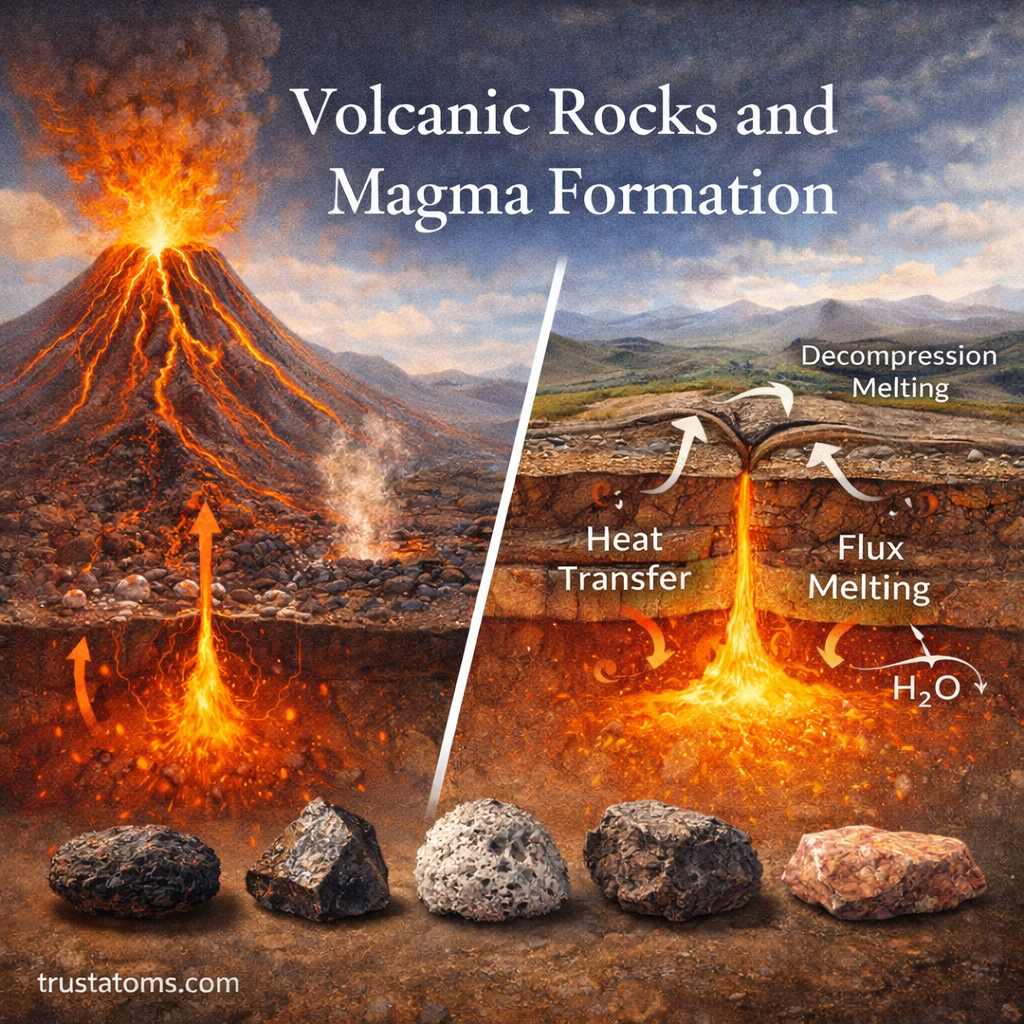
Volcanic rocks are formed from molten material that originates deep within the Earth. These rocks provide valuable insights into the processes happening beneath the surface, including how heat, pressure, and chemical composition interact to shape our planet.
Understanding magma formation and volcanic rocks helps explain volcanic eruptions, the creation of new land, and the evolution of Earth’s crust over time.
What Is Magma?
Magma is molten or partially molten rock located beneath Earth’s surface. It forms under high temperatures and pressures within the mantle or lower crust.
Magma contains:
- Melted rock material
- Crystals (partially melted minerals)
- Dissolved gases such as water vapor and carbon dioxide
When magma reaches the surface, it is called lava.
How Magma Forms
Magma does not form everywhere—it develops under specific geological conditions. There are three main processes responsible for magma formation.
Decompression Melting
- Occurs when pressure decreases without a drop in temperature
- Common at mid-ocean ridges where tectonic plates move apart
- Allows mantle rock to melt as it rises
Flux Melting
- Happens when water or other volatile substances are added
- Lowers the melting point of surrounding rock
- Common in subduction zones where one tectonic plate sinks beneath another
Heat Transfer Melting
- Occurs when hotter magma transfers heat to surrounding rock
- Causes nearby material to partially melt
- Often seen in continental crust regions
Types of Magma
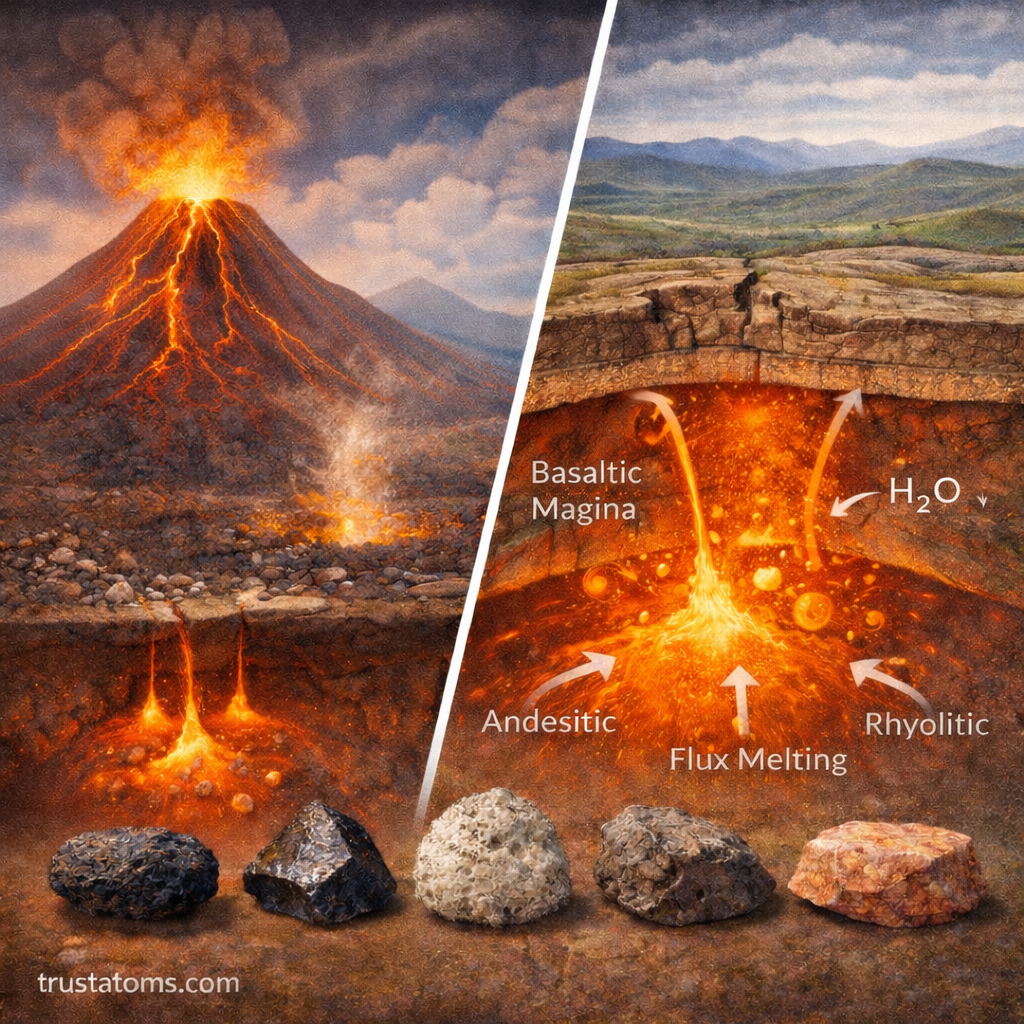
Different types of magma produce different volcanic rocks. The composition of magma affects how it behaves and how eruptions occur.
Basaltic Magma
- Low in silica
- Flows easily (low viscosity)
- Produces gentle eruptions
- Common at mid-ocean ridges and shield volcanoes
Andesitic Magma
- Intermediate silica content
- Moderate viscosity
- Associated with explosive eruptions
- Found in subduction zone volcanoes
Rhyolitic Magma
- High in silica
- Thick and highly viscous
- Traps gases easily, leading to explosive eruptions
- Common in continental volcanic regions
What Are Volcanic Rocks?
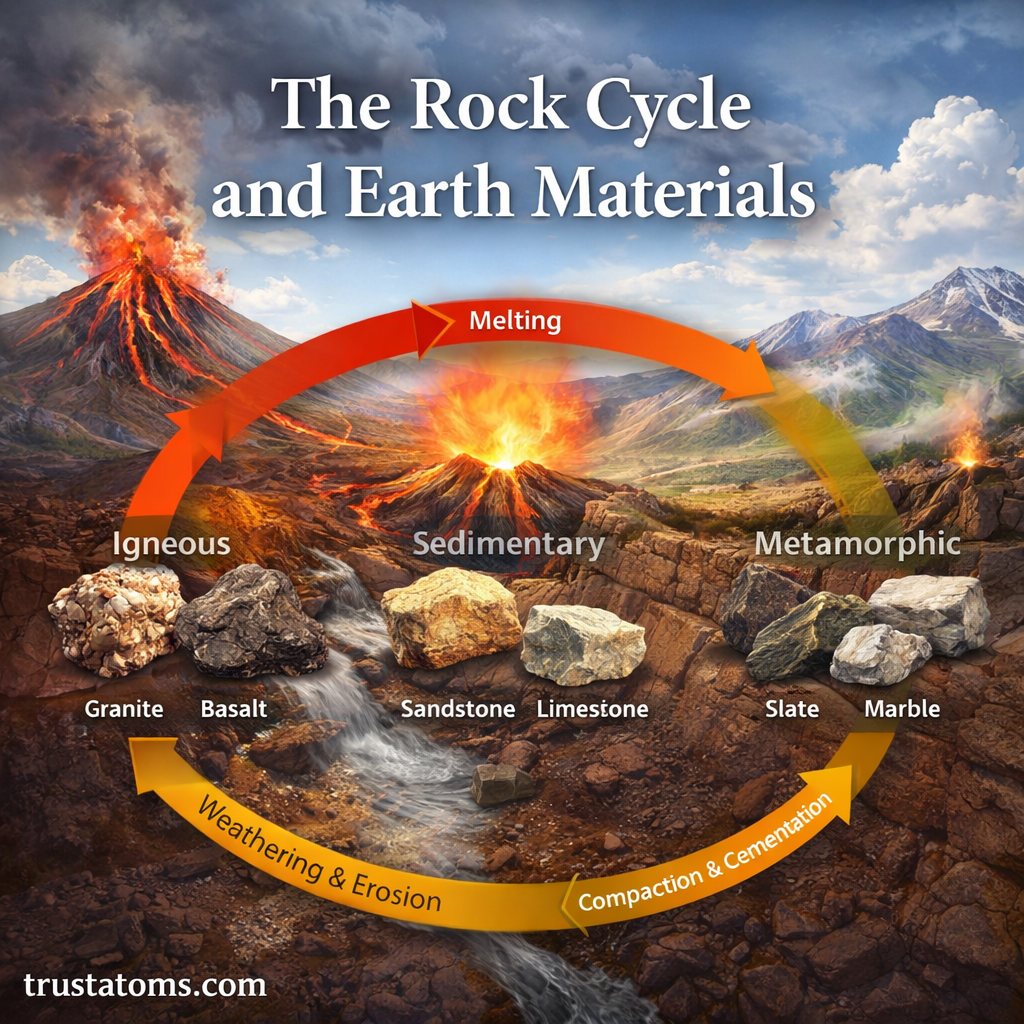
Volcanic rocks are formed when magma cools and solidifies at or near Earth’s surface. They are also known as extrusive igneous rocks.
Because they cool quickly, volcanic rocks often have:
- Fine-grained or glassy textures
- Small or no visible crystals
- Sometimes gas bubbles trapped inside
Common Types of Volcanic Rocks
Basalt
- Dark-colored and dense
- Forms from basaltic magma
- Most common volcanic rock on Earth
Andesite
- Medium-colored rock
- Forms in volcanic arcs
- Associated with explosive volcanic activity
Rhyolite
- Light-colored and rich in silica
- Forms from rhyolitic magma
- Often linked to highly explosive eruptions
Obsidian
- Natural volcanic glass
- Forms when lava cools extremely quickly
- Has a smooth, glassy texture
Pumice
- Light, porous rock full of gas bubbles
- Can float on water
- Forms during explosive eruptions
The Role of Gases in Magma
Gases play a major role in volcanic activity.
Common gases include:
- Water vapor
- Carbon dioxide
- Sulfur dioxide
As magma rises:
- Pressure decreases
- Gases expand
- This can lead to explosive eruptions
The amount of gas and magma viscosity together determine how violent an eruption will be.
From Magma to Rock: The Formation Process
The transformation from magma to volcanic rock follows a clear sequence:
- Magma forms beneath Earth’s surface
- It rises due to lower density compared to surrounding rock
- Pressure decreases as it moves upward
- Gases expand, sometimes triggering eruptions
- Lava cools and solidifies into volcanic rock
The speed of cooling affects the final texture and structure of the rock.
Why Volcanic Rocks Matter
Volcanic rocks are more than just remnants of eruptions—they are key to understanding Earth’s internal processes.
They help scientists:
- Study the composition of Earth’s mantle
- Understand tectonic plate boundaries
- Reconstruct past volcanic activity
- Analyze how continents and ocean floors form
They also have practical uses in construction, landscaping, and even industrial applications.
Key Takeaways
- Magma is molten rock beneath Earth’s surface; lava is magma that reaches the surface
- Magma forms through decompression melting, flux melting, and heat transfer
- Different magma types produce different volcanic rocks
- Volcanic rocks form quickly, leading to fine-grained textures
- Gases play a major role in determining eruption style
Final Thoughts
Volcanic rocks and magma formation are essential parts of Earth’s dynamic system. These processes reveal how energy moves within the planet and how new land is continuously created and reshaped.
By studying volcanic rocks, scientists gain a deeper understanding of Earth’s interior, its history, and the powerful forces that continue to shape the world we live on.