In chemistry, many mixtures do not fit neatly into the categories of solutions or suspensions. Some mixtures contain particles that are small enough to stay dispersed but large enough to scatter light. These mixtures are called colloids.
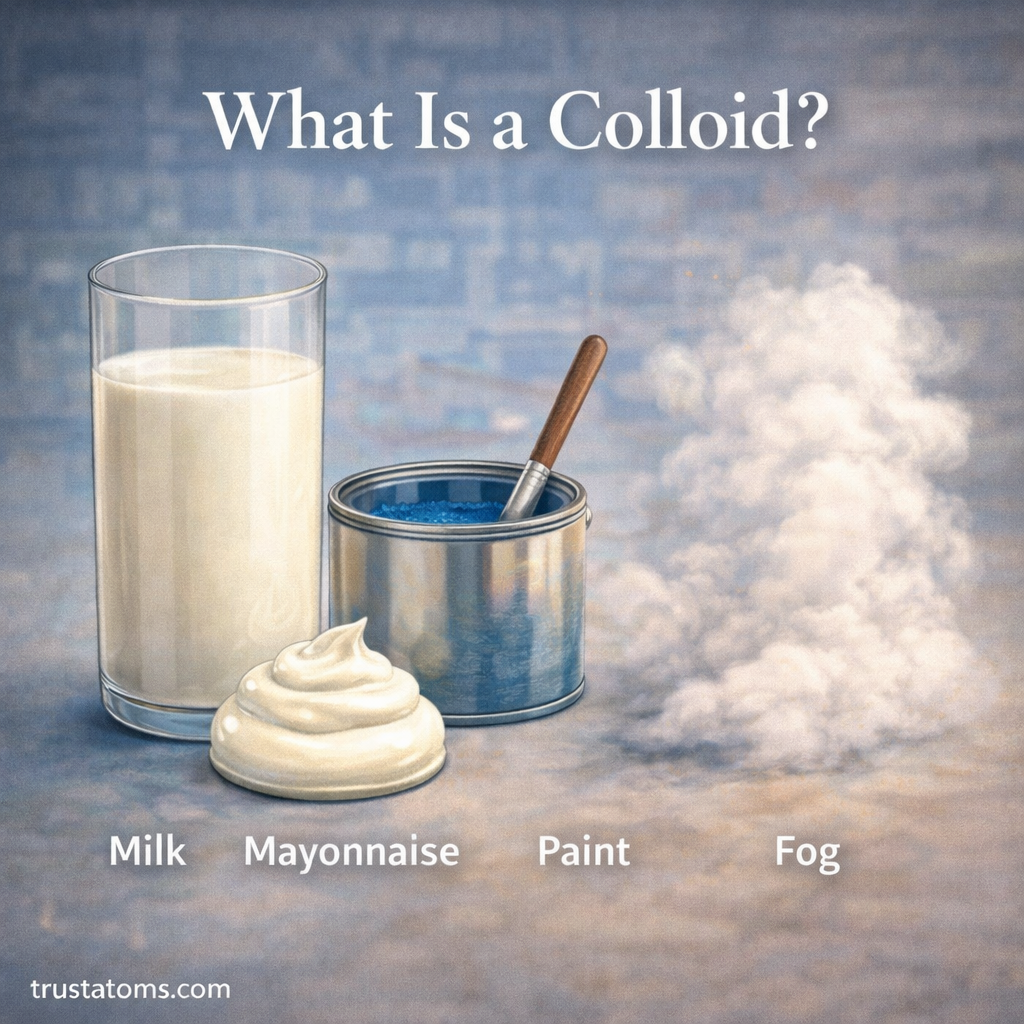
Colloids are extremely common in everyday life. Milk, fog, mayonnaise, paint, and even whipped cream are examples of colloidal mixtures. Understanding colloids helps explain how particles behave in many natural and industrial systems.
This guide explains what a colloid is, how it works, its key characteristics, and examples of colloids found in daily life.
Definition of a Colloid
A colloid is a mixture in which very small particles of one substance are evenly dispersed throughout another substance, without dissolving completely.
The dispersed particles in a colloid are larger than those in a solution but smaller than those in a suspension. Because of their size, these particles remain suspended for long periods and do not settle easily.
Key features of colloids include:
- Particles remain dispersed rather than dissolving
- The mixture appears uniform to the naked eye
- Particles do not settle out over time
- The mixture can scatter light
This combination of properties places colloids between solutions and suspensions.
The Two Main Parts of a Colloid
Every colloid consists of two important components.
Dispersed Phase
The dispersed phase is the substance made up of tiny particles that are spread throughout the mixture.
Examples include:
- Fat droplets in milk
- Water droplets in fog
- Solid pigment particles in paint
Dispersion Medium
The dispersion medium is the substance in which the dispersed particles are suspended.
Examples include:
- Water in milk
- Air in fog
- Liquid base in paint
Together, the dispersed phase and dispersion medium form a stable mixture.
Key Characteristics of Colloids
Colloids have several distinctive properties that separate them from other types of mixtures.
Intermediate Particle Size
Particles in colloids are larger than those in solutions but smaller than particles in suspensions.
Because of their intermediate size:
- They remain suspended in the medium
- They do not settle easily
- They cannot be removed by simple filtration
Stable Dispersion
Unlike suspensions, colloidal particles stay evenly distributed throughout the mixture for long periods.
This stability occurs because tiny particles experience constant movement from surrounding molecules.
Light Scattering (Tyndall Effect)
One of the most recognizable properties of colloids is the Tyndall effect.
When light passes through a colloid, the dispersed particles scatter the light, making the beam visible.
Examples include:
- Sunlight passing through fog
- Car headlights shining through mist
- Light visible in dusty air
Solutions do not show this effect because their particles are too small.
Types of Colloids
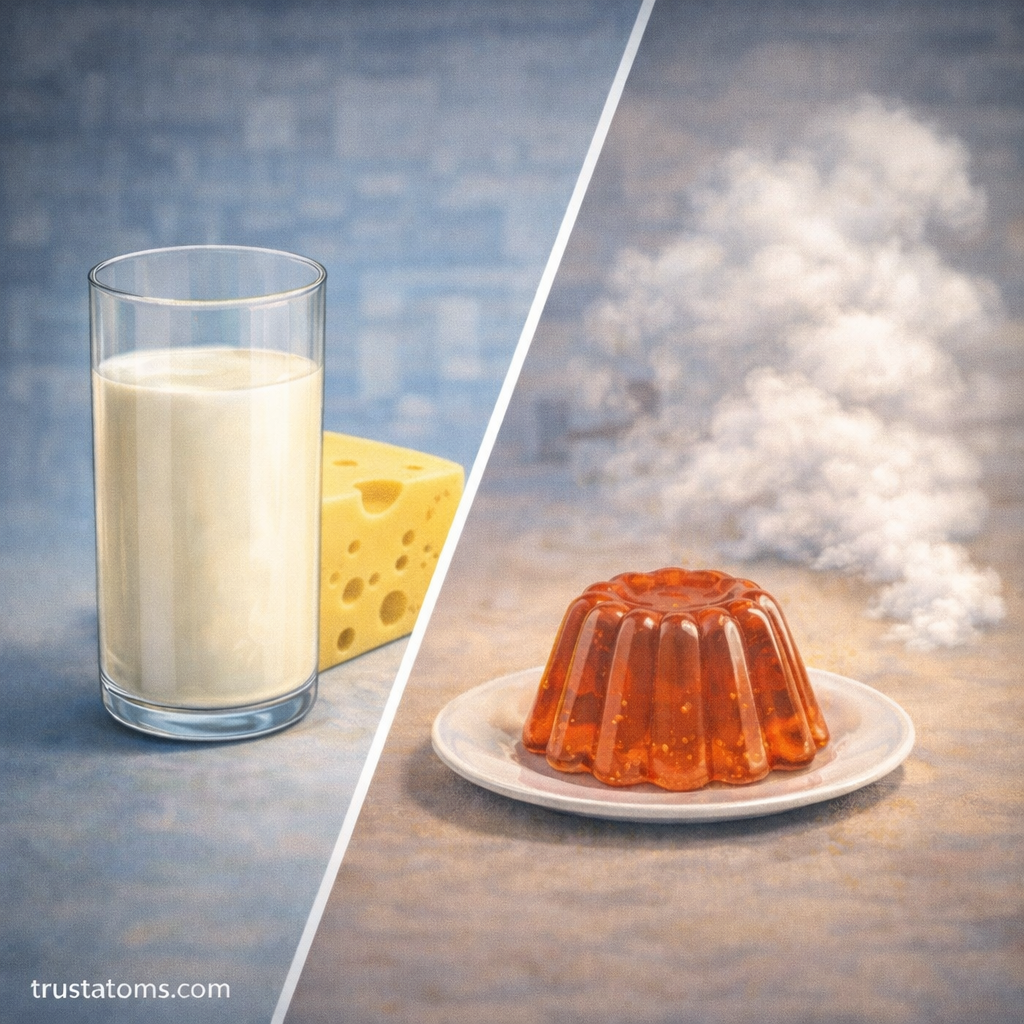
Colloids can exist in many forms depending on the physical states of the dispersed phase and the dispersion medium.
Common types of colloids include:
Aerosols
Aerosols consist of solid or liquid particles dispersed in a gas.
Examples:
- Fog (liquid droplets in air)
- Smoke (solid particles in air)
- Sprays and mists
Emulsions
Emulsions occur when one liquid is dispersed in another liquid that normally would not mix with it.
Examples:
- Milk
- Mayonnaise
- Salad dressing
Foams
Foams form when gas bubbles are dispersed in a liquid or solid.
Examples:
- Whipped cream
- Shaving foam
- Soap bubbles
Gels
Gels are semi-solid colloids where liquid is trapped in a solid structure.
Examples:
- Jelly
- Gelatin
- Hair gel
Examples of Colloids in Everyday Life
Colloids are found in many everyday products and natural systems.
Common examples include:
- Milk
- Butter
- Ice cream
- Paint
- Fog
- Smoke
- Toothpaste
- Lotion
Many foods rely on colloidal structures to maintain their texture and stability.
For example, ice cream is a complex colloid containing air bubbles, fat droplets, and ice crystals.
Colloids vs Solutions vs Suspensions
Colloids are often compared with solutions and suspensions because all three are types of mixtures.
Solutions
Solutions have:
- Extremely small particles (molecular level)
- Completely dissolved substances
- No light scattering
- Uniform composition
Example: Salt dissolved in water.
Colloids
Colloids have:
- Intermediate particle size
- Particles that remain dispersed
- Light scattering (Tyndall effect)
- Long-term stability
Example: Milk.
Suspensions
Suspensions have:
- Large particles
- Visible separation over time
- Particles that settle
- Easy filtration
Example: Muddy water.
Why Colloids Are Important
Colloids play an important role in science, medicine, and industry.
They are essential in areas such as:
- Food science
- Pharmaceuticals
- Cosmetics
- Environmental science
- Materials engineering
For example:
- Many medicines use colloidal formulations to improve stability.
- Paint relies on suspended pigment particles.
- Food products use emulsions to maintain texture.
Understanding colloids helps scientists design better materials and products.
Final Thoughts
A colloid is a mixture in which small particles remain evenly dispersed throughout another substance without dissolving. These particles are larger than those in solutions but smaller than those in suspensions, allowing the mixture to remain stable over time.
Colloids are found in many everyday materials, including milk, fog, mayonnaise, and paint. Their unique properties—such as particle stability and light scattering—make them an important concept in chemistry and many real-world applications.
Learning about colloids helps build a deeper understanding of how different types of mixtures behave in nature and industry.