Mixtures are one of the most common types of matter encountered in everyday life. From the air we breathe to the food we eat, mixtures are everywhere. In chemistry, understanding mixtures helps explain how substances combine physically while still maintaining their individual properties.
This guide explains what a mixture is, the different types of mixtures, and how mixtures differ from compounds.
Definition of a Mixture
A mixture is a combination of two or more substances that are physically combined but not chemically bonded.
Each substance in a mixture retains its own chemical identity and properties. Because the components are not chemically joined, they can usually be separated using physical methods.
Key characteristics of mixtures include:
- Components are physically combined, not chemically bonded
- Each substance keeps its original properties
- The composition can vary
- Components can often be separated by physical methods
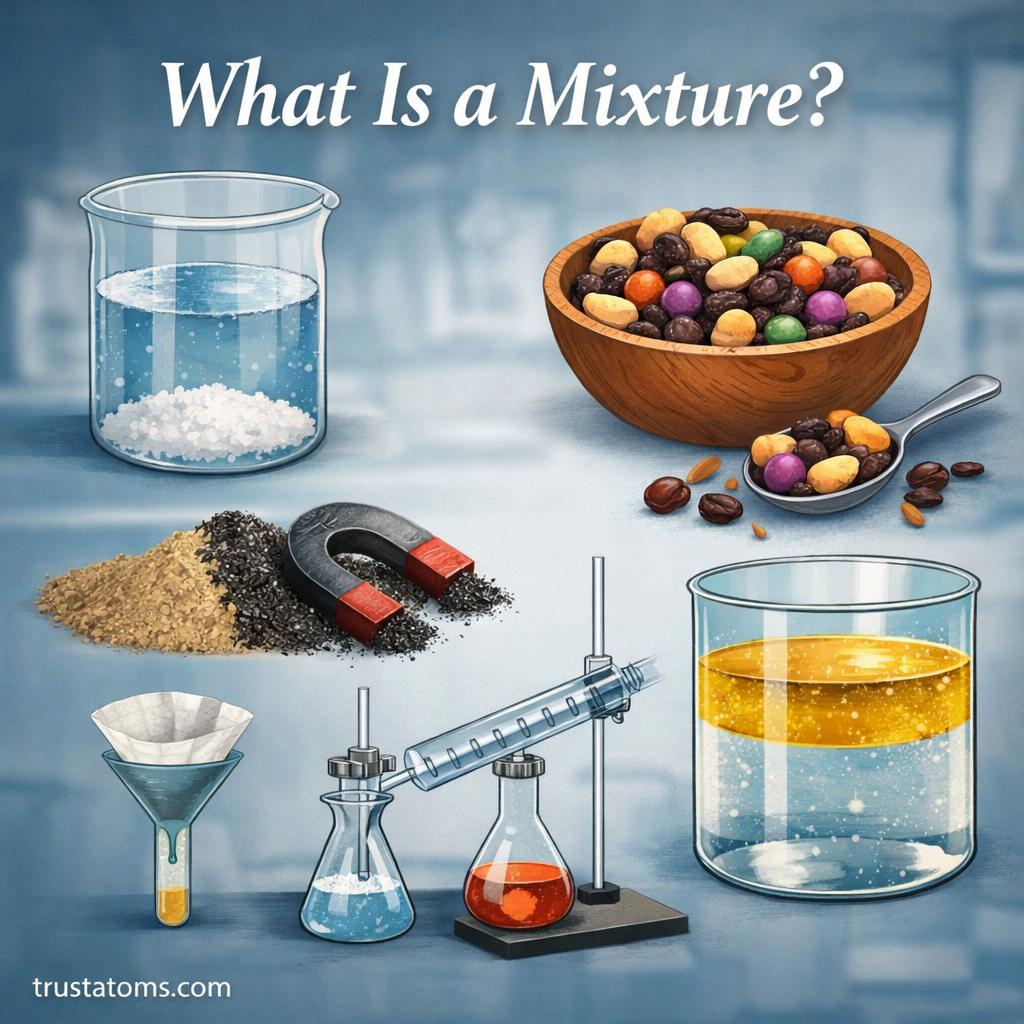
For example, mixing sand and salt creates a mixture. Both materials remain unchanged and can be separated.
Key Properties of Mixtures
Mixtures share several defining properties that distinguish them from pure substances.
Variable Composition
Unlike compounds, mixtures do not have a fixed chemical formula. The ratio of components can vary.
For example:
- Saltwater can contain more or less salt
- Trail mix may contain different proportions of nuts, chocolate, or raisins
No Chemical Reaction Required
When forming a mixture, substances combine without undergoing a chemical reaction.
The individual substances remain the same chemically.
Components Retain Their Properties
Each substance in a mixture maintains its own physical and chemical characteristics.
Examples:
- Sugar dissolved in water still tastes sweet
- Iron filings mixed with sand remain magnetic
Separable by Physical Methods
Because substances are not chemically bonded, they can usually be separated using physical processes such as:
- Filtration
- Distillation
- Evaporation
- Magnetic separation
- Decanting
Types of Mixtures
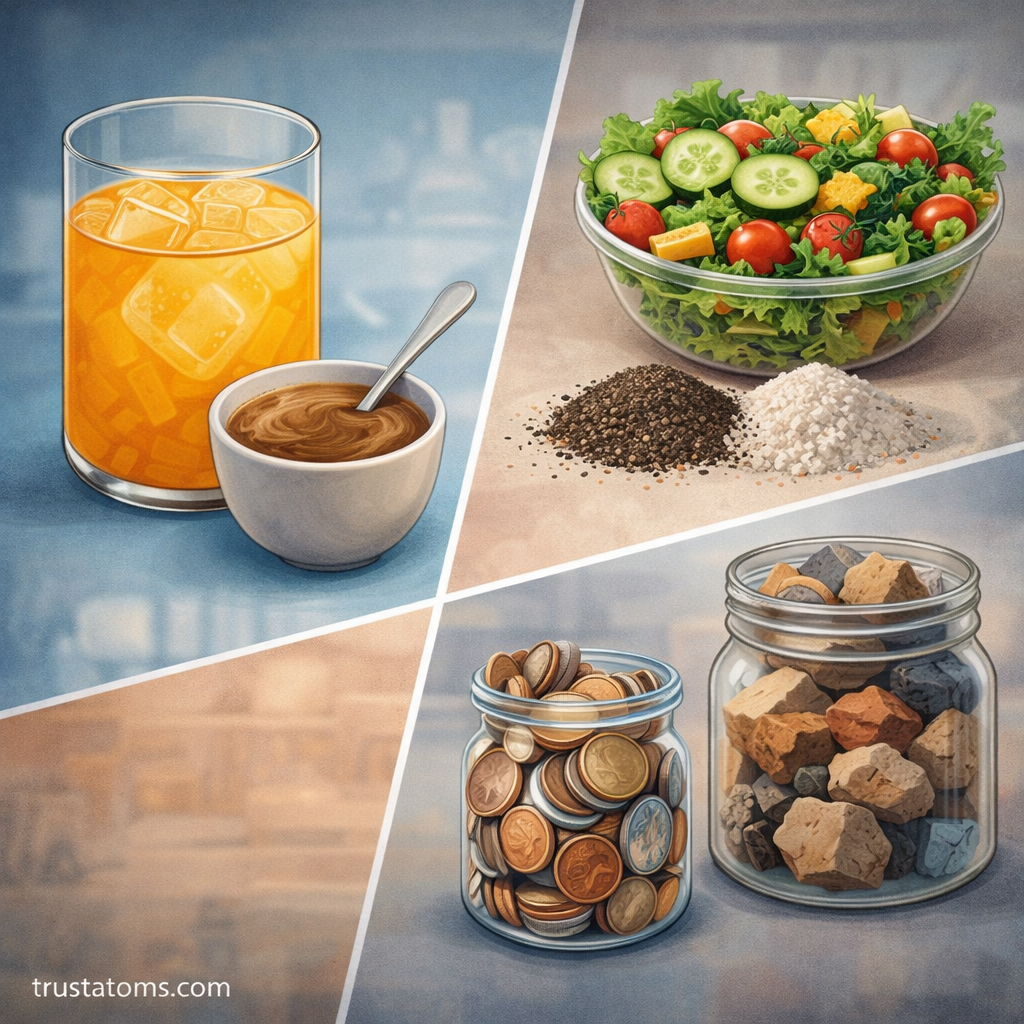
Mixtures are generally divided into two main categories based on how uniformly the components are distributed.
Homogeneous Mixtures
A homogeneous mixture has a uniform composition throughout. The individual substances cannot be easily distinguished.
These mixtures are often called solutions.
Examples include:
- Salt dissolved in water
- Air
- Vinegar
- Sugar dissolved in tea
In homogeneous mixtures:
- Components are evenly distributed
- The mixture appears as a single phase
- Individual components are not visible
Heterogeneous Mixtures
A heterogeneous mixture has a non-uniform composition where the different substances remain visibly distinct.
Examples include:
- Salad
- Sand mixed with gravel
- Oil and water
- Chocolate chip cookies
Characteristics include:
- Uneven distribution of components
- Visible separate parts
- Multiple phases may be present
Examples of Mixtures in Everyday Life
Mixtures appear constantly in natural and human-made systems.
Common examples include:
Air
Air is a mixture of gases including:
- Nitrogen
- Oxygen
- Carbon dioxide
- Water vapor
These gases mix physically without chemically bonding.
Soil
Soil is a complex mixture of:
- Minerals
- Organic matter
- Water
- Air
The proportions of each component vary widely.
Beverages
Many drinks are mixtures, such as:
- Coffee
- Soda
- Juice
- Tea
These contain dissolved substances like sugars, acids, and flavor compounds.
Alloys
An alloy is a mixture of metals.
Examples include:
- Brass (copper and zinc)
- Bronze (copper and tin)
- Steel (iron and carbon)
Alloys combine metals to improve strength, durability, or corrosion resistance.
Mixtures vs. Compounds
It is important to distinguish mixtures from compounds because they form in different ways.
Mixtures
- Components are physically combined
- No chemical bonds form
- Composition can vary
- Components retain their properties
- Can be separated by physical methods
Example: Salt mixed with sand.
Compounds
- Elements are chemically bonded
- A chemical reaction forms the compound
- Composition is fixed
- New chemical properties appear
- Separation requires chemical reactions
Example: Water (H₂O) formed from hydrogen and oxygen.
Methods Used to Separate Mixtures
Chemists and scientists use several techniques to separate the components of mixtures.
Common separation methods include:
Filtration
Filtration separates solids from liquids using a filter.
Example: Separating sand from water.
Distillation
Distillation separates liquids based on different boiling points.
Example: Separating alcohol from water.
Evaporation
Evaporation removes liquid, leaving the solid behind.
Example: Producing salt from seawater.
Magnetic Separation
Magnets can remove magnetic materials from mixtures.
Example: Removing iron filings from sand.
Chromatography
Chromatography separates substances based on how they travel through a medium.
Example: Separating pigments in ink.
Why Mixtures Are Important in Chemistry
Mixtures play a critical role in chemistry, environmental science, and industry.
They help scientists:
- Understand how substances interact
- Develop purification methods
- Analyze environmental samples
- Produce materials and medicines
Many natural systems, including oceans, soils, and the atmosphere, are complex mixtures that influence ecosystems and climate.
Final Thoughts
A mixture is a physical combination of two or more substances that retain their individual properties. Unlike compounds, mixtures do not involve chemical bonding, and their components can usually be separated by physical means.
Understanding mixtures helps explain many everyday phenomena—from the composition of air to the ingredients in food and industrial materials. By studying mixtures and their properties, chemists gain insight into how substances interact in both natural and controlled environments.