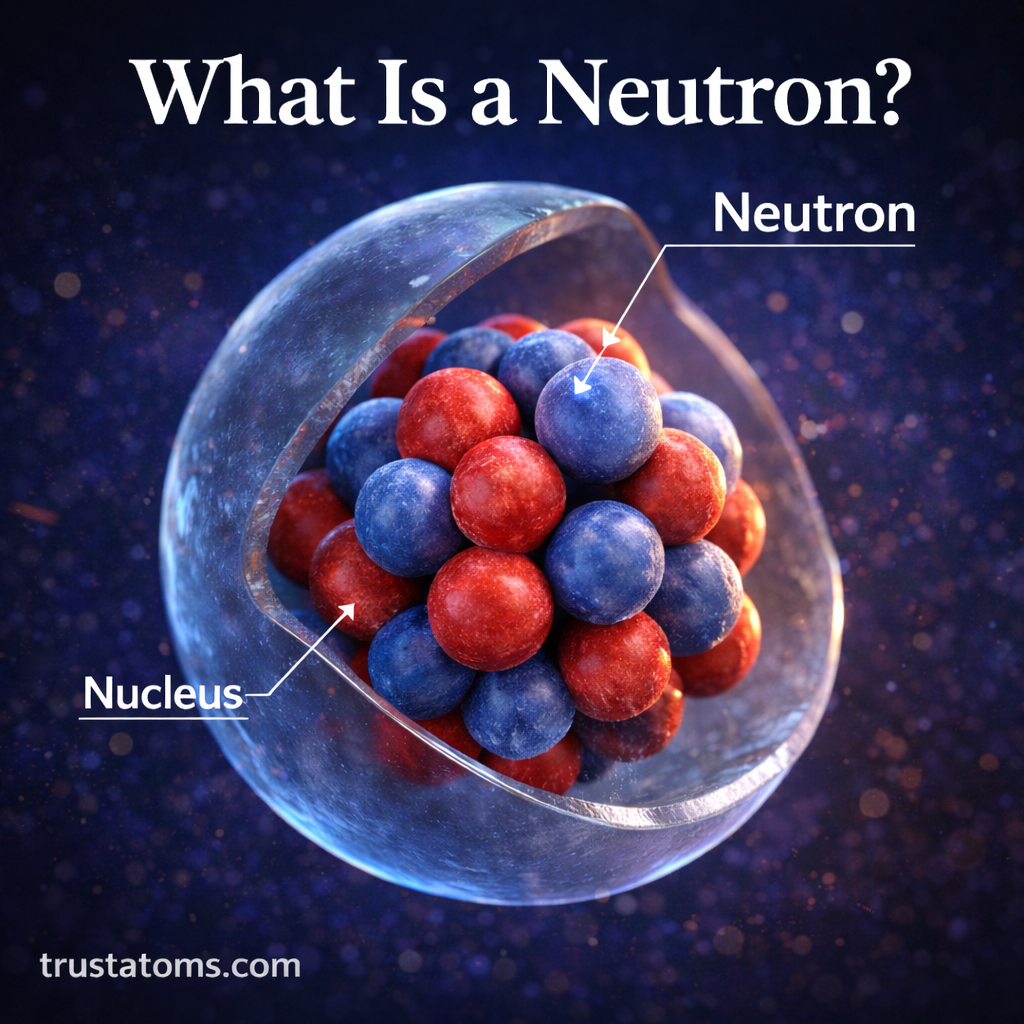
A neutron is one of the three fundamental subatomic particles that make up atoms. Along with protons and electrons, neutrons help form the structure of all matter in the universe.
Although neutrons do not carry an electrical charge, they play an essential role in stabilizing atomic nuclei and determining different forms of elements known as isotopes.
Understanding neutrons helps explain atomic stability, nuclear reactions, and how elements behave in chemistry and physics.
The Basic Definition of a Neutron
A neutron is a subatomic particle with no electrical charge that exists inside the nucleus of an atom.
Neutrons are located alongside protons at the center of the atom. While protons carry a positive charge, neutrons are neutral, meaning they do not attract or repel other charged particles electrically.
Key characteristics of neutrons include:
- No electric charge (neutral)
- Located in the atomic nucleus
- Nearly the same mass as a proton
- Contribute significantly to an atom’s mass
- Help stabilize the atomic nucleus
Despite having no charge, neutrons are critical for maintaining the structure of atoms.
Where Neutrons Are Found in an Atom
Atoms consist of three primary subatomic particles:
- Protons
- Neutrons
- Electrons
Structure of the Atom
- Protons carry a positive charge and are found in the nucleus.
- Neutrons have no charge and are also found in the nucleus.
- Electrons carry a negative charge and move in regions around the nucleus called orbitals.
The nucleus is extremely small compared to the entire atom, yet it contains almost all of the atom’s mass because protons and neutrons are much heavier than electrons.
Properties of Neutrons
Neutrons have several important physical properties that affect atomic structure and stability.
1. No Electrical Charge
Unlike protons and electrons, neutrons have no electric charge. This neutrality allows them to sit closely alongside positively charged protons in the nucleus without adding to the repulsive electrical forces.
This helps keep the nucleus stable.
2. Nearly the Same Mass as Protons
Neutrons are nearly identical in mass to protons.
In fact:
- A neutron’s mass is slightly greater than that of a proton.
- Both particles contribute most of the mass of an atom.
Because electrons are extremely light, nearly all atomic mass comes from protons and neutrons.
3. Stability Within the Nucleus
Neutrons help hold the nucleus together through interactions involving the strong nuclear force, one of the four fundamental forces of nature.
Without neutrons, the positive charges of protons would strongly repel each other, making many atomic nuclei unstable.
The Role of Neutrons in Atomic Stability
Neutrons are crucial for balancing the forces inside the nucleus.
Forces Acting in the Nucleus
Two main forces influence nuclear stability:
- Electromagnetic Repulsion
- Protons repel each other because they have the same positive charge.
- Strong Nuclear Force
- A powerful force that binds protons and neutrons together.
Neutrons help offset the repulsion between protons by increasing the strength of the strong nuclear force without adding more electrical charge.
This balance allows atoms to remain stable.
Neutrons and Isotopes
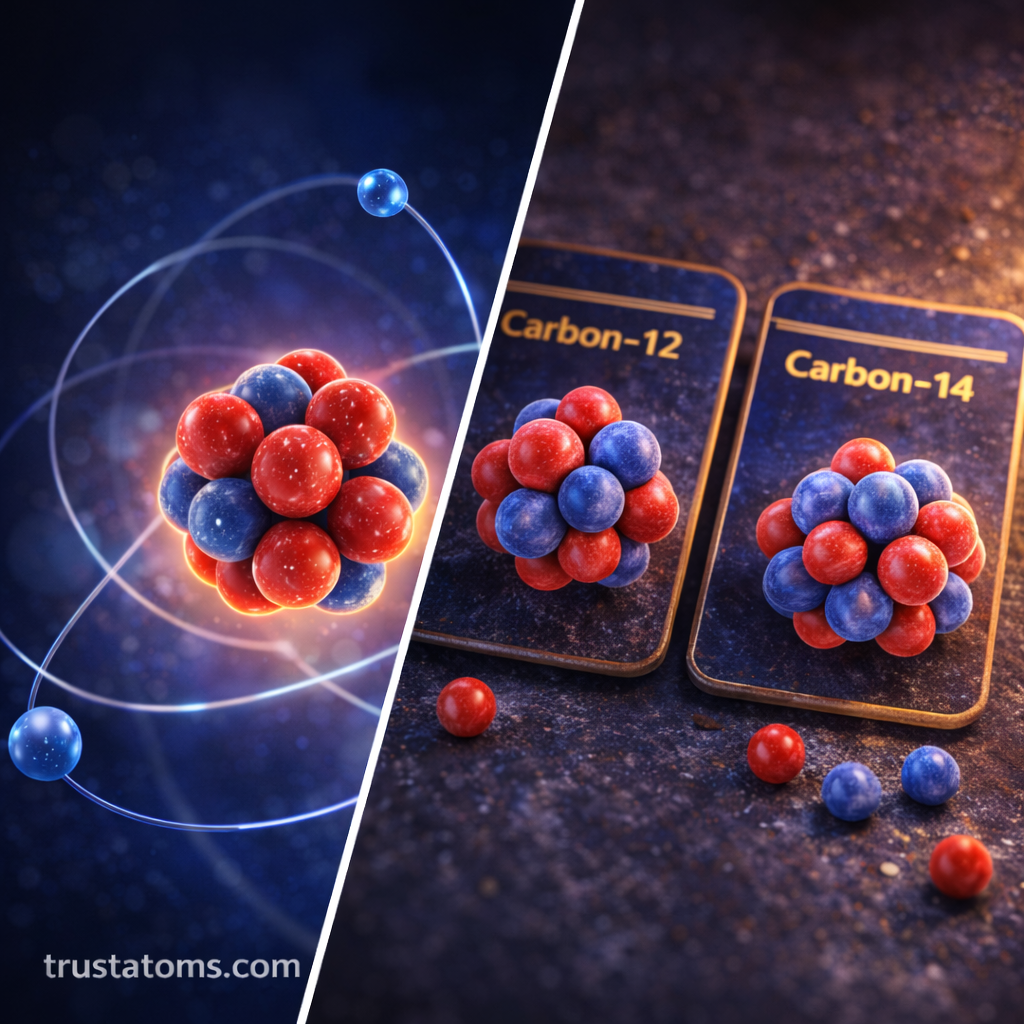
One of the most important roles of neutrons is creating isotopes.
Isotopes are atoms of the same element that contain different numbers of neutrons.
Example: Carbon Isotopes
Carbon atoms always have 6 protons, but they can have different numbers of neutrons:
- Carbon-12 → 6 neutrons
- Carbon-13 → 7 neutrons
- Carbon-14 → 8 neutrons
All three are carbon because they have the same number of protons, but their different neutron counts create different isotopes.
Some isotopes are stable, while others are radioactive.
The Discovery of the Neutron
The neutron was discovered in 1932 by physicist James Chadwick.
Chadwick’s Experiment
Chadwick conducted experiments where particles were fired at atomic nuclei. During these experiments, he observed radiation that could not be explained by protons or electrons.
He concluded that a new type of particle existed that had:
- No electric charge
- A mass similar to a proton
This particle was named the neutron, and its discovery greatly improved scientists’ understanding of atomic structure.
Neutrons in Nuclear Reactions
Neutrons play an important role in nuclear processes because their lack of charge allows them to easily penetrate atomic nuclei.
This makes neutrons key participants in:
- Nuclear fission (splitting atomic nuclei)
- Nuclear fusion (combining atomic nuclei)
- Radioactive decay
- Nuclear energy production
In nuclear reactors, controlled neutron reactions are used to generate heat that produces electricity.
Key Takeaways
Neutrons are fundamental particles that contribute to the structure and stability of atoms.
Important points to remember:
- Neutrons are neutral subatomic particles
- They are located inside the atomic nucleus
- They have nearly the same mass as protons
- They help stabilize atomic nuclei
- Different numbers of neutrons create isotopes of elements
Without neutrons, many atomic nuclei would not remain stable, making them essential for the existence of most elements.