In chemistry, mixtures can behave in different ways depending on the size of the particles and how evenly they are distributed. One important type of mixture is called a suspension.
Suspensions are common in both natural systems and everyday products. From muddy water to certain medicines and paints, suspensions help scientists understand how solid particles can remain temporarily mixed within liquids.
This guide explains what a suspension is, how it works, examples of suspensions, and how suspensions differ from other mixtures like solutions and colloids.
Definition of a Suspension
A suspension is a type of heterogeneous mixture in which solid particles are dispersed throughout a liquid (or sometimes a gas) but are large enough to eventually settle out over time.
Unlike solutions, the particles in a suspension do not dissolve. Instead, they remain suspended temporarily and may separate if the mixture is left undisturbed.
Key characteristics of suspensions include:
- Particles are large enough to be seen with the naked eye or a microscope
- The mixture appears cloudy or opaque
- Particles eventually settle due to gravity
- The components can often be separated by filtration
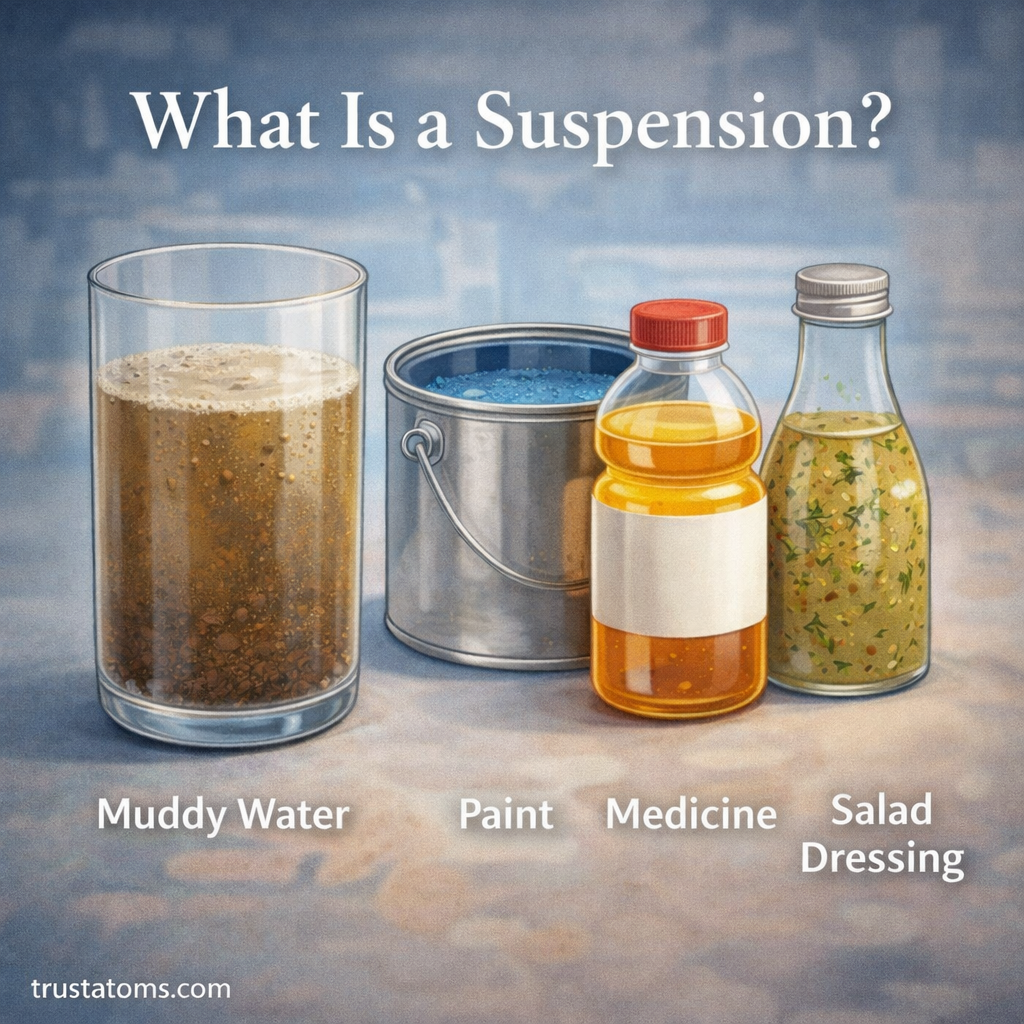
A common example is muddy water, where soil particles remain suspended in the water for a period before settling to the bottom.
Key Characteristics of Suspensions
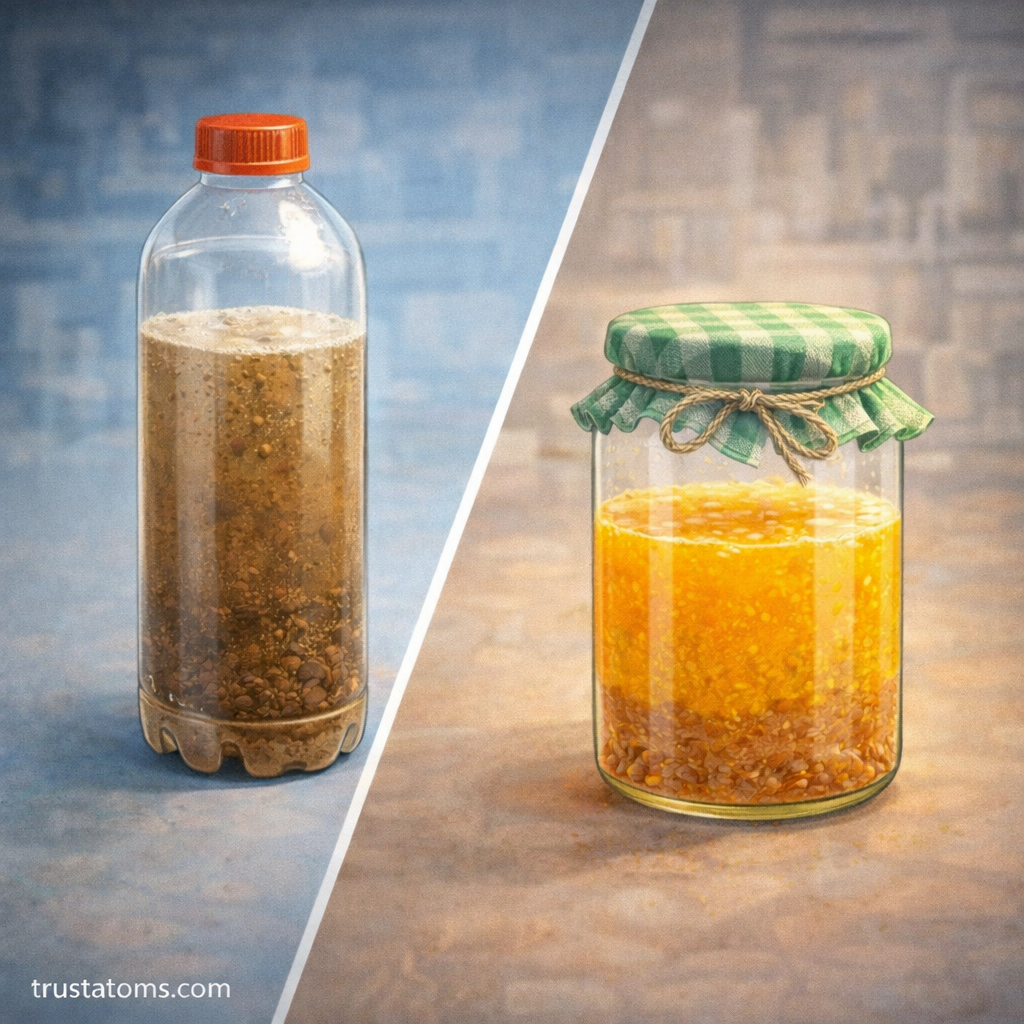
Suspensions have several unique properties that help distinguish them from other types of mixtures.
Large Particle Size
Particles in suspensions are relatively large compared to those in solutions or colloids. Because of their size, they scatter light and can often be seen directly.
Examples of suspended particles include:
- Soil in water
- Flour in liquid
- Dust in air
Temporary Mixing
Suspensions do not remain evenly mixed forever. Over time, gravity pulls the particles downward, causing them to settle.
This is why many suspension-based products instruct users to shake before use.
Visible Separation
When a suspension sits undisturbed, layers may form as particles settle to the bottom.
For example:
- Sand in water collects at the bottom of a container
- Some liquid medicines separate if left sitting
Easily Separated
Suspensions can usually be separated using physical methods such as:
- Filtration
- Decanting
- Centrifugation
These methods remove the suspended particles from the liquid.
Common Examples of Suspensions
Suspensions appear in everyday life, natural environments, and industrial processes.
Muddy Water
Muddy water contains soil particles suspended in water. When the mixture sits still, the particles slowly settle.
Paint
Many paints are suspensions where pigment particles are dispersed in a liquid base.
When left sitting for long periods, paint may separate and require stirring before use.
Salad Dressing
Some salad dressings contain herbs, spices, or oil droplets that remain suspended temporarily before separating.
Liquid Medicines
Certain medications contain active ingredients suspended in liquid form. These medicines often include instructions to shake well before use.
Dust in Air
Dust particles floating in the air form a suspension within the surrounding gases.
How Suspensions Form
Suspensions form when solid particles are mixed into a liquid or gas but do not dissolve.
The process generally follows these steps:
- A solid material is broken into small particles.
- The particles are dispersed throughout a fluid (usually a liquid).
- The mixture becomes cloudy or opaque as particles scatter light.
- Over time, gravity causes particles to settle.
The stability of a suspension depends on factors such as particle size, density, and the viscosity of the liquid.
Suspension vs Solution vs Colloid
Suspensions are one of three major types of mixtures often studied in chemistry. The others are solutions and colloids.
Understanding their differences helps explain how particles behave in mixtures.
Suspensions
Suspensions have the following properties:
- Large particles
- Non-uniform mixture
- Particles settle over time
- Can be filtered easily
Example: Muddy water.
Solutions
Solutions are homogeneous mixtures where substances dissolve completely.
Characteristics include:
- Very small particles (molecular level)
- Uniform mixture
- Particles do not settle
- Cannot be filtered
Example: Salt dissolved in water.
Colloids
Colloids fall between suspensions and solutions.
Characteristics include:
- Intermediate particle size
- Particles remain dispersed
- Do not settle easily
- Scatter light (Tyndall effect)
Example: Milk.
Why Suspensions Are Important
Suspensions play an important role in science, medicine, and industry.
Understanding suspensions helps scientists:
- Design effective medications
- Create paints and coatings
- Study environmental processes
- Analyze water quality
- Develop food products
In environmental science, for example, suspended particles in rivers and oceans influence water clarity and ecosystem health.
How Suspensions Are Stabilized
In some applications, scientists want to keep particles suspended longer to prevent separation.
This can be achieved using stabilizing techniques such as:
- Increasing liquid thickness (viscosity)
- Adding stabilizing agents
- Reducing particle size
- Continuous mixing or agitation
These strategies help products remain evenly mixed for longer periods.
Final Thoughts
A suspension is a heterogeneous mixture in which solid particles are dispersed in a fluid but remain large enough to settle over time. Unlike solutions, the particles do not dissolve and can often be separated by physical methods.
Suspensions are common in everyday life, appearing in muddy water, paints, medicines, and food products. By studying suspensions, scientists gain valuable insights into how particles behave in mixtures and how materials interact in natural and industrial environments.
Understanding suspensions is an important step in learning how different types of mixtures function in chemistry.