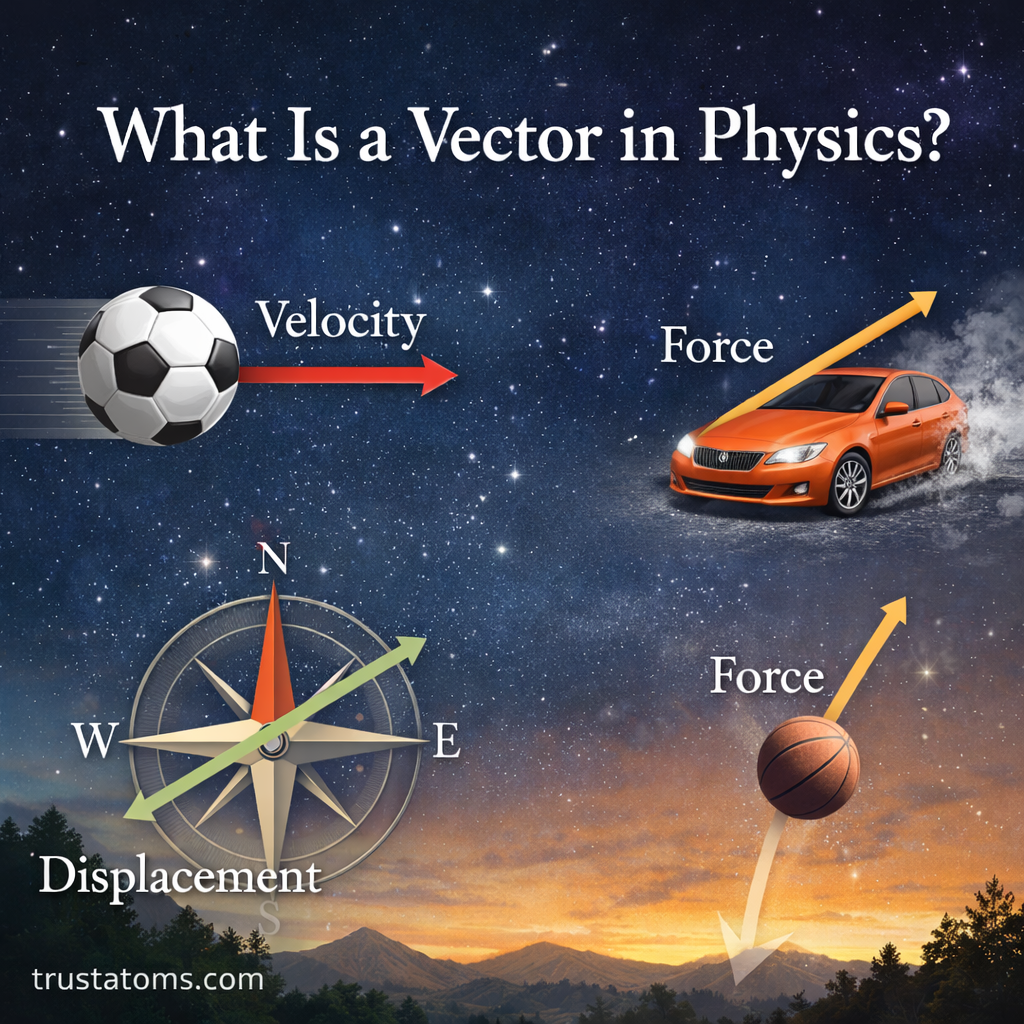
In physics, many quantities describe how things move, interact, and change. Some of these quantities only require a number to describe them, while others require both a number and a direction.
A vector is a physical quantity that has both magnitude and direction.
Vectors are essential in physics because many real-world phenomena—such as motion, forces, and fields—depend not only on how strong something is but also which direction it acts.
Understanding vectors is fundamental to studying mechanics, electromagnetism, and many other areas of physics.
Understanding Scalars vs Vectors
To understand vectors, it helps to compare them with scalars.
A scalar quantity has magnitude only, meaning it can be described with a number and a unit.
Examples of scalar quantities include:
- Temperature
- Mass
- Time
- Energy
- Speed
For example:
- A temperature of 25°C describes only how hot something is.
- A mass of 10 kg describes how much matter an object contains.
Vectors, on the other hand, require both magnitude and direction.
Examples of vector quantities include:
- Velocity
- Force
- Acceleration
- Momentum
- Displacement
For instance:
- A velocity might be 20 m/s north.
- A force might be 10 newtons downward.
Without direction, these quantities would be incomplete.
Key Characteristics of a Vector
Every vector contains two essential components.
Magnitude
The magnitude describes the size or strength of the vector.
Examples include:
- Speed in meters per second
- Force in newtons
- Distance in meters
Magnitude is always a positive value that represents how large the quantity is.
Direction
The direction indicates where the vector points in space.
Common ways to express direction include:
- Cardinal directions (north, south, east, west)
- Angles relative to a reference axis
- Upward or downward orientation
Together, magnitude and direction fully describe the vector.
Common Vector Quantities in Physics
Vectors appear frequently in physics because many physical interactions depend on direction.
Some of the most important vector quantities include the following.
Displacement
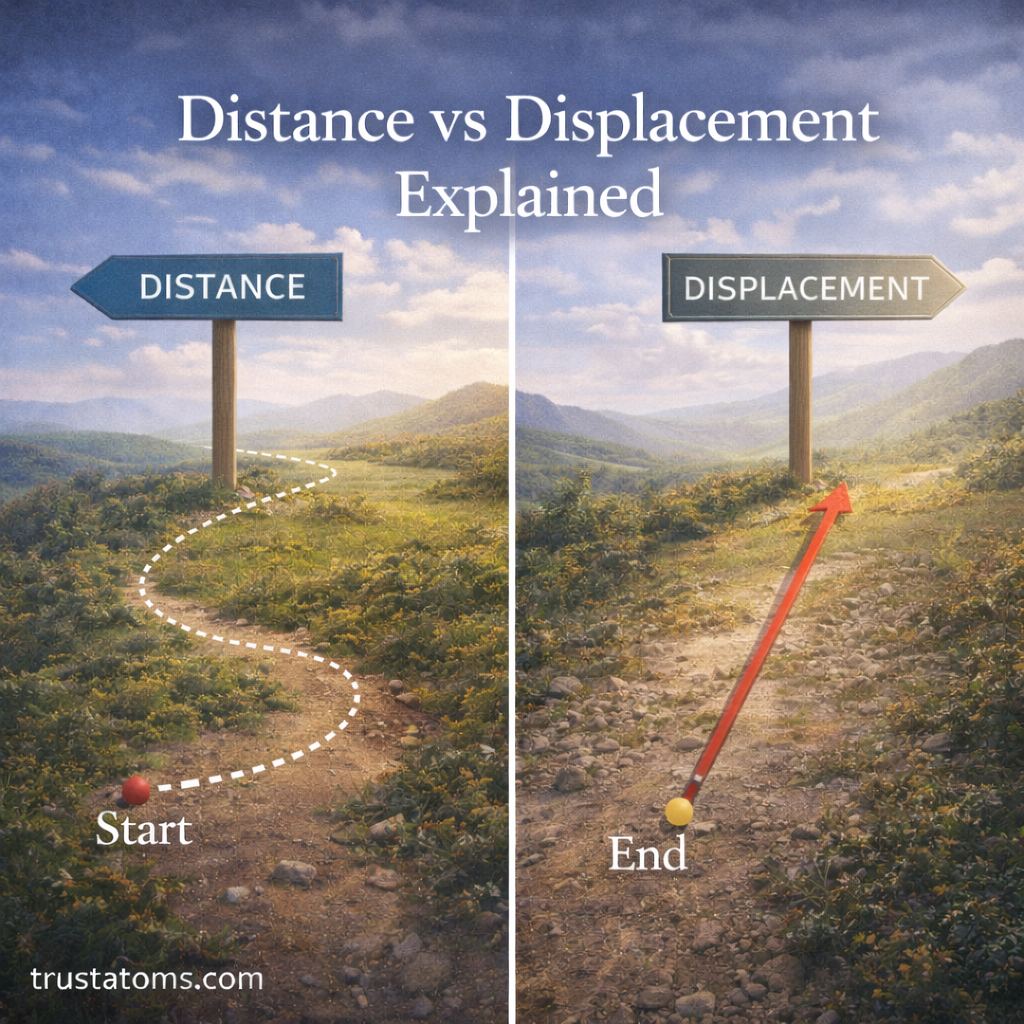
Displacement describes the change in position of an object, including the direction of movement.
Example:
- Walking 5 meters east from a starting point.
This differs from distance, which only measures how far something travels.
Velocity
Velocity describes how fast something moves and in which direction.
Example:
- A car traveling 60 km/h north.
Speed alone is a scalar, but velocity is a vector because direction matters.
Acceleration
Acceleration measures how quickly velocity changes over time.
Example:
- A car accelerating forward at 3 m/s².
Because velocity includes direction, acceleration must also include direction.
Force
Force is a push or pull acting on an object.
Example:
- Gravity pulling objects downward toward Earth.
Forces can act in different directions and combine with other forces, making vector analysis essential.
How Vectors Are Represented
Vectors are commonly represented in several ways in physics.
Arrow Diagrams
One of the most common visual representations uses arrows.
In these diagrams:
- The length of the arrow represents magnitude
- The arrow direction represents direction
For example:
- A longer arrow represents a stronger force.
- An arrow pointing upward represents upward motion or force.
Coordinate Form
Vectors can also be expressed using coordinates.
For example:
- A vector may be written as (3, 4) in a two-dimensional system.
This means:
- 3 units in the horizontal direction
- 4 units in the vertical direction
This representation is common in mathematics and physics calculations.
Unit Vectors
Unit vectors help describe direction along coordinate axes.
Common unit vectors include:
- i → horizontal direction
- j → vertical direction
- k → depth direction in three-dimensional space
These unit vectors help break complex vectors into components.
Vector Components
A vector can be divided into smaller parts called components.
These components describe how much of the vector lies along each axis.
For example, a diagonal vector might be broken into:
- Horizontal component (x-direction)
- Vertical component (y-direction)
Breaking vectors into components allows physicists to analyze motion and forces more easily.
Component analysis is especially useful in:
- Projectile motion
- Force balancing
- Engineering calculations
- Navigation systems
Vector Addition
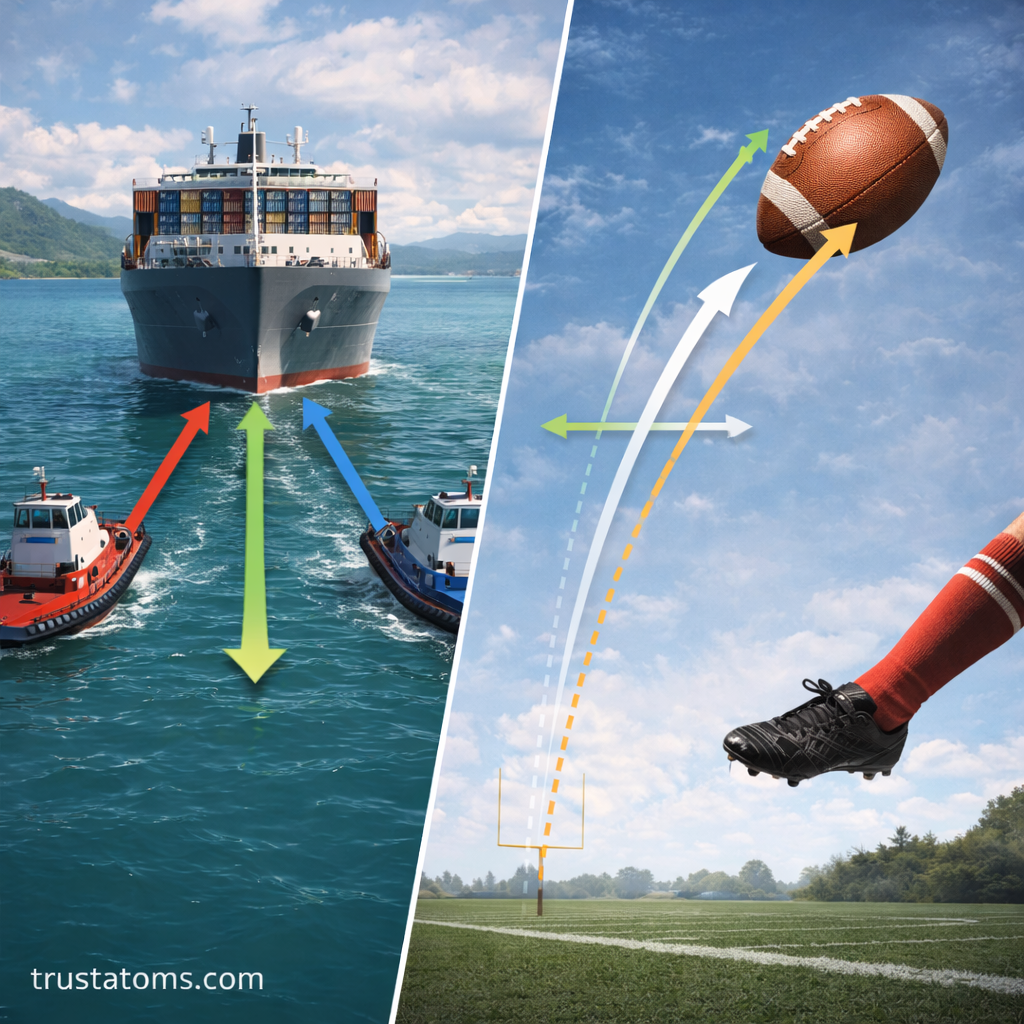
Vectors can be combined using vector addition.
This process determines the resultant vector, which represents the combined effect of multiple vectors.
Two common methods are used.
Head-to-Tail Method
In this graphical method:
- Place the tail of the second vector at the head of the first.
- Draw a new vector from the start of the first vector to the end of the second.
The resulting arrow represents the total vector.
Component Method
In this method:
- Break each vector into x and y components.
- Add the x-components together.
- Add the y-components together.
- Combine the results to find the final vector.
This method is commonly used in physics calculations and simulations.
Real-World Examples of Vectors
Vectors appear in many real-world situations.
Navigation
Airplanes and ships use vectors to determine direction and speed when traveling.
For example:
- Wind direction can change the actual path of an aircraft.
Pilots must combine velocity vectors with wind vectors to determine the correct heading.
Sports
Many sports involve vector quantities.
Examples include:
- The direction of a soccer kick
- The path of a basketball shot
- The trajectory of a golf ball
Understanding vectors helps athletes and coaches analyze motion and performance.
Engineering and Construction
Engineers use vectors to calculate:
- Structural forces
- Load distribution
- Mechanical motion
Without vectors, designing bridges, buildings, and machines would be extremely difficult.
Why Vectors Are Important in Physics
Vectors are essential because many physical interactions depend on direction.
They allow scientists to accurately describe:
- Motion in two and three dimensions
- Interactions between forces
- Electric and magnetic fields
- Orbital mechanics in space
Vectors provide the mathematical framework needed to analyze complex physical systems.
From the movement of everyday objects to the motion of galaxies, vectors help physicists model and understand the universe.
Final Thoughts
A vector in physics is a quantity that includes both magnitude and direction. Unlike scalar quantities, vectors fully describe physical quantities such as velocity, acceleration, and force.
Vectors allow scientists and engineers to analyze motion, predict outcomes, and understand how different forces interact in the physical world.
Because so many natural phenomena depend on direction as well as size, vectors are one of the most important tools in physics and mathematics.