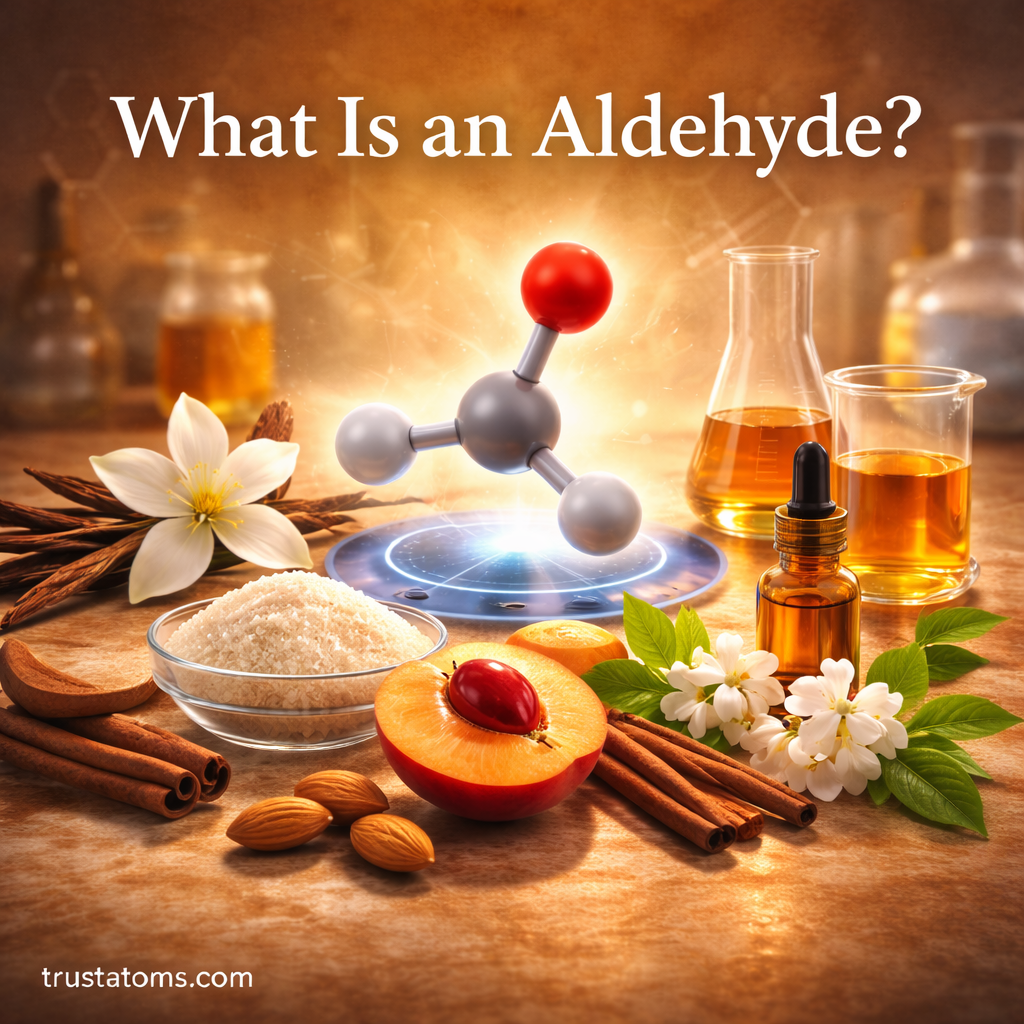
An aldehyde is a type of organic compound that contains a carbonyl functional group located at the end of a carbon chain. This group consists of a carbon atom double-bonded to an oxygen atom and single-bonded to a hydrogen atom.
Aldehydes are widely found in nature and play important roles in biology, food chemistry, fragrances, and industrial manufacturing. Many natural aromas—such as the smell of almonds, vanilla, and cinnamon—are produced by aldehyde compounds.
Because of their chemical reactivity, aldehydes are also important building blocks in organic chemistry and are frequently used in the production of plastics, pharmaceuticals, and other chemical products.
The Basic Structure of an Aldehyde
The defining feature of an aldehyde is the aldehyde functional group, often written as:
R–CHO
Where:
- R represents a hydrocarbon chain or organic group
- CHO represents the aldehyde group
The key structural feature is that the carbonyl carbon (C=O) is located at the end of the molecule, bonded to a hydrogen atom.
This distinguishes aldehydes from ketones, which have the carbonyl group located within the carbon chain rather than at the end.
How Aldehydes Form
Aldehydes can form through several common chemical reactions, especially through the oxidation of alcohols.
Oxidation of Primary Alcohols
One of the most common ways aldehydes are produced is when primary alcohols are partially oxidized.
Example reaction:
Primary alcohol → Aldehyde
If oxidation continues further, the aldehyde may convert into a carboxylic acid.
Other Formation Methods
Aldehydes may also be produced through:
- Controlled oxidation reactions
- Hydroformylation in industrial chemistry
- Certain metabolic processes in living organisms
Common Examples of Aldehydes
Many aldehydes occur naturally and contribute to familiar scents and flavors.
Formaldehyde
Formaldehyde is one of the simplest aldehydes.
It is commonly used in:
- Chemical manufacturing
- Preservatives
- Resin and plastic production
Acetaldehyde
Acetaldehyde appears in many natural processes, including alcohol metabolism in the human body.
It also occurs in:
- Ripe fruit
- Coffee
- Bread
Benzaldehyde
Benzaldehyde is responsible for the characteristic almond aroma.
It is commonly used in:
- Flavorings
- Fragrances
- Cosmetic products
Vanillin
Vanillin, the compound responsible for the scent of vanilla, is another well-known aldehyde used in food flavoring and perfumes.
Where Aldehydes Are Found in Nature
Aldehydes are common in many natural biological and environmental processes.
Plants and Fruits
Plants produce aldehydes that contribute to:
- Fruit aromas
- Flower scents
- Plant defense chemicals
These compounds help attract pollinators or deter predators.
Food Chemistry
During cooking and food processing, aldehydes can form through:
- Sugar reactions
- Fat oxidation
- Fermentation
These reactions contribute to the flavor and aroma of cooked foods.
Biological Processes
In living organisms, aldehydes appear as intermediates in metabolic reactions, including:
- Alcohol metabolism
- Fat metabolism
- Cellular respiration
Chemical Properties of Aldehydes
Aldehydes have several distinctive chemical properties due to the carbonyl group in their structure.
Key Properties
- Often have strong or distinctive odors
- Can participate in oxidation and reduction reactions
- Usually reactive molecules
- Can form hydrogen bonds with water
- Smaller aldehydes are water soluble
Because the carbonyl carbon is highly reactive, aldehydes easily participate in many organic reactions.
Chemical Reactions Involving Aldehydes
Aldehydes participate in a variety of chemical reactions used in organic chemistry.
1. Oxidation Reactions
Aldehydes can be oxidized to form carboxylic acids.
Example:
Aldehyde → Carboxylic acid
2. Reduction Reactions
Aldehydes can be reduced to form primary alcohols.
This reaction is common in laboratory chemistry.
3. Addition Reactions
Because the carbonyl group is reactive, aldehydes often undergo nucleophilic addition reactions, where other molecules add to the carbonyl carbon.
4. Polymer Formation
Some aldehydes can link together to form polymers or complex molecules used in industrial materials.
How Aldehydes Are Named
Chemists use systematic naming rules for aldehydes.
The typical naming pattern replaces the -e ending of the parent hydrocarbon with -al.
Examples
- Methane → methanal (formaldehyde)
- Ethane → ethanal (acetaldehyde)
- Propane → propanal
If the aldehyde group is attached to a ring structure, the suffix -carbaldehyde may be used.
Industrial Uses of Aldehydes

Aldehydes are widely used in industrial chemistry due to their reactivity and versatility.
Common Applications
- Plastic and resin production
Formaldehyde is used to produce many synthetic materials. - Perfumes and fragrances
Aldehydes contribute to complex scent profiles. - Food flavoring
Many flavor compounds are aldehydes. - Pharmaceutical manufacturing
Aldehydes serve as intermediates in drug synthesis. - Preservation and sterilization
Some aldehydes have antimicrobial properties.
Aldehydes in Everyday Life
Even outside laboratories, aldehydes appear in many familiar places.
Examples include:
- The scent of vanilla
- The smell of cinnamon and almonds
- Aromas released during cooking
- Certain cleaning products and disinfectants
These compounds help create many of the smells and flavors people experience daily.
Why Aldehydes Matter in Chemistry
Aldehydes are one of the most important functional groups in organic chemistry. Their unique structure makes them highly reactive and useful for building more complex molecules.
They connect multiple areas of science, including:
- Organic chemistry
- Biochemistry
- Food chemistry
- Industrial manufacturing
Because of their versatility, aldehydes serve as essential intermediates in both natural biochemical pathways and modern chemical industries.
Final Thoughts
An aldehyde is an organic compound that contains a carbonyl group bonded to a hydrogen atom at the end of a carbon chain. This structure gives aldehydes unique chemical properties that make them both reactive and useful.
From the scent of vanilla to industrial plastics and pharmaceuticals, aldehydes appear in many natural and manufactured substances. Understanding aldehydes helps explain the chemistry behind everyday smells, flavors, and many important chemical processes.