Electrons are one of the fundamental building blocks of matter. Every atom contains electrons, and their behavior determines how atoms interact, bond, and form the substances around us.
Although electrons are extremely small and invisible to the naked eye, they play a major role in chemistry, electricity, and modern technology. Understanding what electrons are and how they behave helps explain everything from chemical reactions to how electronic devices work.
The Basic Definition of an Electron
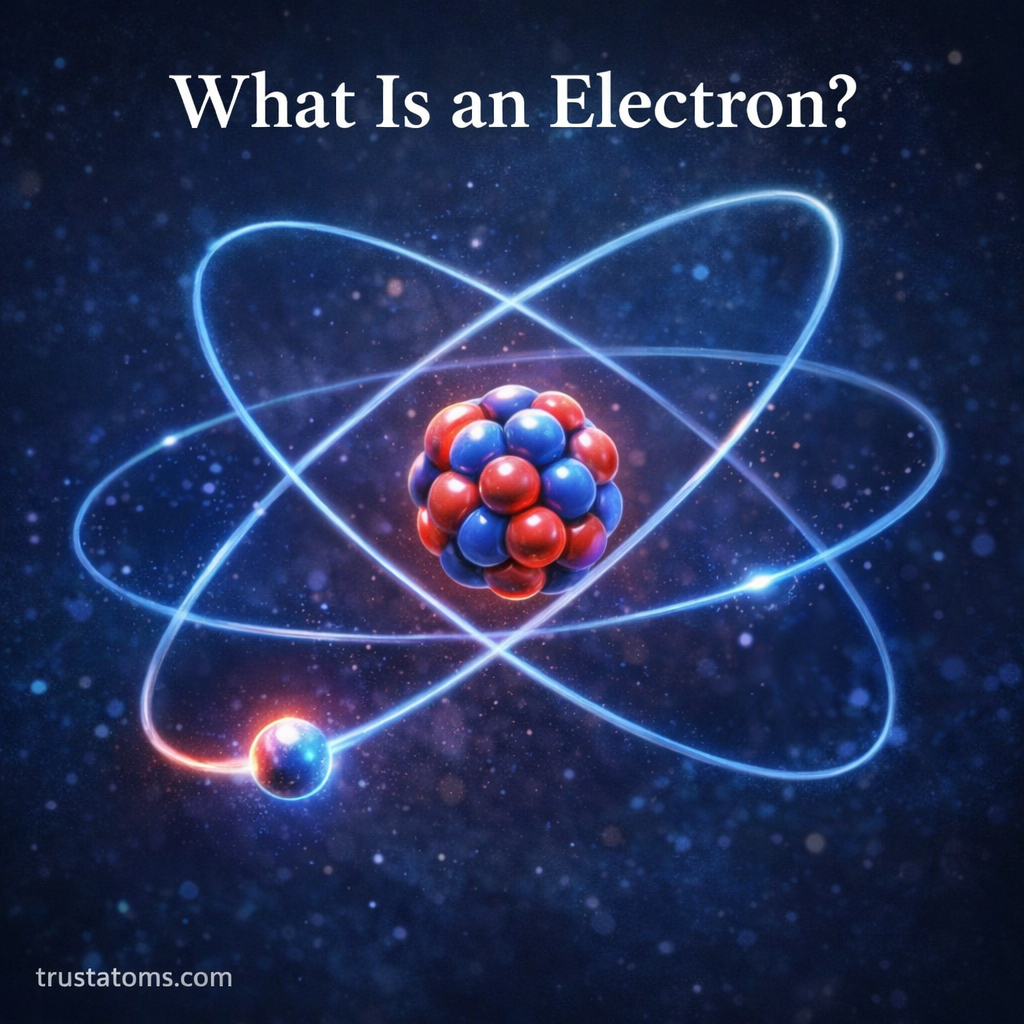
An electron is a subatomic particle with a negative electric charge that exists outside the nucleus of an atom.
Electrons move in regions of space around the nucleus known as electron clouds or orbitals. These areas represent where electrons are most likely to be found.
Key characteristics of electrons include:
- Negative electrical charge
- Extremely small mass
- Constant motion around the atomic nucleus
- Ability to participate in chemical bonding
Electrons are essential for determining the chemical behavior of atoms, making them central to the study of chemistry.
Where Electrons Are Located in an Atom
Atoms are composed of three main subatomic particles:
- Protons
- Neutrons
- Electrons
Structure of an Atom
- Protons have a positive charge and are located in the nucleus.
- Neutrons have no charge and are also located in the nucleus.
- Electrons have a negative charge and exist in orbitals surrounding the nucleus.
The nucleus sits at the center of the atom, while electrons occupy different energy levels or shells around it.
Because electrons carry a negative charge and protons carry a positive charge, they attract each other through electrical forces.
Important Properties of Electrons
Electrons have several unique properties that influence how atoms behave.
1. Negative Electric Charge
Electrons carry a −1 charge, which balances the positive charge of protons in neutral atoms.
For example:
- Hydrogen has 1 proton and 1 electron
- Carbon has 6 protons and 6 electrons
When the number of electrons equals the number of protons, the atom is electrically neutral.
2. Extremely Small Mass
Electrons have a much smaller mass than protons or neutrons.
In fact, an electron’s mass is about 1/1836 the mass of a proton. Because of this, most of an atom’s mass comes from the nucleus.
3. High Speed and Constant Motion
Electrons move rapidly within orbitals surrounding the nucleus. Instead of fixed paths like planets around the Sun, they exist in probability regions called electron clouds.
This concept comes from quantum mechanics, which describes how particles behave at extremely small scales.
Energy Levels and Electron Shells
Electrons occupy specific energy levels around the nucleus.
These levels are often called electron shells.
Basic Electron Shell Structure
Electrons fill shells starting from the lowest energy level outward:
- First shell – holds up to 2 electrons
- Second shell – holds up to 8 electrons
- Third shell – holds up to 18 electrons
Each shell represents a region where electrons are most likely to exist.
Electrons in the outermost shell are called valence electrons, and they play the most important role in chemical reactions.
The Role of Electrons in Chemical Bonding
Electrons are responsible for how atoms connect to form molecules.
Atoms bond with one another by sharing, gaining, or losing electrons.
Types of Chemical Bonds Involving Electrons
- Ionic Bonds
- One atom transfers electrons to another
- Creates positively and negatively charged ions
- Example: sodium chloride (table salt)
- Covalent Bonds
- Atoms share pairs of electrons
- Common in organic molecules and biological systems
- Metallic Bonds
- Electrons move freely among metal atoms
- Responsible for electrical conductivity in metals
These interactions allow atoms to combine into the vast variety of substances found in nature.
Electrons and Electricity
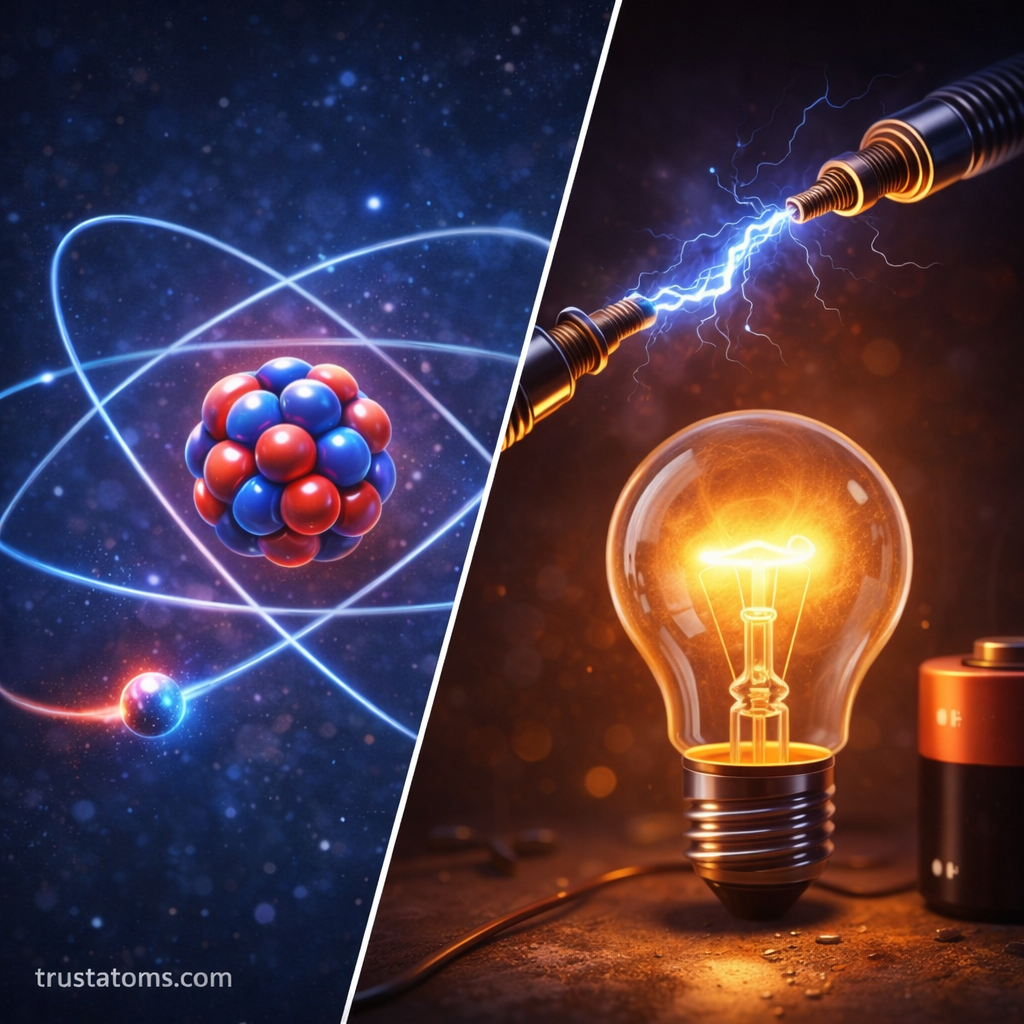
Electricity is essentially the movement of electrons through a material.
In conductive materials such as metals:
- Electrons can move freely between atoms
- This movement creates an electric current
Electrical systems rely on electron flow to power:
- Lights
- Computers
- Phones
- Household appliances
Without electrons, modern electrical technology would not exist.
How Electrons Were Discovered
The electron was discovered in 1897 by physicist J. J. Thomson.
The Cathode Ray Experiment
Thomson conducted experiments using vacuum tubes and electric fields.
He observed that:
- A beam of particles traveled from the negative electrode (cathode)
- These particles were attracted to positive charges
- The particles were extremely small and negatively charged
This discovery proved that atoms contained smaller components, revolutionizing atomic theory.
Why Electrons Matter in Chemistry
Electrons determine how atoms interact with one another. Nearly all chemical behavior can be explained by electron arrangement and movement.
Chemists study electrons to understand:
- Chemical reactions
- Molecular structures
- Material properties
- Energy transfer
- Electrical conductivity
By analyzing electron behavior, scientists can predict how substances will react and design new materials for medicine, technology, and industry.
Key Takeaways
Electrons are fundamental particles that shape the behavior of atoms and molecules.
Important points to remember:
- Electrons are negatively charged subatomic particles
- They move in orbitals around the atomic nucleus
- Their arrangement determines chemical properties
- They enable chemical bonding between atoms
- The flow of electrons produces electricity
Despite their tiny size, electrons play an enormous role in the structure of matter and the functioning of modern technology.