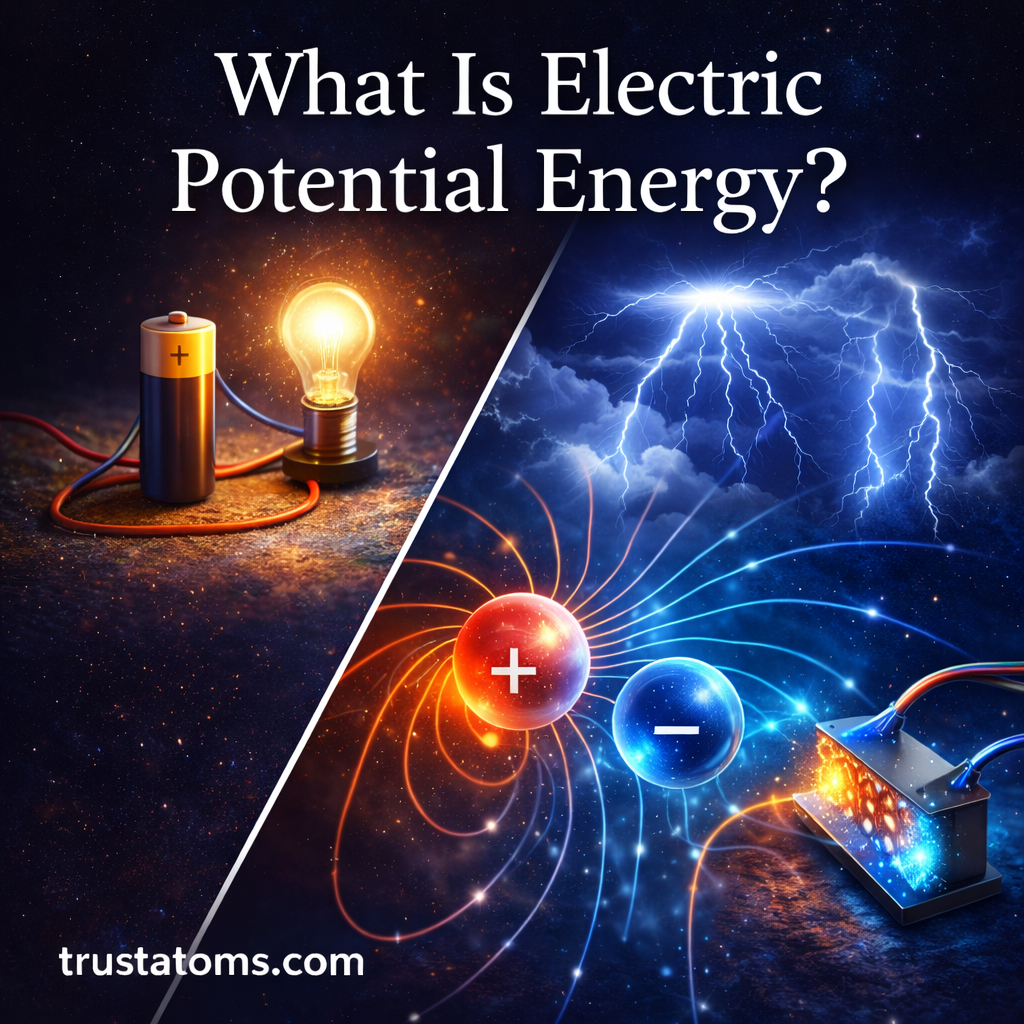
Electric potential energy is a form of stored energy that results from the position of charged particles within an electric field. It plays an important role in electricity, electronics, and many natural processes involving charged particles.
Whenever electric charges interact with one another—whether attracting or repelling—they create conditions where energy can be stored and later released. This stored energy is known as electric potential energy.
Understanding electric potential energy helps explain how batteries work, how electrical circuits operate, and how charged particles behave in fields created by other charges.
What Is Electric Potential Energy?
Electric potential energy is the energy stored in a system of electric charges due to their positions relative to one another.
It arises when charged particles interact through electric forces. These interactions can involve:
- Attraction between opposite charges
- Repulsion between like charges
- Movement of charges within an electric field
The energy stored in this system can later be converted into other forms of energy such as:
- Electrical energy
- Light
- Heat
- Mechanical motion
For example, when a battery stores energy, much of that energy exists as electric potential energy that can later power electronic devices.
How Electric Potential Energy Works
Electric potential energy depends on two main factors:
- The amount of electric charge
- The distance between the charges
When two charges interact, energy is stored in the electric field created by those charges.
Key behaviors include:
- Opposite charges attract, lowering the system’s potential energy when they move closer together.
- Like charges repel, increasing potential energy if they are forced closer together.
This relationship is similar to other forms of potential energy in physics, such as gravitational potential energy.
Just as lifting an object stores energy in Earth’s gravitational field, positioning charged particles within an electric field stores electric potential energy.
Electric Fields and Stored Energy
Electric potential energy exists because electric charges create electric fields around them.
An electric field is the region of space where other charged particles experience electric forces.
When a charged particle enters an electric field:
- It experiences a force
- Work may be done on the particle
- Energy can be stored or released depending on its movement
If a charge moves against the direction of the electric force, energy must be added to the system, increasing electric potential energy.
If it moves with the force, stored energy is released.
Electric Potential vs. Electric Potential Energy
Electric potential energy is closely related to a concept called electric potential, also known as voltage.
Although the terms sound similar, they describe different things.
Electric Potential Energy
Electric potential energy refers to the total stored energy in a system of charges.
It depends on:
- The amount of charge involved
- The electric field
- The position of the charges
Electric Potential (Voltage)
Electric potential describes the potential energy per unit charge.
It measures how much energy each unit of charge would gain or lose in an electric field.
In everyday electronics, electric potential is what we commonly call voltage.
Examples include:
- A 1.5-volt battery
- A 9-volt battery
- Household electrical outlets
Voltage represents the difference in electric potential between two points.
Examples of Electric Potential Energy
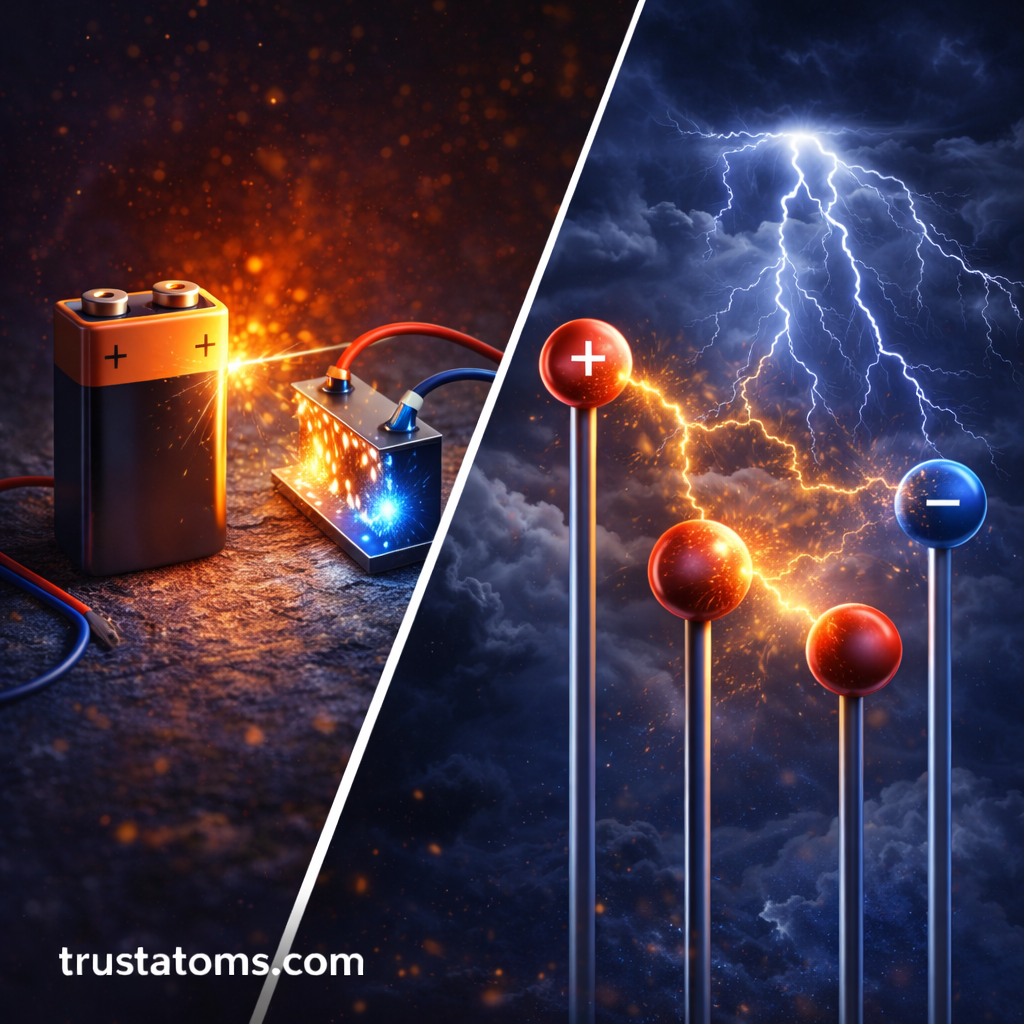
Electric potential energy appears in many natural and technological systems.
Batteries
Batteries store energy chemically and convert it into electric potential energy.
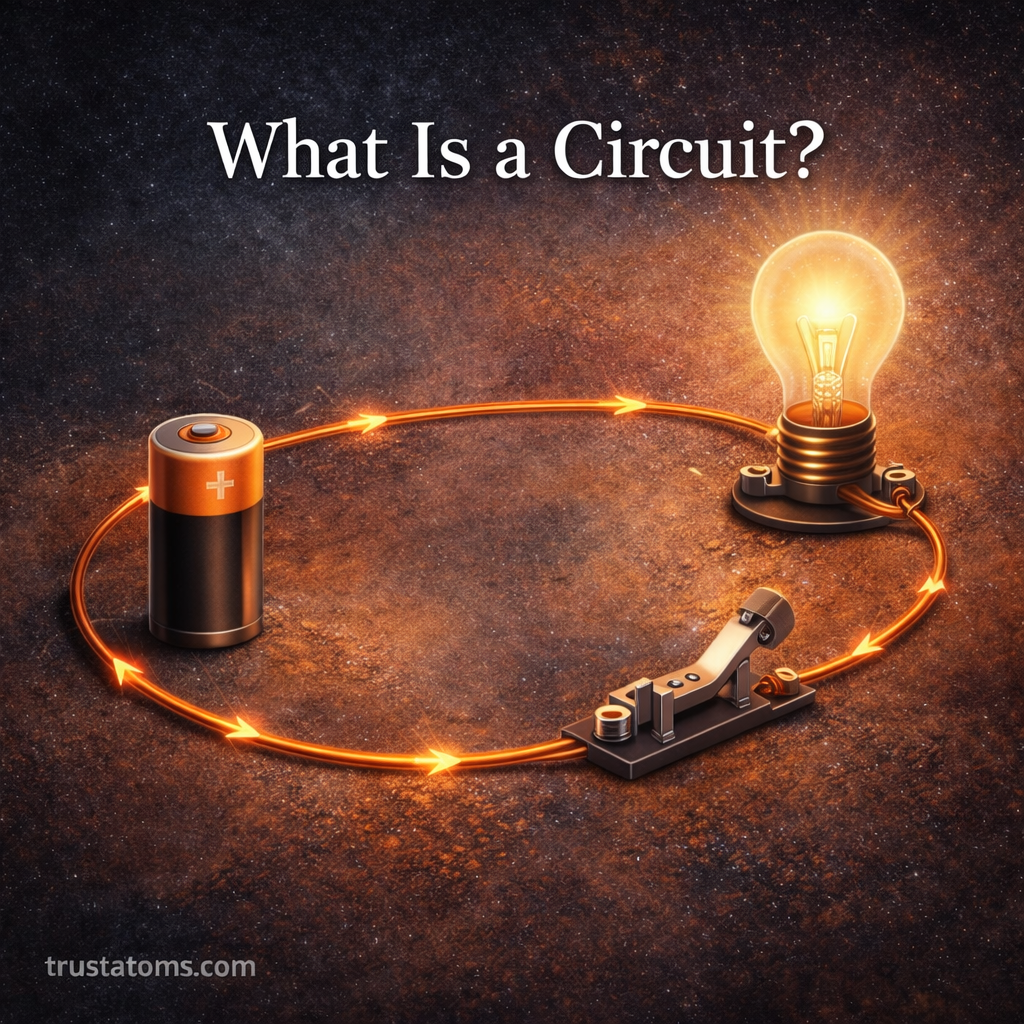
When a circuit is connected:
- Electric charges begin to move
- Stored potential energy is converted into electrical energy
- Devices such as lights, phones, or motors receive power
Capacitors
Capacitors are electronic components designed to store electric potential energy.
They consist of two conductive plates separated by an insulating material.
When connected to a power source:
- Electric charges accumulate on the plates
- An electric field forms between them
- Energy becomes stored in the field
Capacitors are used in many devices, including:
- Power supplies
- Cameras
- Radios
- Computers
Lightning
Lightning is a powerful natural example of electric potential energy.
During storms:
- Electrical charges build up in clouds
- Large differences in electric potential develop
- When the difference becomes strong enough, a sudden discharge occurs
This release of stored electric potential energy produces:
- Lightning flashes
- Thunder
- Intense heat
Energy Conversion in Electrical Systems
Electric potential energy often transforms into other forms of energy.
In electrical circuits, stored energy can become:
- Light in light bulbs
- Heat in electric heaters
- Motion in electric motors
- Sound in speakers
For example:
- A battery stores electric potential energy.
- The circuit allows charges to move.
- The stored energy converts into useful output such as light or motion.
This energy conversion is the foundation of modern electrical technology.
Why Electric Potential Energy Matters
Electric potential energy is essential to understanding how electricity works in both natural systems and human-made technologies.
It explains:
- How batteries power devices
- How electric circuits deliver energy
- How charged particles behave in electric fields
- How energy can be stored and released in electrical systems
Engineers and scientists use these principles when designing electronics, power systems, and communication technologies.
Electric Potential Energy in Everyday Life
Even though we cannot see electric potential energy directly, it influences many devices used every day.
Common examples include:
- Smartphones and laptops powered by batteries
- Electric vehicles storing energy for propulsion
- Power grids delivering electricity to homes
- Lightning storms in Earth’s atmosphere
- Static electricity generated by friction
In all of these cases, electric charges interact through electric fields, storing and releasing energy as electric potential energy.
Final Thoughts
Electric potential energy is the stored energy that results from the position of electric charges within an electric field. It arises from the interactions between charged particles and can be released when those charges move.
This form of energy is central to many technologies that power modern life, from batteries and electronic circuits to large-scale electrical power systems. By understanding electric potential energy, scientists and engineers can better explain how electricity works and how energy flows through electrical systems.