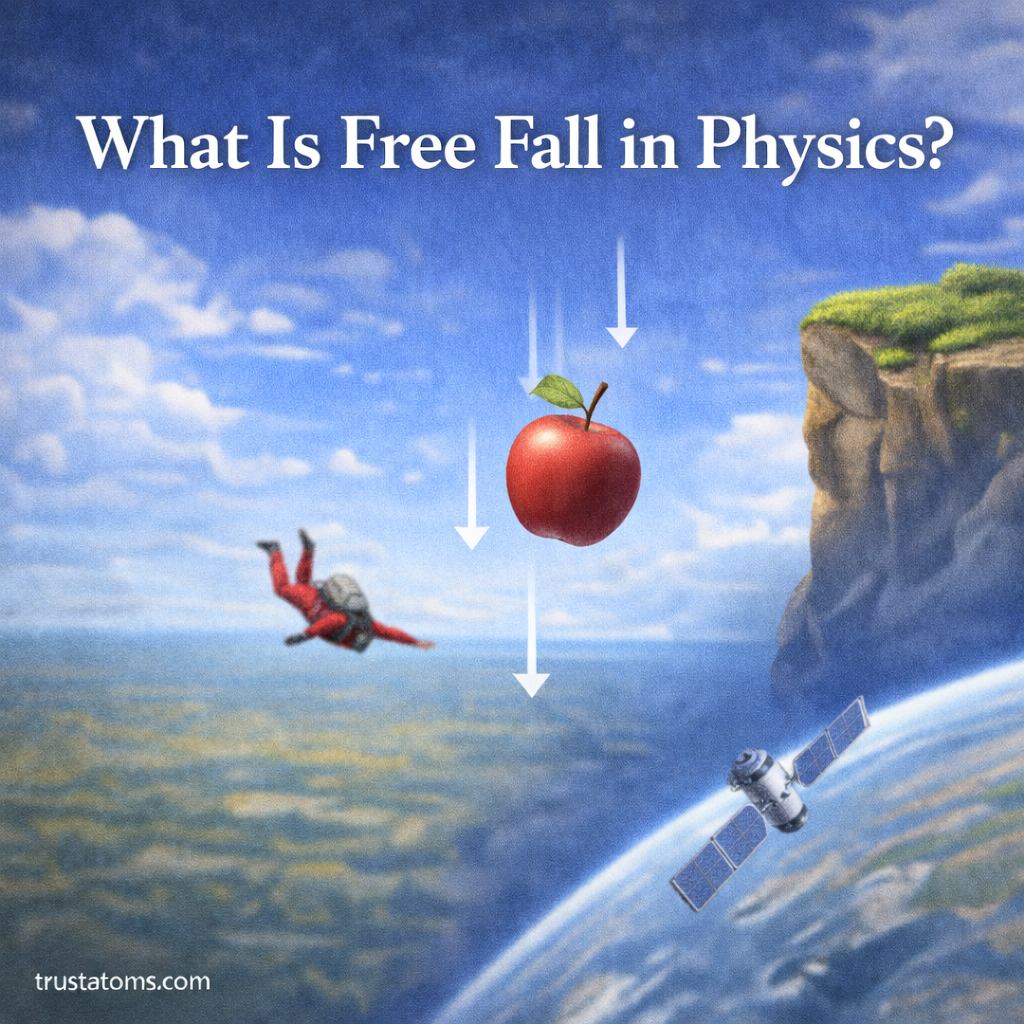
Free fall is a fundamental concept in physics that describes the motion of an object when gravity is the only force acting on it. When an object is in free fall, it accelerates toward Earth due to gravity alone, without interference from forces such as air resistance.
This concept helps scientists and students understand how objects move under the influence of gravity. Free fall explains phenomena ranging from a dropped ball to the motion of objects in space and the behavior of falling bodies on Earth.
Understanding Free Fall
In physics, free fall occurs when an object moves only under the influence of gravity.
This means that no other forces—such as friction, air resistance, or propulsion—are significantly affecting the object’s motion.
Examples of free fall include:
- A rock dropped from a cliff
- A ball released from a person’s hand
- An apple falling from a tree
- A skydiver falling before air resistance becomes significant
Even though air resistance often exists in real-world situations, physicists often simplify problems by ignoring it to better understand gravitational motion.
Acceleration Due to Gravity
One key feature of free fall is that all objects accelerate at the same rate due to gravity, regardless of their mass.
Near Earth’s surface, this acceleration is approximately:
- 9.8 meters per second squared (9.8 m/s²)
This means that during free fall:
- Speed increases continuously
- The object gains about 9.8 meters per second of velocity every second
For example:
- After 1 second, the object is moving about 9.8 m/s.
- After 2 seconds, it reaches about 19.6 m/s.
- After 3 seconds, it reaches about 29.4 m/s.
This constant acceleration continues until another force—like air resistance or impact with the ground—interferes.
Why Mass Does Not Affect Free Fall
A surprising aspect of free fall is that mass does not affect how fast objects fall.
In a vacuum (where there is no air resistance):
- A feather and a bowling ball fall at the same rate.
- Both accelerate equally under gravity.
This principle was famously demonstrated by experiments and observations associated with Galileo Galilei, who studied falling objects and challenged earlier beliefs that heavier objects fall faster.
In everyday life, air resistance often makes lighter objects fall more slowly, but the underlying gravitational acceleration remains the same.
Free Fall vs Falling With Air Resistance
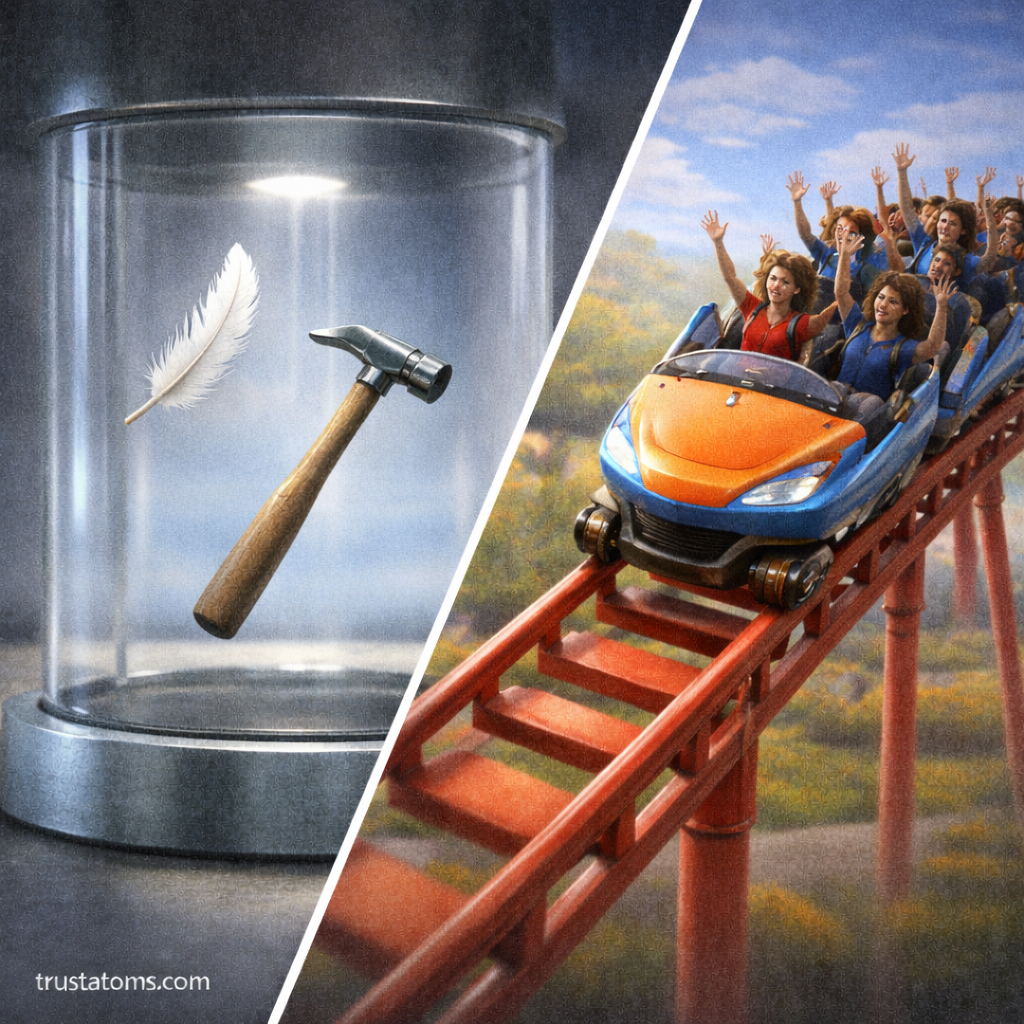
Many real-world falls are not perfect examples of free fall because air resistance affects motion.
Air resistance creates an upward force that opposes gravity.
As an object falls:
- Gravity pulls it downward
- Air resistance pushes upward
Eventually, these forces can balance, causing the object to reach terminal velocity, where it falls at a constant speed.
Examples where air resistance plays a role include:
- Parachutes slowing skydivers
- Leaves drifting from trees
- Paper fluttering downward
Because of this, pure free fall is best observed in environments without air, such as vacuum chambers or outer space experiments.
Examples of Free Fall in Everyday Life
Free fall appears in many everyday situations and natural phenomena.
Dropping Objects
When you drop an object from your hand, it initially enters free fall. Gravity pulls it downward and its speed increases as it falls.
Skydiving
A skydiver experiences near-free fall immediately after jumping from an aircraft, before air resistance becomes strong enough to slow the fall.
Roller Coasters
When a roller coaster rapidly descends a steep hill, riders briefly experience sensations similar to free fall.
Space Experiments
Astronauts in orbit appear weightless because both they and their spacecraft are in continuous free fall around Earth.
Free Fall in Space
Free fall does not only happen on Earth. It also occurs in space whenever gravity is the only force acting on an object.
For example:
- Satellites orbiting Earth are in constant free fall.
- The Moon is in free fall toward Earth but moves sideways fast enough to remain in orbit.
- Astronauts aboard the International Space Station experience weightlessness because they are falling around Earth.
This phenomenon explains why objects appear to float in space environments.
Why Free Fall Matters in Physics
Free fall is a key concept that helps scientists understand gravity, motion, and energy.
It plays an important role in many areas of science and engineering, including:
- Astronomy and planetary motion
- Rocket launches and space travel
- Engineering and structural safety
- Sports physics and motion analysis
By studying free fall, physicists can predict how objects move under gravity and develop models for motion in many real-world systems.
Key Takeaways
Free fall describes motion when gravity is the only force acting on an object.
Important points include:
- Free fall occurs when no other forces significantly affect motion.
- Objects accelerate downward at about 9.8 m/s² near Earth’s surface.
- In a vacuum, all objects fall at the same rate regardless of mass.
- Air resistance can alter real-world falling motion.
- Free fall explains phenomena such as falling objects, skydiving, and satellite orbits.
Understanding free fall provides insight into how gravity influences motion across both everyday experiences and large-scale systems in the universe.