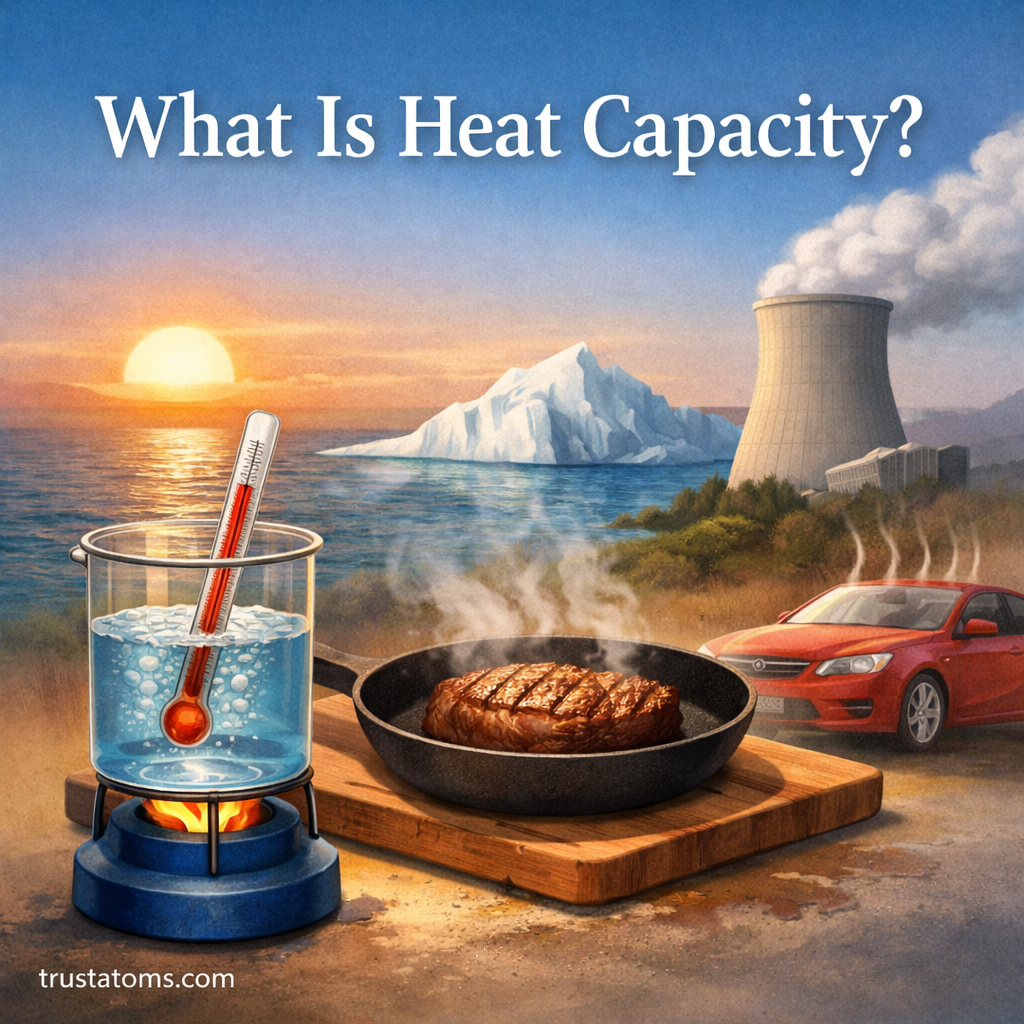
Heat capacity is a fundamental concept in physics that describes how much heat energy a substance must absorb to change its temperature. Some materials heat up quickly, while others require much more energy to increase in temperature. Heat capacity explains why this difference occurs.
Understanding heat capacity helps scientists and engineers predict how materials respond to heating and cooling. It plays a role in everyday phenomena such as cooking, climate regulation by oceans, engine design, and thermal insulation.
Understanding Heat Capacity
Heat capacity refers to the amount of heat required to raise the temperature of a substance by a specific amount.
In physics, it is commonly defined as the amount of heat energy needed to raise the temperature of an object by 1 degree Celsius (°C) or 1 Kelvin (K).
C = \frac{Q}{\Delta T}
Where:
- C = Heat capacity
- Q = Heat added to the system (in joules)
- ΔT = Change in temperature
This formula shows that heat capacity measures how much energy is required to change temperature.
For example:
- A material with high heat capacity needs a lot of energy to warm up.
- A material with low heat capacity warms up quickly with little energy.
Heat Capacity vs. Specific Heat Capacity
Heat capacity is closely related to another concept called specific heat capacity, but the two are not identical.
Heat Capacity
- Depends on the entire object
- Changes with the amount of material present
Specific Heat Capacity
- Measured per unit mass
- Represents an intrinsic property of a substance
For instance, if you double the amount of water in a container, the heat capacity doubles, but the specific heat capacity remains the same.
This distinction is important when scientists compare materials.
Units of Heat Capacity
The standard unit for heat capacity in the International System of Units (SI) is:
Joules per Kelvin (J/K)
Other commonly used units include:
- Joules per degree Celsius (J/°C)
- Calories per degree Celsius (cal/°C)
Because a temperature change of 1 K equals 1°C, these two units are often interchangeable when measuring heat capacity.
Why Heat Capacity Matters
Heat capacity influences many physical processes and real-world systems.
Climate and the Environment
Water has an unusually high heat capacity, meaning it absorbs large amounts of heat without rapidly changing temperature. This property helps regulate Earth’s climate by storing and slowly releasing heat.
Large bodies of water like oceans stabilize temperatures near coastlines and reduce extreme seasonal temperature changes.
Cooking and Everyday Life
Different materials transfer heat differently due to their heat capacity.
Examples include:
- Metal pans heat quickly because they generally have lower heat capacity.
- Water-based foods take longer to heat because water absorbs more energy.
Engineering and Technology
Engineers must account for heat capacity when designing systems that produce or manage heat.
Examples include:
- Car engines and cooling systems
- Electronic devices and processors
- Industrial furnaces and boilers
Correctly managing heat prevents overheating and improves efficiency.
Factors That Affect Heat Capacity
Several factors determine how much heat energy a substance can store.
1. Type of Material
Different substances have different atomic structures, which influence how energy is stored within the material.
For example:
- Water: high heat capacity
- Metals: typically lower heat capacity
2. Mass of the Object
Larger objects require more heat energy to raise their temperature because they contain more particles that must absorb energy.
3. Molecular Structure
Materials with more complex molecular structures can store energy in additional ways, such as vibrations and rotations of molecules.
This often results in higher heat capacities.
Heat Capacity in Thermodynamics
In thermodynamics, heat capacity plays a key role in describing how systems exchange energy.
Two commonly discussed forms include:
Heat Capacity at Constant Volume (Cv)
Measured when the volume of the system remains fixed.
Heat Capacity at Constant Pressure (Cp)
Measured when the system can expand while being heated.
These concepts are important in studying gases and understanding how energy moves through physical systems.
Real-World Examples of Heat Capacity

Here are several examples that demonstrate how heat capacity appears in everyday life:
- Ocean temperature stability
Oceans warm slowly in summer and cool slowly in winter. - Stone vs. sand at the beach
Sand heats quickly during the day because of lower heat capacity. - Cast-iron cookware
Cast iron stores heat well and maintains stable cooking temperatures. - Thermal energy storage systems
Some renewable energy systems store heat in materials with high heat capacity.
Heat Capacity and Energy Storage
Heat capacity is also important in energy storage technologies.
Thermal storage systems use materials capable of absorbing large amounts of heat without large temperature changes. These systems help store excess energy from renewable sources such as solar power.
Examples include:
- Molten salt energy storage
- Thermal batteries
- Phase-change materials
Such technologies allow energy to be used later when needed.
Final Thoughts
Heat capacity describes how much heat energy a substance must absorb to change its temperature. Materials with higher heat capacity require more energy to warm up, while materials with lower heat capacity heat quickly.
This concept plays an important role in physics, thermodynamics, climate science, engineering, and everyday life. From the way oceans regulate Earth’s climate to how cookware retains heat, heat capacity helps explain many thermal behaviors we experience daily.
Understanding heat capacity allows scientists and engineers to design more efficient systems, manage energy more effectively, and better predict how materials respond to heat.