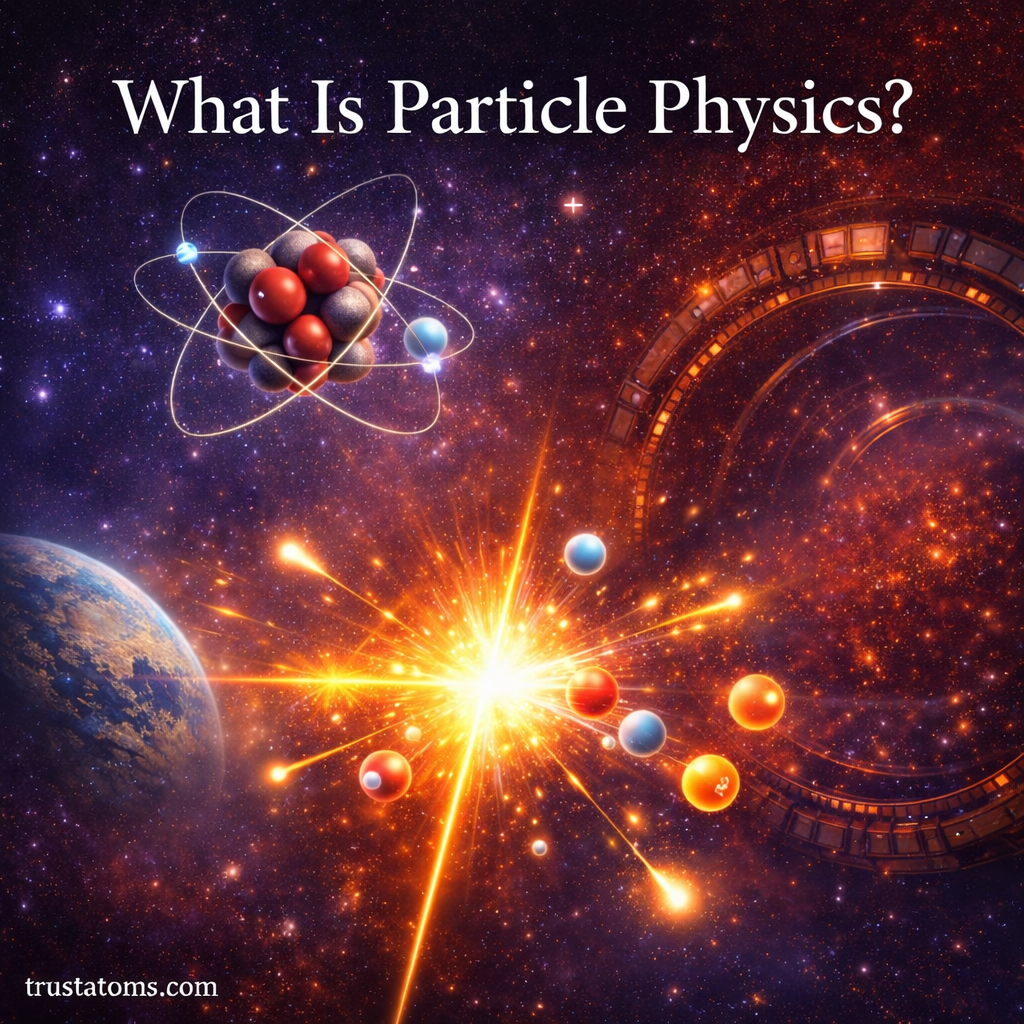
Particle physics is the branch of physics that studies the smallest known building blocks of the universe and the forces that govern how they interact. Instead of studying large objects like planets or stars, particle physicists focus on extremely tiny components of matter called elementary particles.
By investigating these particles, scientists try to answer some of the biggest questions in science:
- What is everything made of?
- How did the universe begin?
- What forces control matter and energy?
Particle physics sits at the foundation of modern science because it explores the most fundamental level of reality.
The Basic Idea Behind Particle Physics
Particle physics examines the particles that make up atoms and the even smaller particles inside them.
For much of history, scientists believed atoms were the smallest pieces of matter. Today we know that atoms themselves contain smaller components.
Atoms are made of:
- Protons
- Neutrons
- Electrons
Protons and neutrons are themselves composed of even smaller particles called quarks.
Particle physics investigates these elementary particles and the rules that determine how they behave.
What Are Elementary Particles?
Elementary particles are particles that cannot currently be divided into smaller parts. They represent the most basic ingredients of the universe.
Scientists categorize elementary particles into several groups.
Quarks
Quarks are the particles that form protons and neutrons.
There are six types, known as flavors:
- Up
- Down
- Charm
- Strange
- Top
- Bottom
Quarks combine in groups to form larger particles called hadrons, including protons and neutrons.
Leptons
Leptons are another class of fundamental particles.
Examples include:
- Electrons
- Muons
- Tau particles
- Neutrinos
Electrons are especially important because they orbit atomic nuclei and help determine the chemical properties of elements.
Force Carrier Particles
Some particles exist primarily to transmit forces between other particles.
Examples include:
- Photons – carry the electromagnetic force
- Gluons – hold quarks together inside protons and neutrons
- W and Z bosons – responsible for the weak nuclear force
These particles allow interactions between matter.
The Four Fundamental Forces
Particle physics studies how particles interact through four fundamental forces of nature.
1. Gravity
Gravity is the force that attracts objects with mass.
It controls:
- Planetary orbits
- The motion of galaxies
- The large-scale structure of the universe
However, gravity is extremely weak compared with other forces at the particle level.
2. Electromagnetic Force
The electromagnetic force acts between charged particles.
It governs:
- Electricity
- Magnetism
- Light
- Atomic structure
Photons carry this force.
3. Strong Nuclear Force
The strong force binds quarks together inside protons and neutrons.
It also holds atomic nuclei together.
This force is extremely powerful but acts only over very short distances.
4. Weak Nuclear Force
The weak force is responsible for certain types of radioactive decay and nuclear reactions.
It plays an important role in processes such as nuclear fusion inside stars.
The Standard Model of Particle Physics
The Standard Model is the scientific framework that describes the known fundamental particles and their interactions.
It organizes particles into categories and explains how three of the four fundamental forces work.
The Standard Model includes:
- Quarks
- Leptons
- Force carrier particles
- The Higgs boson
The discovery of the Higgs boson in 2012 confirmed an important prediction of this theory.
Despite its success, the Standard Model is not complete because it does not fully explain:
- Gravity at the quantum level
- Dark matter
- Dark energy
Scientists continue searching for new physics beyond this model.
How Scientists Study Particles
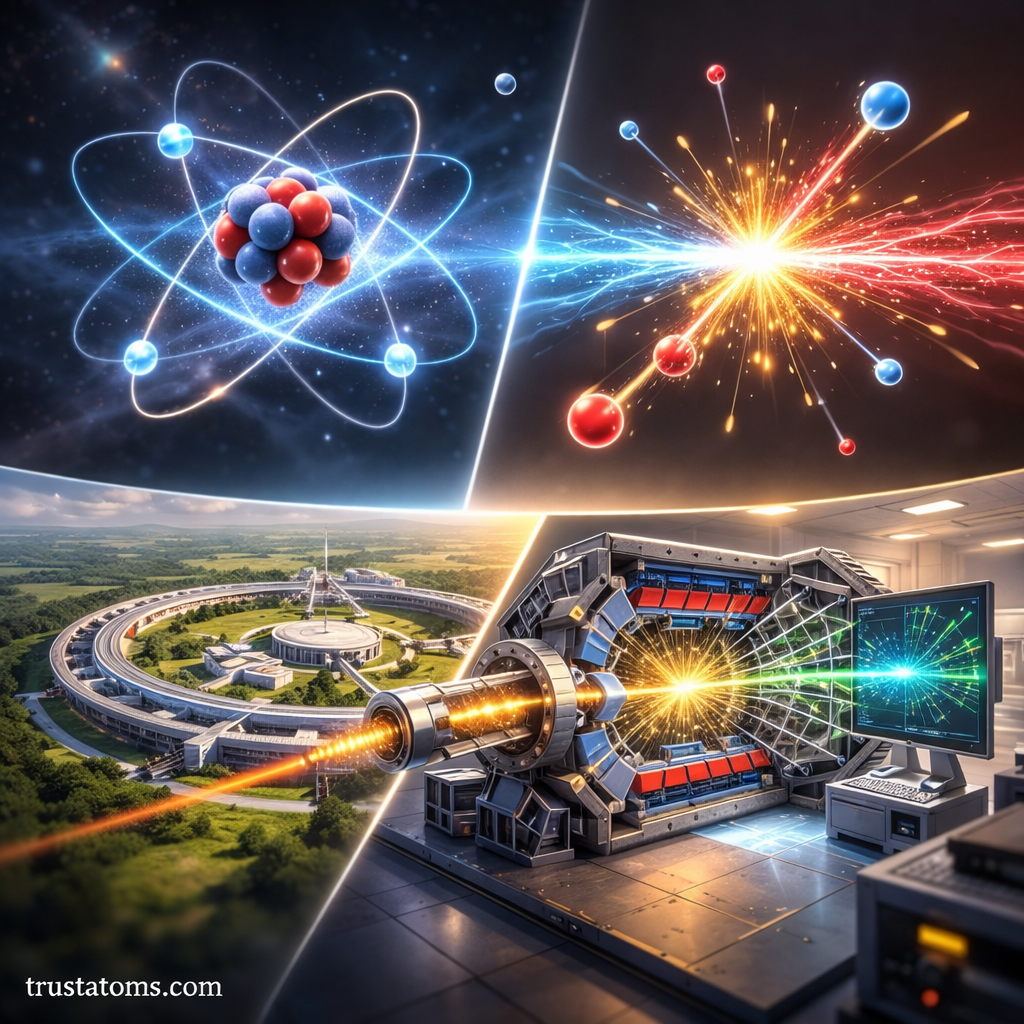
Because elementary particles are extremely small, scientists cannot observe them directly with traditional microscopes.
Instead, particle physicists use powerful research tools.
Particle Accelerators
Particle accelerators speed up particles to extremely high energies and collide them together.
These collisions create new particles that scientists can study.
One of the most famous accelerators is the Large Hadron Collider (LHC) at CERN in Switzerland.
Particle Detectors
Detectors surround collision areas to record what happens when particles interact.
They measure:
- Energy
- Momentum
- Particle tracks
These measurements allow physicists to reconstruct the events that occurred during collisions.
Why Particle Physics Matters
Although particle physics studies extremely small objects, its discoveries affect many areas of science and technology.
Understanding the Universe
Particle physics helps explain:
- How the universe formed after the Big Bang
- The structure of matter
- The behavior of fundamental forces
Advancing Technology
Research in particle physics has led to several important technologies, including:
- Medical imaging (PET scans)
- Radiation therapy for cancer
- Advanced computing systems
- The World Wide Web, originally developed at CERN
Exploring Unsolved Mysteries
Particle physics may help answer major scientific puzzles such as:
- What dark matter is made of
- Why the universe contains more matter than antimatter
- Whether additional particles or forces exist
The Future of Particle Physics
Scientists are continuing to push the boundaries of particle research.
Future experiments aim to:
- Build more powerful particle accelerators
- Detect dark matter particles
- Discover new particles beyond the Standard Model
- Understand quantum gravity
These discoveries could reshape our understanding of the universe.
Final Thoughts
Particle physics explores the smallest building blocks of reality and the forces that govern them. By studying elementary particles like quarks, leptons, and bosons, scientists gain insight into the fundamental structure of matter.
Although much has already been discovered, particle physics still contains many mysteries. As experiments grow more advanced, researchers continue uncovering clues about how the universe works at its deepest level.
Understanding particle physics not only expands human knowledge but also drives technological innovations that impact everyday life.