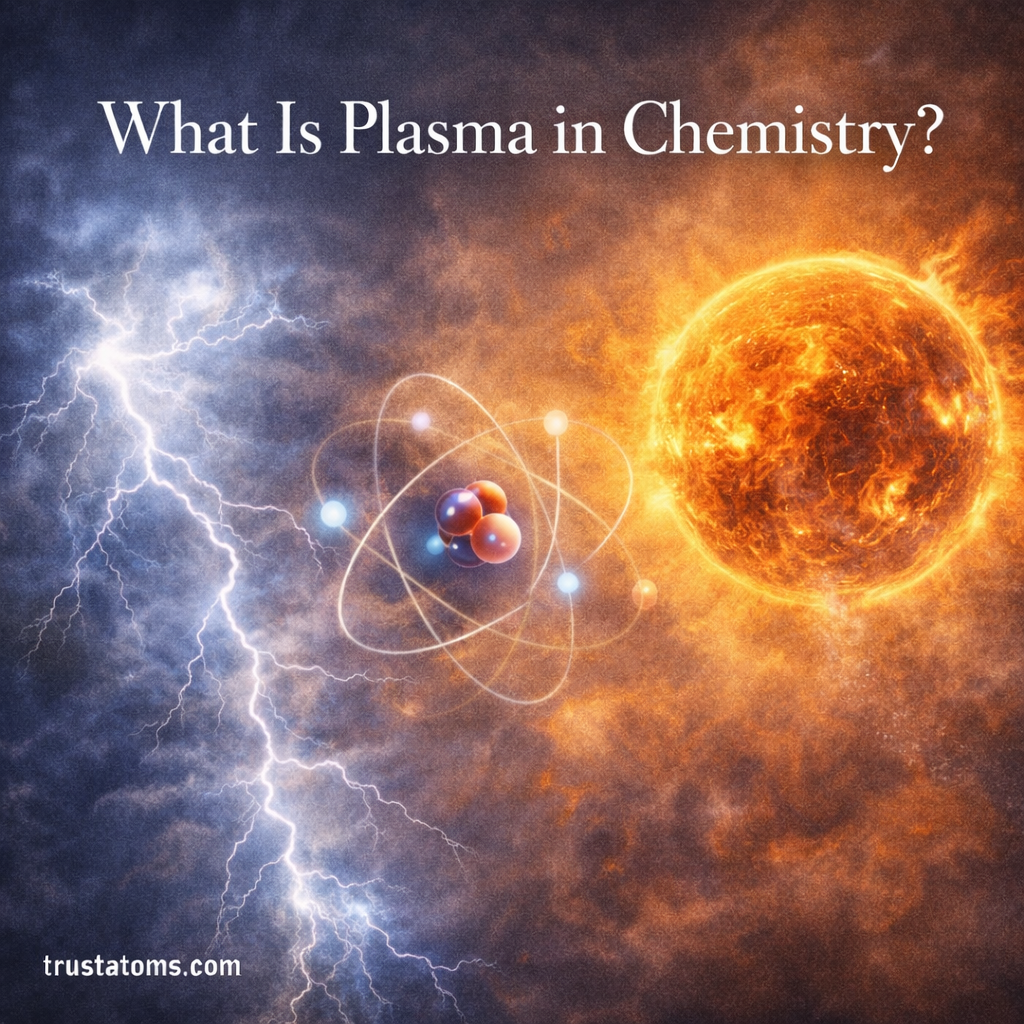
Plasma is often referred to as the fourth state of matter. While solids, liquids, and gases are commonly observed in everyday life, plasma exists under conditions of extremely high energy where atoms become ionized.
In chemistry and physics, plasma is important because it behaves very differently from other states of matter. It conducts electricity, responds to magnetic fields, and is found throughout the universe—from lightning on Earth to the interiors of stars.
Understanding plasma helps scientists study everything from space phenomena to advanced technologies used in manufacturing and medicine.
What Is Plasma?
Plasma is a high-energy state of matter composed of charged particles.
It forms when a gas receives enough energy that its atoms lose electrons. When this happens, the gas becomes a mixture of:
- Positively charged ions
- Free electrons
- Neutral atoms
Because the particles carry electrical charge, plasma behaves differently from ordinary gases.
In simple terms:
- Gas: neutral atoms moving freely
- Plasma: electrically charged particles moving freely
This ionization gives plasma unique physical and chemical properties.
How Plasma Forms
Plasma forms when a gas is exposed to very high temperatures or strong electrical energy.
These conditions provide enough energy to strip electrons away from atoms.
Steps in Plasma Formation
- A gas is heated or exposed to strong electrical energy.
- Atoms begin moving faster as energy increases.
- Electrons separate from atoms.
- Charged ions and free electrons form.
- The gas becomes electrically conductive plasma.
This process is known as ionization.
The higher the energy supplied to the gas, the more ionized the plasma becomes.
Key Properties of Plasma
Plasma has several properties that distinguish it from solids, liquids, and gases.
Electrically Conductive
Because plasma contains free-moving electrons and ions, it can conduct electricity efficiently.
This property allows plasma to interact with electrical currents and electromagnetic fields.
Influenced by Magnetic Fields
Unlike ordinary gases, plasma can be shaped or controlled using magnetic fields.
This behavior is important in areas such as nuclear fusion research.
Highly Energetic
Plasma particles move extremely fast due to their high energy levels.
This energy can cause plasma to emit bright light or glowing effects, which is why many plasma sources appear luminous.
Variable Density
Plasma density can vary greatly depending on temperature and pressure conditions.
Some plasmas are extremely hot and dense, while others are thin and diffuse.
Examples of Plasma in Nature
Although plasma is less familiar in everyday life than solids or liquids, it is extremely common in nature.
Stars
The Sun and other stars are massive spheres of plasma.
Inside stars, extremely high temperatures keep gases ionized, producing light and energy through nuclear reactions.
Lightning
Lightning occurs when electrical energy ionizes air molecules, briefly creating plasma in the atmosphere.
The bright flash seen during a lightning strike is glowing plasma.
Auroras
Auroras—such as the Aurora Borealis and Aurora Australis—occur when charged particles from the Sun interact with gases in Earth’s upper atmosphere, creating plasma that emits colorful light.
Interstellar Space
Large portions of space contain plasma made of ionized gas clouds and charged particles moving through magnetic fields.
Examples of Plasma in Technology

Plasma is used in several modern technologies and scientific applications.
Neon and Fluorescent Lights
In neon signs and fluorescent lamps, electricity passes through gas-filled tubes and ionizes the gas, producing glowing plasma that emits visible light.
Plasma Televisions
Older plasma televisions used tiny cells of plasma to generate images by producing colored light.
Plasma Cutting
Industrial plasma cutters use extremely hot plasma jets to cut through metal quickly and precisely.
Semiconductor Manufacturing
Plasma plays a role in microchip manufacturing, where it is used to etch microscopic patterns into silicon wafers.
Plasma vs Gas
Plasma is sometimes mistaken for a gas because both states have particles that move freely. However, they differ in important ways.
Gas Characteristics
- Particles are neutral atoms or molecules
- Does not conduct electricity easily
- Not strongly influenced by magnetic fields
Plasma Characteristics
- Contains ions and free electrons
- Conducts electricity
- Responds to magnetic and electric fields
- Often glows due to high energy
Because of these differences, plasma is classified as a separate state of matter.
Why Plasma Is Important in Science
Plasma plays a major role in many areas of scientific research.
Space and Astrophysics
Most visible matter in the universe exists in the plasma state, making it critical for understanding stars, galaxies, and cosmic radiation.
Nuclear Fusion Research
Scientists studying fusion energy attempt to control extremely hot plasma inside magnetic containment systems.
If successful, fusion could provide a powerful and clean energy source.
Materials Science
Plasma is used to modify surfaces, create coatings, and manufacture advanced materials.
Medicine and Sterilization
Cold plasma technologies are being studied for:
- Sterilizing medical equipment
- Treating wounds
- Killing bacteria without damaging surrounding tissue
Plasma Compared to Other States of Matter
The four major states of matter can be summarized by particle behavior.
Solid
- Particles tightly packed
- Fixed shape and volume
- Low energy
Liquid
- Particles close together but mobile
- Fixed volume
- Moderate energy
Gas
- Particles widely spaced
- No fixed shape or volume
- Higher energy
Plasma
- Ionized charged particles
- Extremely high energy
- Conducts electricity and interacts with magnetic fields
Plasma represents the most energetic of these states.
Everyday Encounters With Plasma
Even though plasma is more common in extreme environments, it can still appear in everyday life.
Examples include:
- Neon signs
- Plasma globes
- Lightning storms
- Fluorescent lighting
These examples demonstrate how electrical energy can transform gases into glowing plasma.
Final Thoughts
Plasma is the fourth state of matter and forms when gases gain enough energy to become ionized. Unlike solids, liquids, or gases, plasma consists of charged particles that conduct electricity and interact with magnetic fields.
Although it is less familiar in everyday settings, plasma is actually the most abundant state of matter in the universe. From the Sun and stars to lightning and modern technology, plasma plays a crucial role in both natural phenomena and scientific innovation.
Studying plasma helps scientists understand the universe, develop advanced technologies, and explore new energy sources for the future.