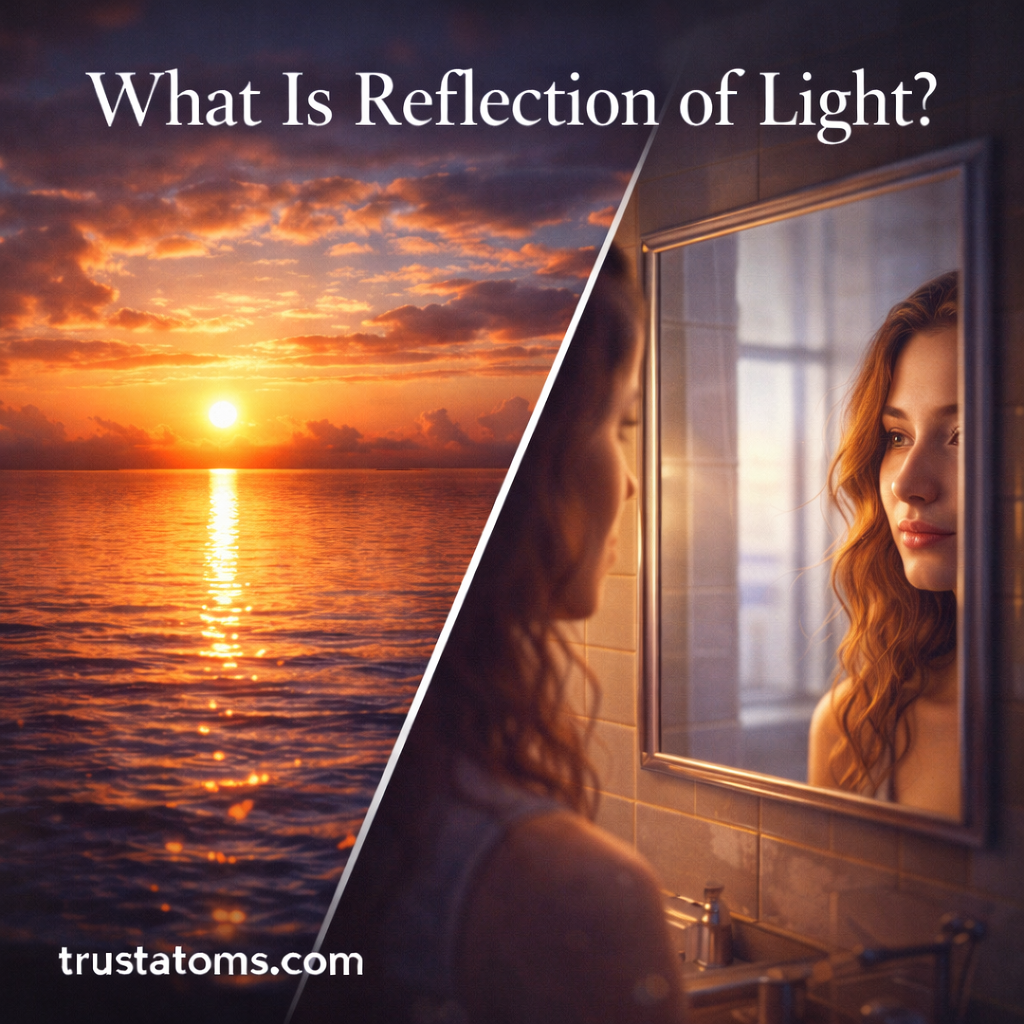
Reflection of light is a basic physical process that occurs when light waves bounce off a surface instead of passing through it. This phenomenon allows us to see objects, observe mirrors, and understand how light interacts with the world around us.
Every day, reflection makes many common experiences possible—from looking at your reflection in a mirror to seeing sunlight reflecting off water or glass. In physics, studying how light reflects helps scientists understand optics, imaging systems, and the behavior of electromagnetic waves.
What Is Reflection of Light?
Reflection of light occurs when light strikes a surface and bounces back into the surrounding environment rather than being absorbed or transmitted.
When light hits a surface, three things can happen:
- The light can be reflected
- The light can be absorbed
- The light can be transmitted through the material
Reflection happens because light behaves like a wave that interacts with atoms on the surface of materials. These interactions redirect the light back into space.
This process allows our eyes to detect light reflected from objects, making vision possible.
How Reflection Works
Reflection occurs when light waves encounter a surface and change direction.
The process typically follows these steps:
- Light travels from a source such as the Sun or a light bulb.
- The light reaches a surface.
- The surface redirects the light waves.
- The reflected light travels to the observer’s eyes.
For example, when you look in a mirror, light from your body reflects off the mirror and travels back to your eyes, allowing you to see your reflection.
The Law of Reflection
In physics, reflection follows a predictable rule known as the law of reflection.
The law states that:
- The angle of incidence equals the angle of reflection.
This means that the angle at which light strikes a surface is the same as the angle at which it leaves the surface.
The angles are measured relative to an imaginary line called the normal, which is perpendicular to the reflecting surface.
This principle applies to many types of reflective surfaces, including mirrors, water, and polished metals.
Types of Reflection
Not all reflections appear the same. The way light reflects depends largely on the smoothness of the surface.
There are two primary types of reflection.
Specular Reflection
Specular reflection occurs when light reflects from a smooth surface.
In this case:
- Light rays reflect in a uniform direction
- Clear images can be formed
- The reflection appears sharp and defined
Examples of specular reflection include:
- Mirrors
- Calm water surfaces
- Polished metal
- Glass surfaces
Specular reflection is what allows mirrors to create accurate images.
Diffuse Reflection
Diffuse reflection occurs when light strikes a rough or uneven surface.
Instead of reflecting in one direction, the light scatters in many directions.
Characteristics include:
- No clear image is formed
- Light spreads out across the surface
- Objects become visible from many angles
Examples of diffuse reflection include:
- Paper
- Walls
- Wood
- Fabric
Most objects we see every day are visible because of diffuse reflection.
Reflection and Human Vision
Reflection of light is essential for human vision.
Objects do not produce light on their own unless they are light sources. Instead, we see them because they reflect light from other sources.
The process works like this:
- Light from a source such as the Sun or a lamp hits an object.
- The object reflects some of that light.
- The reflected light enters the eyes.
- The brain interprets the incoming light as an image.
Without reflection, objects would remain invisible to our eyes.
Everyday Examples of Light Reflection
Reflection of light occurs constantly in everyday life.
Common examples include:
- Seeing yourself in a mirror
- Sunlight reflecting off water
- Reflections in windows
- Shiny metal surfaces
- Headlights reflecting off road signs
Even objects that appear dull reflect light. The difference is that rough surfaces scatter light rather than producing a clear image.
Reflection in Technology
Reflection plays an important role in many scientific and technological systems.
Optical Instruments
Many devices rely on mirrors and reflective surfaces to control light.
Examples include:
- Telescopes
- Periscopes
- Microscopes
- Cameras
These instruments use carefully shaped mirrors to direct and focus light.
Solar Energy Systems
Solar panels and solar concentrators use reflective surfaces to direct sunlight toward energy-collecting components.
This helps increase the efficiency of solar energy systems.
Road and Safety Signs
Reflective materials on road signs and safety gear help drivers see them clearly at night.
These surfaces reflect light from vehicle headlights back toward the driver.
Satellite Communication
Many satellite dishes and antennas use reflective shapes to focus electromagnetic signals toward receivers.
This allows communication signals to travel long distances efficiently.
Why Reflection of Light Matters
Reflection is one of the fundamental ways that light interacts with matter.
It helps scientists understand:
- Optical systems
- Imaging technologies
- Laser devices
- Astronomical observations
Without reflection, many technologies—including cameras, telescopes, and mirrors—would not function.
Reflection also helps explain how light behaves when it encounters different surfaces and materials.
Final Thoughts
Reflection of light occurs when light waves bounce off a surface instead of being absorbed or transmitted. This simple process allows us to see objects, observe reflections in mirrors, and develop many technologies that rely on controlling light.
From everyday mirrors to advanced optical instruments, reflection plays a key role in both natural vision and scientific innovation. Understanding how light reflects helps explain how we observe the world and how engineers design systems that use light effectively.