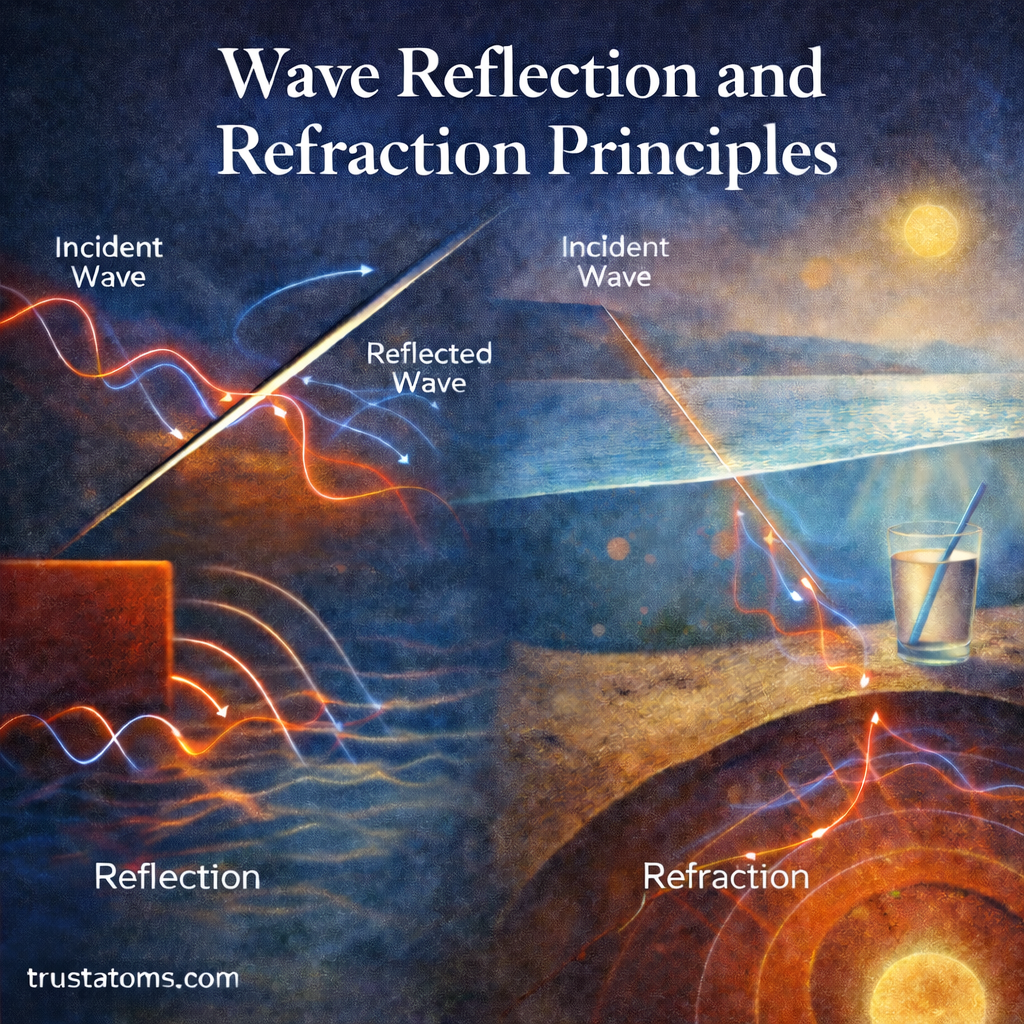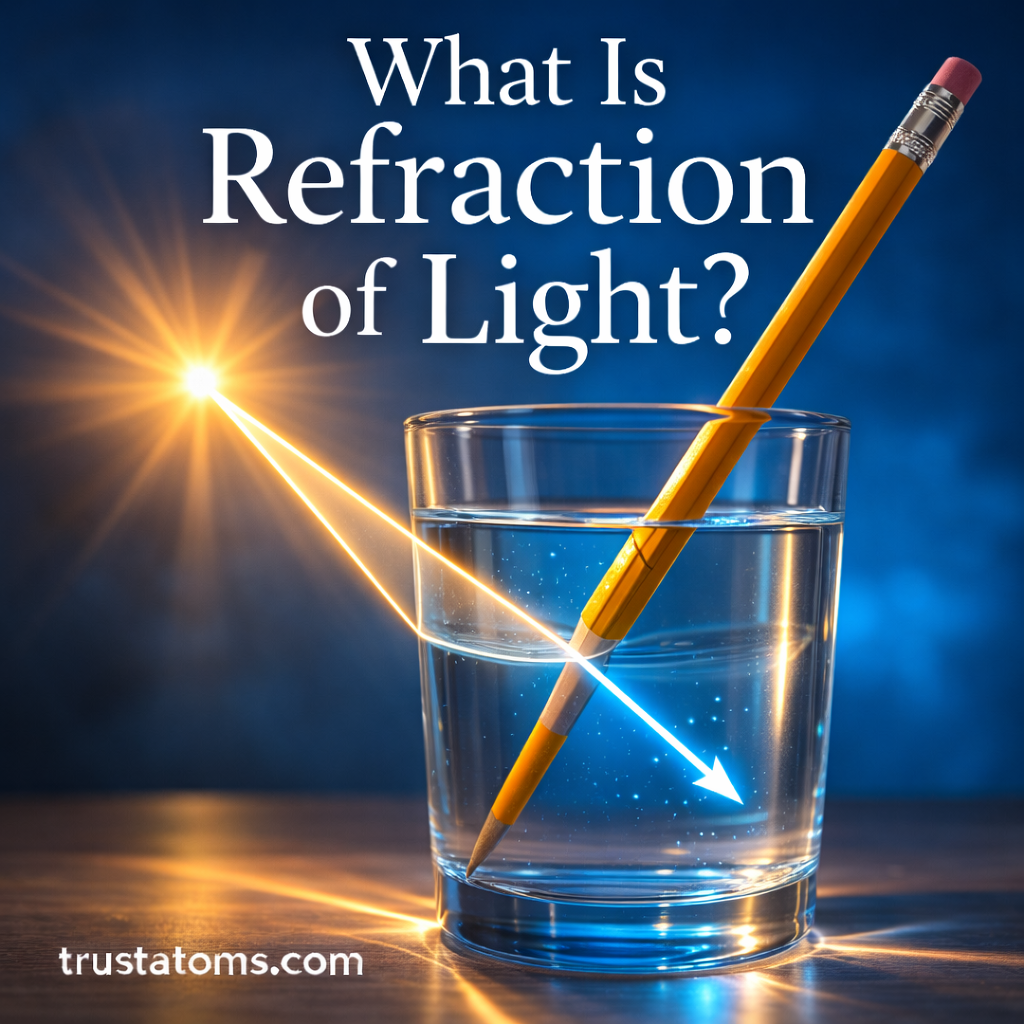
Refraction of light is a fundamental concept in physics that explains how light changes direction when it passes from one medium to another. This bending of light occurs because light travels at different speeds in different materials.
Refraction is responsible for many everyday visual effects, such as a straw appearing bent in a glass of water or rainbows forming in the sky. It also plays a key role in technologies like lenses, cameras, microscopes, and eyeglasses.
Understanding refraction helps scientists and engineers design optical systems and explains how light behaves as it moves through the world.
What Is Refraction of Light?
Refraction of light occurs when light changes direction as it passes from one medium into another medium with a different optical density.
A medium is any material through which light travels. Common examples include:
- Air
- Water
- Glass
- Plastic
When light moves between these materials, its speed changes. Because of this change in speed, the light bends at the boundary between the two materials.
This bending of light is called refraction.
Why Refraction Happens
Refraction happens because light travels at different speeds in different materials.
For example:
- Light travels fastest in a vacuum.
- It slows slightly in air.
- It slows more in water.
- It slows even more in glass.
When light enters a material where it travels more slowly, it bends toward the normal (an imaginary line perpendicular to the surface). When it enters a material where it travels faster, it bends away from the normal.
The change in speed causes the direction of the light to change.
The Law of Refraction
Refraction follows a predictable rule called the law of refraction, also known as Snell’s Law.
This law explains how the angle of incoming light relates to the angle of the refracted light when it enters a different medium.
Key ideas of the law include:
- The incident ray, refracted ray, and normal line all lie in the same plane.
- The angles depend on the optical properties of the two materials involved.
- Each material has a property called the refractive index, which describes how strongly it bends light.
The refractive index determines how much light slows down and how sharply it bends when entering a material.
Examples of Refraction in Everyday Life
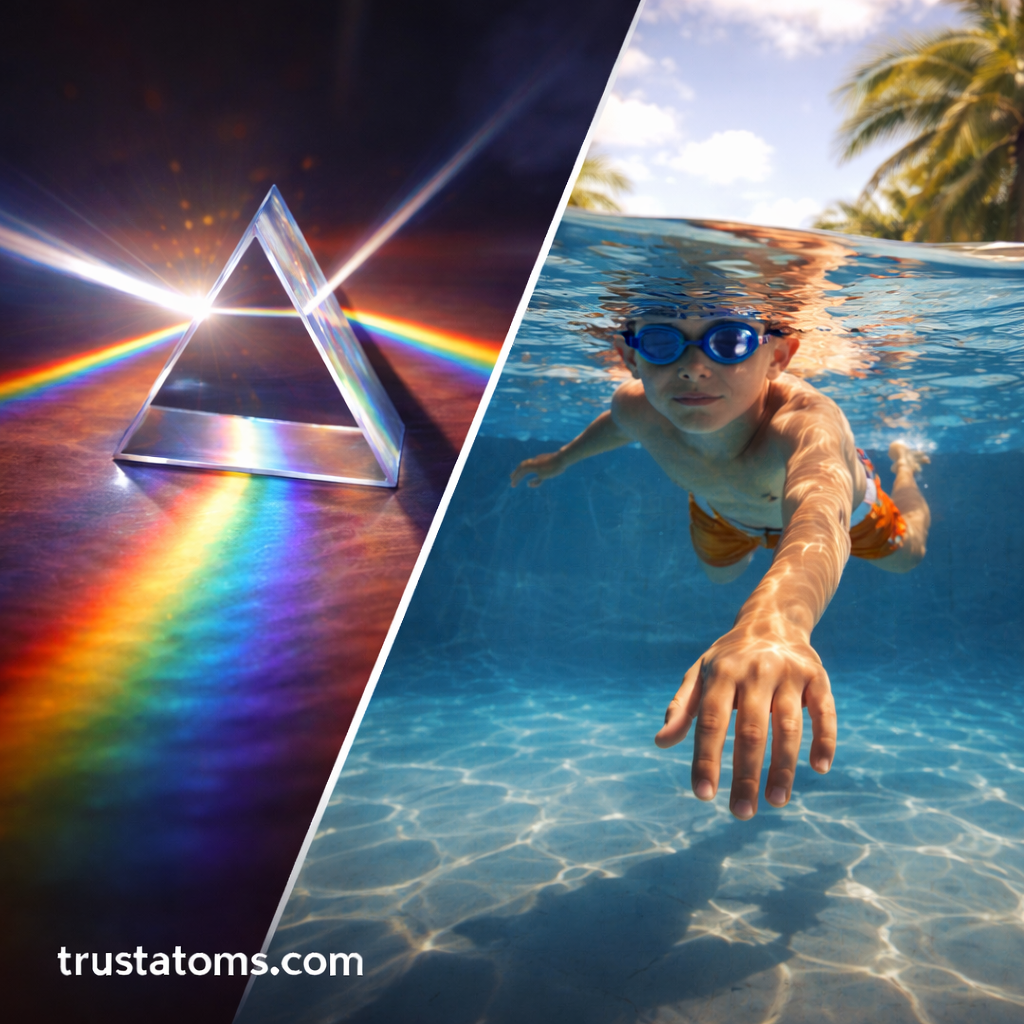
Refraction occurs constantly in nature and in everyday experiences.
A Straw in Water
When a straw is placed in a glass of water, it often appears bent or broken at the water’s surface.
This happens because light from the submerged portion of the straw refracts as it moves from water into air.
Rainbows
Rainbows form when sunlight enters raindrops in the atmosphere.
Inside the droplet:
- Light refracts as it enters the water.
- It reflects off the inner surface of the droplet.
- It refracts again as it exits.
This process separates white sunlight into different colors.
Swimming Pools
Objects underwater appear closer to the surface than they actually are.
This effect occurs because light bends as it leaves the water and enters the air.
Atmospheric Refraction
Earth’s atmosphere can also bend light slightly.
This is why the Sun can sometimes be seen just before it fully rises or after it sets. The atmosphere bends the sunlight, allowing it to reach the observer even when the Sun is slightly below the horizon.
Refraction in Optical Devices
Many important technologies rely on refraction to control and focus light.
Eyeglasses and Contact Lenses
Corrective lenses use refraction to adjust how light enters the eye.
They help focus light properly onto the retina, improving vision.
Cameras
Camera lenses use carefully shaped glass elements to refract light and focus images onto sensors or film.
Without refraction, cameras could not capture sharp photographs.
Microscopes
Microscopes use multiple lenses that refract light to magnify extremely small objects such as cells and microorganisms.
Telescopes
Refracting telescopes use lenses to bend incoming light from distant stars and planets, focusing it to produce clear images.
Refraction and Color
Refraction also explains why white light separates into different colors when passing through certain materials.
Different wavelengths of light bend by different amounts when they refract.
This phenomenon is called dispersion.
A common example is a prism, which splits white light into a spectrum of colors.
The colors appear in the familiar order:
- Red
- Orange
- Yellow
- Green
- Blue
- Indigo
- Violet
Dispersion is also responsible for the colors seen in rainbows.
Why Refraction Matters in Physics
Refraction is essential for understanding how light interacts with matter.
It helps scientists study:
- Optical systems
- Atmospheric effects
- Astronomical observations
- Laser technologies
- Fiber optic communication
Refraction also allows engineers to design devices that precisely control the path of light.
Final Thoughts
Refraction of light occurs when light changes direction as it passes between materials with different optical properties. This bending happens because light travels at different speeds in different substances.
From the bending of a straw in water to the formation of rainbows and the operation of cameras and eyeglasses, refraction plays an important role in both everyday life and advanced technology. By studying refraction, scientists gain deeper insight into the behavior of light and the principles that govern optical systems.