Introduction
The law of reflection is a fundamental principle in physics that explains how light behaves when it strikes a reflective surface. It describes the predictable way in which light bounces off surfaces such as mirrors, calm water, or polished metal.
Understanding the law of reflection helps scientists and engineers design optical systems, telescopes, cameras, and many everyday technologies that rely on controlled light behavior.
In simple terms, the law of reflection states that light reflects off a surface at the same angle it arrives.
What Is Reflection?
Reflection occurs when light waves strike a surface and bounce back into the original medium instead of passing through the material.
This process happens constantly around us. Every time we see our reflection in a mirror or observe sunlight glinting off water, reflection is taking place.
Reflection allows objects to become visible because light rays bounce off their surfaces and travel into our eyes.
The Law of Reflection Explained
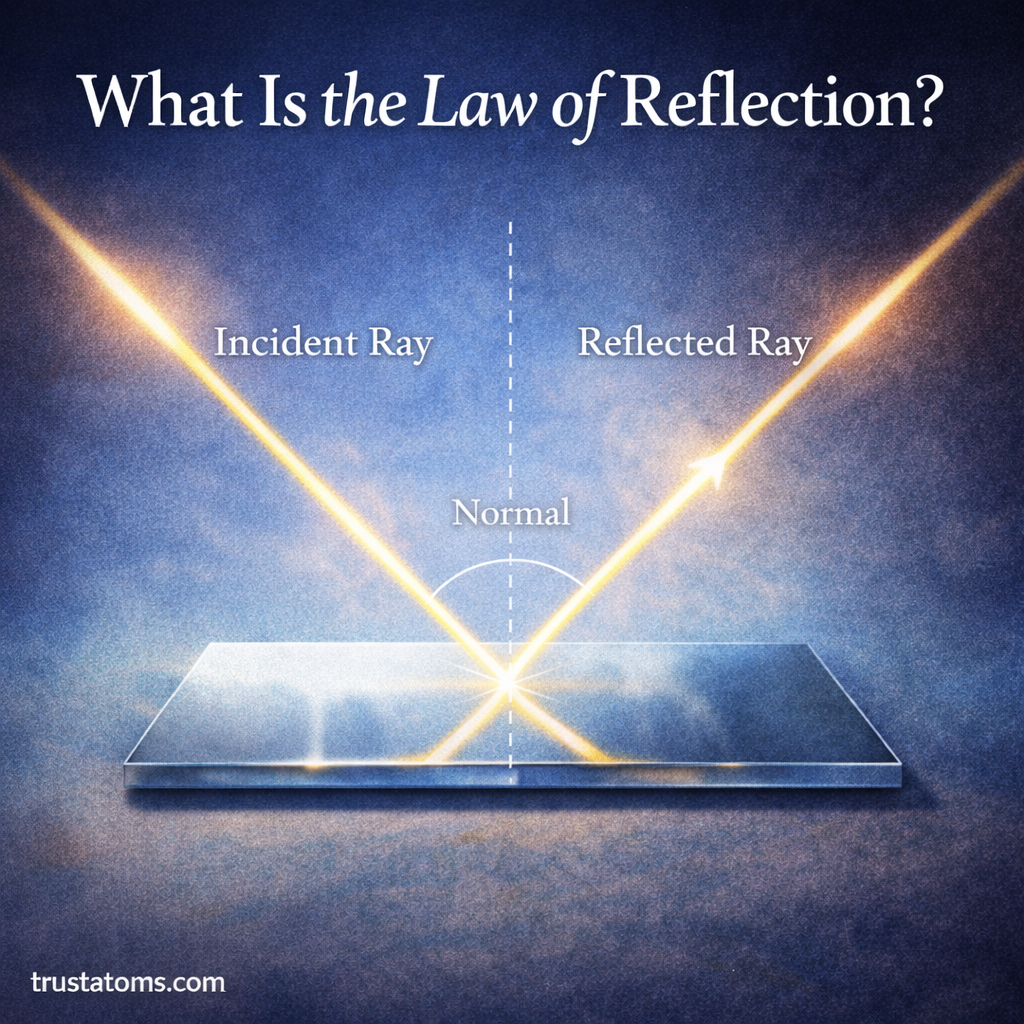
The law of reflection states two important rules about how light behaves when it reflects off a surface.
Rule 1: Angle of Incidence Equals Angle of Reflection
The angle of incidence is the angle between the incoming light ray and a line perpendicular to the surface.
The angle of reflection is the angle between the reflected ray and the same perpendicular line.
According to the law of reflection:
- The angle of incidence is always equal to the angle of reflection.
This means if light hits a surface at a certain angle, it will bounce away at exactly the same angle.
Rule 2: Rays and the Normal Lie in the Same Plane
The second rule states that three elements always lie in the same plane:
- The incoming ray of light
- The reflected ray of light
- The normal line (an imaginary line perpendicular to the surface)
This ensures the reflection follows a predictable geometric pattern.
Key Terms in the Law of Reflection
Understanding reflection becomes easier when you know the main terms used in optics.
Incident Ray
The incident ray is the incoming light ray that strikes a surface.
Reflected Ray
The reflected ray is the light ray that bounces away from the surface after contact.
Normal Line
The normal is an imaginary line drawn perpendicular to the surface at the point where the light hits.
Angles are always measured relative to this normal line rather than the surface itself.
Types of Reflection
Reflection can occur in different ways depending on the type of surface involved.
Specular Reflection
Specular reflection occurs when light reflects off a smooth surface, such as:
- Mirrors
- Calm water
- Polished metal
- Glass
In specular reflection, the reflected rays remain orderly and travel in a single direction. This creates clear, sharp images.
Diffuse Reflection
Diffuse reflection occurs when light hits a rough surface, such as:
- Paper
- Fabric
- Painted walls
- Wood
Instead of reflecting in one direction, the light scatters in many directions. This scattering allows objects to be seen from multiple angles but prevents clear reflections.
How Mirrors Use the Law of Reflection
Mirrors work because of the predictable behavior described by the law of reflection.
When light rays from an object strike a mirror:
- The rays hit the mirror surface.
- Each ray reflects at the same angle it arrives.
- The reflected rays travel toward the observer’s eyes.
- The brain interprets the rays as coming from behind the mirror.
This creates the illusion of an image behind the mirror surface.
Everyday Examples of Reflection
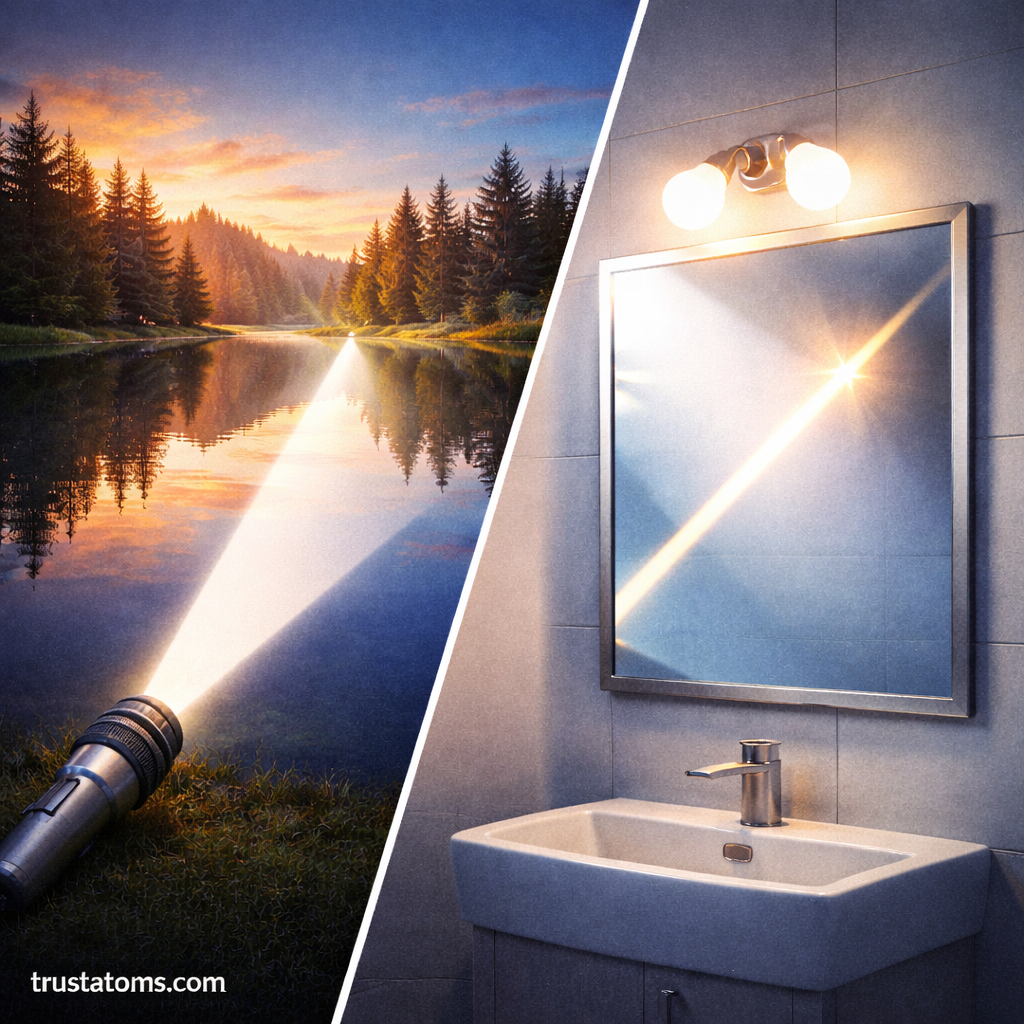
Reflection appears in many common situations.
Some familiar examples include:
- Seeing your face in a bathroom mirror
- Sunlight reflecting off a lake
- Light bouncing off a shiny car surface
- Reflections in glass windows
- Flashlight beams reflecting from mirrors
Even surfaces that are not perfectly smooth still reflect light in some form.
Reflection in Optical Technology
The law of reflection plays a critical role in modern technology and scientific instruments.
Periscopes
Periscopes use mirrors to redirect light, allowing viewers to see objects from different angles or over obstacles.
Telescopes
Reflecting telescopes use curved mirrors to gather and focus light from distant stars and galaxies.
Cameras
Some cameras use reflective mirrors to direct light from the lens toward sensors or viewfinders.
Laser Systems
Precision mirrors guide and control laser beams in scientific and industrial applications.
Reflection vs Refraction
Reflection is often confused with refraction, but the two processes are different.
Reflection occurs when:
- Light bounces off a surface.
Refraction occurs when:
- Light passes through a material and bends due to a change in speed.
Both processes are essential to understanding how light behaves in optical systems.
Why the Law of Reflection Matters
The law of reflection is one of the most important concepts in optics because it allows scientists to predict how light will behave.
This predictability is essential for designing technologies such as:
- Optical instruments
- Fiber optic systems
- Solar energy devices
- Scientific measurement tools
Without a clear understanding of reflection, modern imaging and optical technology would not be possible.
Final Thoughts
The law of reflection explains how light behaves when it encounters reflective surfaces. By stating that the angle of incidence equals the angle of reflection and that both rays lie in the same plane as the normal, this law provides a simple yet powerful rule that governs how light interacts with the world around us.
From mirrors and telescopes to everyday reflections on water or glass, the law of reflection helps explain many of the optical phenomena we observe in daily life.