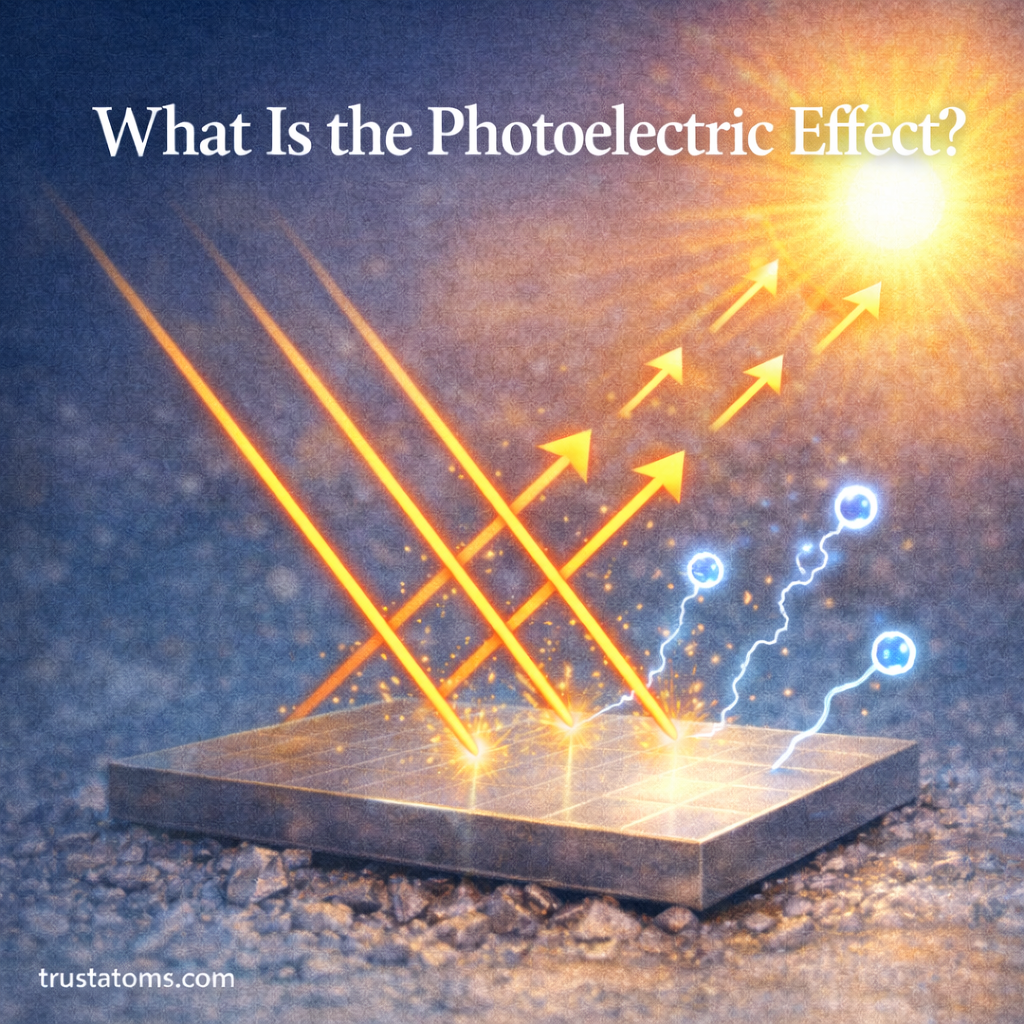
The photoelectric effect is a phenomenon in physics where light striking a material causes electrons to be emitted from its surface. This discovery played a critical role in the development of modern physics and helped scientists understand that light behaves both as a wave and as a particle.
First observed in the late 19th century and later explained by Albert Einstein in 1905, the photoelectric effect became one of the key foundations of Quantum Mechanics. Einstein’s explanation showed that light can carry energy in discrete packets called photons.
Today, the photoelectric effect is used in many technologies, including solar panels, light sensors, and imaging devices.
Understanding the Photoelectric Effect
The photoelectric effect occurs when light with sufficient energy hits the surface of a metal and causes electrons to be released.
In simple terms:
- Light shines on a material.
- Energy from the light transfers to electrons.
- If the energy is high enough, electrons escape from the material.
The emitted electrons are known as photoelectrons.
Not all light can trigger this effect. The light must have a minimum frequency, known as the threshold frequency, to provide enough energy to release electrons.
How the Photoelectric Effect Works
The process can be broken down into several steps.
Step 1: Light Hits the Surface
When light strikes a metal surface, it delivers energy to electrons inside the material.
Step 2: Energy Transfers to Electrons
The electrons absorb energy from the incoming photons.
Step 3: Electrons Escape the Material
If the photon energy is high enough, electrons overcome the attractive forces holding them inside the metal and escape from the surface.
The escaping electrons can then be detected or used in electronic devices.
The Photoelectric Effect Formula
The energy relationship involved in the photoelectric effect is described by the following equation.
E = hf
Where:
- E = Energy of a photon
- h = Planck’s constant
- f = Frequency of the light
This equation shows that the energy of light depends on its frequency.
Higher-frequency light—such as ultraviolet light—carries more energy and is more likely to cause electrons to be emitted.
Why the Photoelectric Effect Was Important
Before the photoelectric effect was understood, scientists believed light behaved purely as a wave.
However, experiments revealed something surprising:
- Increasing light intensity did not always release electrons.
- Instead, the frequency of light determined whether electrons were emitted.
This discovery showed that light behaves like a stream of particles called photons.
Einstein’s explanation earned him the Nobel Prize in Physics 1921, not for his theory of relativity, but for explaining the photoelectric effect.
Key Characteristics of the Photoelectric Effect
Several observations define how the photoelectric effect behaves.
1. Threshold Frequency
Each material requires a minimum light frequency before electrons can be emitted.
Light below this frequency will not produce the effect, regardless of brightness.
2. Instantaneous Electron Emission
Electrons are emitted almost immediately when sufficient-frequency light hits the surface.
There is no noticeable delay in the process.
3. Intensity Affects Number of Electrons
Increasing the brightness (intensity) of light increases the number of emitted electrons but does not increase their energy.
4. Frequency Affects Electron Energy
Higher-frequency light produces electrons with greater kinetic energy.
Materials That Exhibit the Photoelectric Effect
Not all materials respond the same way to light.
Metals with relatively low work functions are commonly used, including:
- Cesium
- Potassium
- Sodium
- Zinc
These materials require less energy for electrons to escape.
Real-World Applications of the Photoelectric Effect
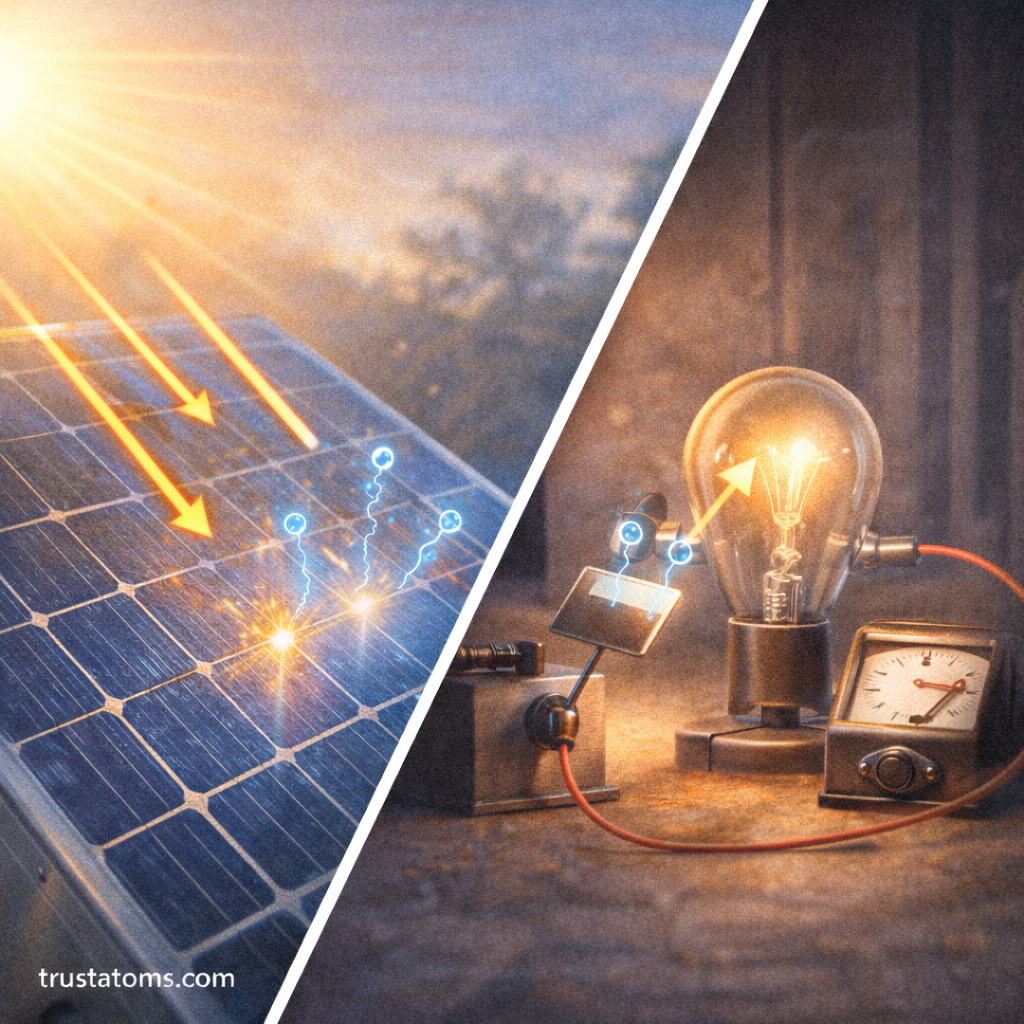
The photoelectric effect has many practical uses in modern technology.
Solar Panels
Solar panels convert sunlight into electricity using a related phenomenon called the Photovoltaic Effect, which is closely connected to the photoelectric effect.
This technology powers homes, satellites, and renewable energy systems.
Light Sensors
Photoelectric sensors detect light and trigger electronic responses.
Examples include:
- Automatic doors
- Camera exposure meters
- Streetlight sensors
Imaging Technology
The photoelectric effect is used in devices that detect light and convert it into electrical signals, such as:
- Digital cameras
- Scientific detectors
- Medical imaging equipment
The Photoelectric Effect and Quantum Physics
The photoelectric effect helped establish one of the core principles of quantum physics: energy is quantized.
Instead of energy being continuous, light transfers energy in fixed packets called photons.
This idea helped launch the field of Quantum Physics, which studies how matter and energy behave at extremely small scales.
The discovery also influenced later breakthroughs in atomic physics and electronics.
Simple Everyday Example
Imagine shining different colors of light onto a metal surface.
- Red light might not release any electrons.
- Blue or ultraviolet light might immediately eject electrons.
Even if the red light is brighter, it may still fail to release electrons because its photons do not carry enough energy.
This demonstrates that frequency matters more than intensity in triggering the photoelectric effect.
Final Thoughts
The photoelectric effect is a fundamental concept in physics that demonstrates how light can behave like particles carrying energy. When light with sufficient frequency strikes a metal surface, it transfers energy to electrons, allowing them to escape.
This discovery transformed our understanding of light and laid the foundation for quantum physics. Today, the photoelectric effect continues to power technologies such as solar panels, sensors, and imaging systems, making it one of the most important phenomena in modern science.