Introduction
Thermal expansion is a physical phenomenon where materials expand when heated and contract when cooled. This occurs because heat increases the motion of particles inside a substance, causing them to spread farther apart.
Thermal expansion affects solids, liquids, and gases, though the degree of expansion varies depending on the material. This concept is important in physics, engineering, construction, and many everyday situations.
From bridges and railroad tracks to thermometers and pipelines, engineers must account for thermal expansion to ensure structures remain safe and functional as temperatures change.
Why Materials Expand When Heated
At the microscopic level, all matter is made of atoms and molecules that are constantly in motion.
When heat is added to a material:
- The particles gain energy.
- They vibrate or move more rapidly.
- The average distance between particles increases.
- The material expands in size.
When the material cools:
- Particle motion slows down.
- The particles move closer together.
- The material contracts.
This change in size due to temperature is known as thermal expansion.
Types of Thermal Expansion
Thermal expansion can occur in different ways depending on the dimensions of the object being considered.
Linear Expansion
Linear expansion refers to the increase in length of a material when temperature rises.
This type of expansion is most noticeable in long objects such as:
- Metal rods
- Railway tracks
- Bridges
- Power lines
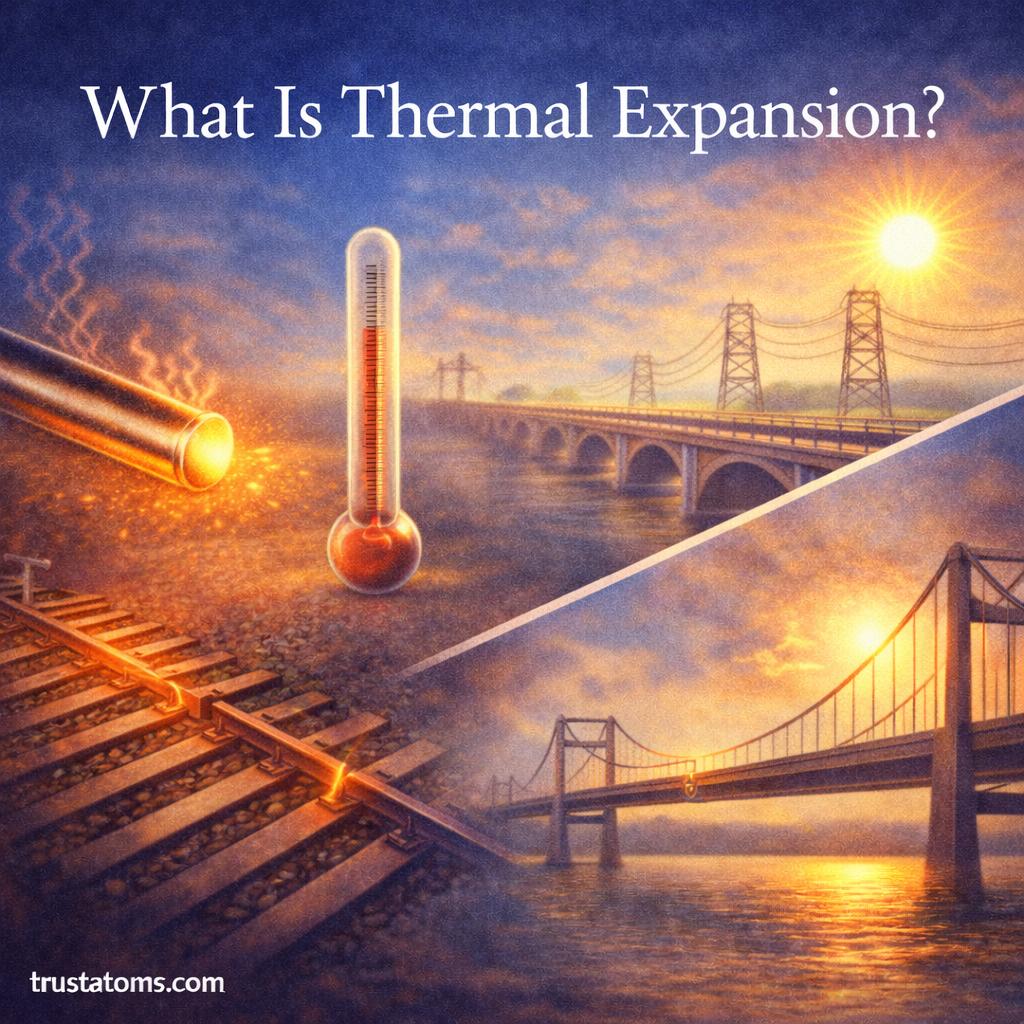
For example, railway tracks are designed with small gaps between sections so the metal can expand on hot days without bending or buckling.
Area Expansion
Area expansion occurs when the surface area of a material increases with temperature.
This is commonly observed in thin materials such as:
- Metal plates
- Sheets of glass
- Flat panels
As the temperature increases, both the length and width of the material expand, increasing the total area.
Volume Expansion
Volume expansion refers to the increase in the overall volume of a material as temperature rises.
This type of expansion occurs in:
- Solids
- Liquids
- Gases
Liquids and gases generally experience greater expansion than solids because their particles are less tightly packed.
Thermal Expansion in Different States of Matter
Different states of matter expand at different rates when heated.
Solids
In solids, particles are tightly packed together, so expansion is usually small but still measurable.
Common examples include:
- Metal expanding in bridges
- Electrical wires sagging in hot weather
- Glass expanding when heated
Liquids
Liquids expand more than solids because their particles have greater freedom to move.
This principle is used in devices such as:
- Thermometers
- Temperature sensors
- Fluid measurement systems
For example, the liquid inside a thermometer rises when temperature increases due to volume expansion.
Gases
Gases experience the largest expansion when heated.
This is because gas particles are already far apart and move freely.
Examples include:
- Hot air balloons rising when heated
- Air pressure changes with temperature
- Expanding air in engines and turbines
Everyday Examples of Thermal Expansion

Thermal expansion occurs in many common situations.
Some familiar examples include:
Bridges and Expansion Joints
Bridges include expansion joints that allow materials to expand and contract with temperature changes without causing structural damage.
Railroad Tracks
Small gaps are left between rail sections to prevent the tracks from warping or buckling in hot weather.
Power Lines
Electrical wires expand in hot temperatures and contract in cold temperatures, which is why they appear looser during warm days.
Jar Lids
Running hot water over a tight metal jar lid causes the lid to expand slightly, making it easier to open.
Thermal Expansion in Engineering
Engineers must carefully consider thermal expansion when designing structures and machines.
Important applications include:
- Building construction
- Transportation infrastructure
- Mechanical systems
- Electronics and machinery
Design solutions often include:
- Expansion joints
- Flexible connectors
- Heat-resistant materials
These features prevent damage caused by temperature changes.
Thermal Expansion and Temperature Measurement
Thermal expansion is also used to measure temperature.
Liquid Thermometers
Traditional thermometers work by measuring the expansion of a liquid such as:
- Mercury
- Alcohol
As temperature increases, the liquid expands and rises inside a narrow tube.
Bimetallic Strips
Bimetallic strips consist of two different metals bonded together. Because each metal expands at a different rate, the strip bends when heated.
This principle is used in:
- Thermostats
- Temperature sensors
- Household appliances
Why Thermal Expansion Matters in Physics
Thermal expansion is important because it connects temperature changes to physical changes in materials.
Understanding this phenomenon helps scientists and engineers:
- Design safer structures
- Predict material behavior
- Improve temperature measurement devices
- Build reliable machines and infrastructure
Without accounting for thermal expansion, many systems would fail under changing temperatures.
Final Thoughts
Thermal expansion is the tendency of materials to change size when temperature changes. As particles gain energy from heat, they move more vigorously and spread farther apart, causing the material to expand.
This simple physical principle affects everything from bridges and power lines to thermometers and engines. By understanding thermal expansion, scientists and engineers can design structures and devices that remain stable and functional in changing temperature conditions.