
Introduction
Total internal reflection is a fascinating optical phenomenon that occurs when light traveling through a dense medium hits a boundary with a less dense medium and reflects completely back into the original material instead of passing through.
Unlike normal reflection, which occurs at the surface of mirrors or other objects, total internal reflection happens inside transparent materials such as glass, water, or optical fibers.
This principle plays a crucial role in modern technology, including fiber-optic communication, medical imaging tools, and advanced optical devices.
Understanding How Light Travels Between Materials
Light changes behavior when it moves from one material to another. For example, when light passes from air into water or glass, it slows down and bends. This bending is known as refraction.
Refraction occurs because different materials have different optical densities, which affect the speed of light.
Common examples include:
- Light bending when entering water
- A straw appearing bent in a glass of water
- Lenses focusing light in cameras and microscopes
Under certain conditions, this bending effect leads to total internal reflection.
What Is Total Internal Reflection?
Total internal reflection occurs when all of the light hitting a boundary is reflected back into the original medium instead of refracting into the second medium.
For this to happen, two conditions must be met:
- Light must travel from a denser medium to a less dense medium.
- The angle at which the light hits the boundary must be greater than a specific value called the critical angle.
When these conditions are satisfied, light cannot escape the material and instead reflects completely inside it.
The Critical Angle
The critical angle is the minimum angle of incidence that causes total internal reflection to occur.
When light hits the boundary:
- At angles smaller than the critical angle, some light refracts into the second medium.
- At the critical angle, the refracted ray travels along the boundary.
- At angles greater than the critical angle, total internal reflection occurs.
Once the critical angle is exceeded, all the light remains inside the material.
How Total Internal Reflection Works
The process can be understood step by step.
- Light travels through a dense material such as glass or water.
- The light ray approaches the boundary with a less dense medium, such as air.
- As the angle increases, the refracted ray bends further away from the normal.
- When the critical angle is reached, the refracted ray moves along the surface.
- If the angle increases further, the light reflects completely inside the material.
This internal reflection allows light to travel long distances inside materials without escaping.
Everyday Examples of Total Internal Reflection
Although it may sound complex, total internal reflection appears in several natural and everyday situations.
Sparkling Diamonds
Diamonds sparkle brightly because light entering the gemstone undergoes multiple total internal reflections. The light bounces inside the crystal before exiting, producing brilliant flashes of color.
Water Surface Reflection
When you look up at the surface from underwater, you may see a mirror-like effect. This occurs because light hitting the water-air boundary at steep angles undergoes total internal reflection.
Optical Devices
Many scientific and optical instruments rely on total internal reflection to guide light efficiently.
Fiber Optics and Total Internal Reflection
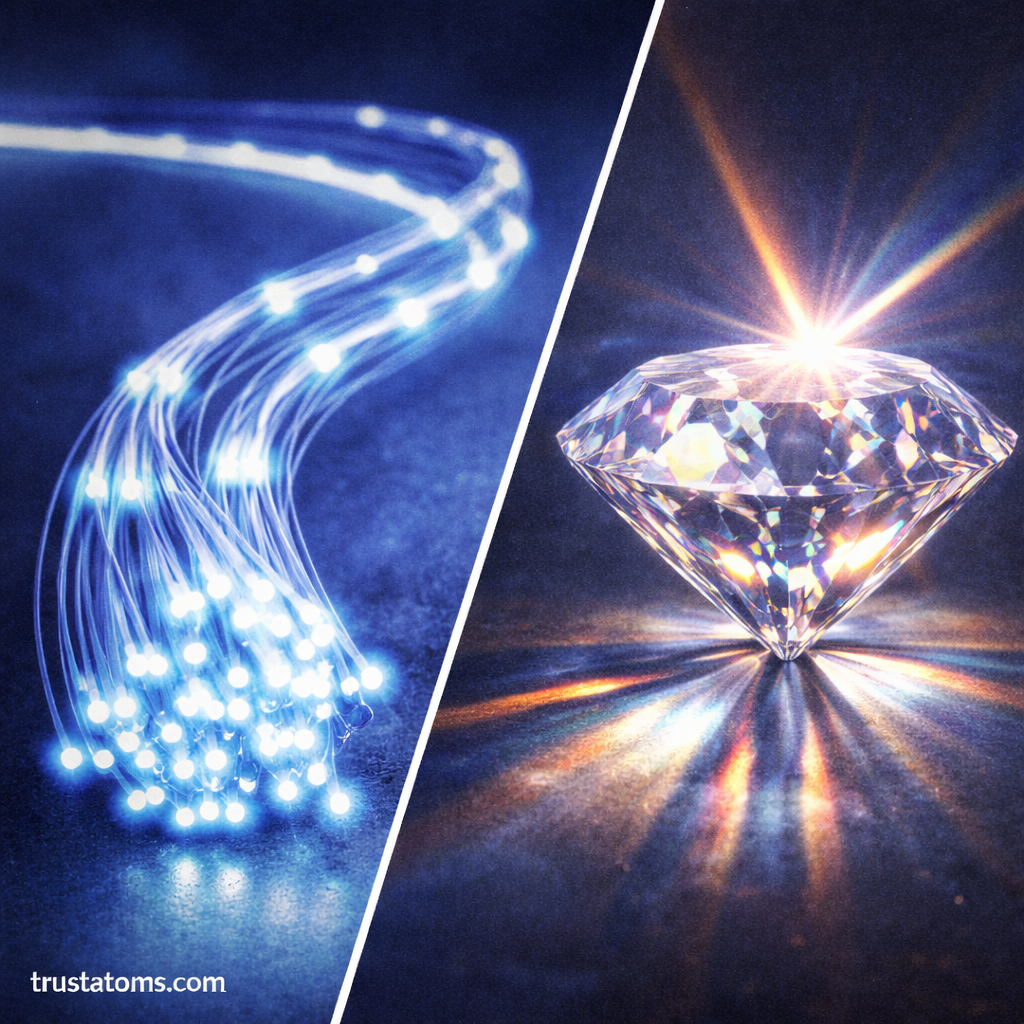
One of the most important modern applications of total internal reflection is fiber-optic technology.
Fiber-optic cables consist of thin strands of glass or plastic that guide light signals over long distances.
Inside these fibers:
- Light enters the fiber at a specific angle.
- The light repeatedly reflects off the inner walls.
- Total internal reflection keeps the light contained within the fiber.
- The signal travels long distances with minimal loss.
Fiber optics are used in:
- High-speed internet networks
- Telecommunications systems
- Medical imaging devices
- Endoscopes used by doctors
Total Internal Reflection in Optical Instruments
Many optical devices use total internal reflection instead of mirrors.
Examples include:
- Prisms in binoculars
- Periscopes
- Optical sensors
- Laser systems
Using internal reflection can reduce energy loss and improve image clarity.
Total Internal Reflection vs Regular Reflection
Although they sound similar, these two types of reflection occur in different situations.
Regular reflection:
- Happens at the surface of objects
- Occurs when light bounces off materials like mirrors
- Some energy may be absorbed
Total internal reflection:
- Occurs inside transparent materials
- Requires specific angles and material conditions
- Reflects all the light with almost no loss
Because of this efficiency, total internal reflection is extremely useful in optical engineering.
Why Total Internal Reflection Matters
Total internal reflection is important because it allows light to be controlled and guided efficiently.
It enables technologies such as:
- Fiber-optic communication networks
- High-precision optical instruments
- Medical imaging systems
- Advanced laser technology
By keeping light contained within materials, scientists and engineers can transmit signals with remarkable accuracy and speed.
Final Thoughts
Total internal reflection is a powerful optical phenomenon where light reflects entirely inside a material instead of passing through its boundary. This occurs when light moves from a denser medium to a less dense one and exceeds the critical angle.
From sparkling diamonds to high-speed fiber-optic networks, total internal reflection plays a key role in both natural beauty and modern technology. Understanding this concept helps explain how light can be controlled, guided, and used in many scientific applications.