Thunderstorms are among the most dynamic and powerful weather events on Earth. From towering clouds to lightning strikes and heavy rainfall, they are driven by one key process: convection.
Understanding how thunderstorms form and evolve helps explain everything from daily weather patterns to severe storms like hailstorms, tornadoes, and flash floods.
What Is a Thunderstorm?
A thunderstorm is a localized storm system characterized by:
- Lightning and thunder
- Heavy rain or hail
- Strong, gusty winds
- Rapid cloud development
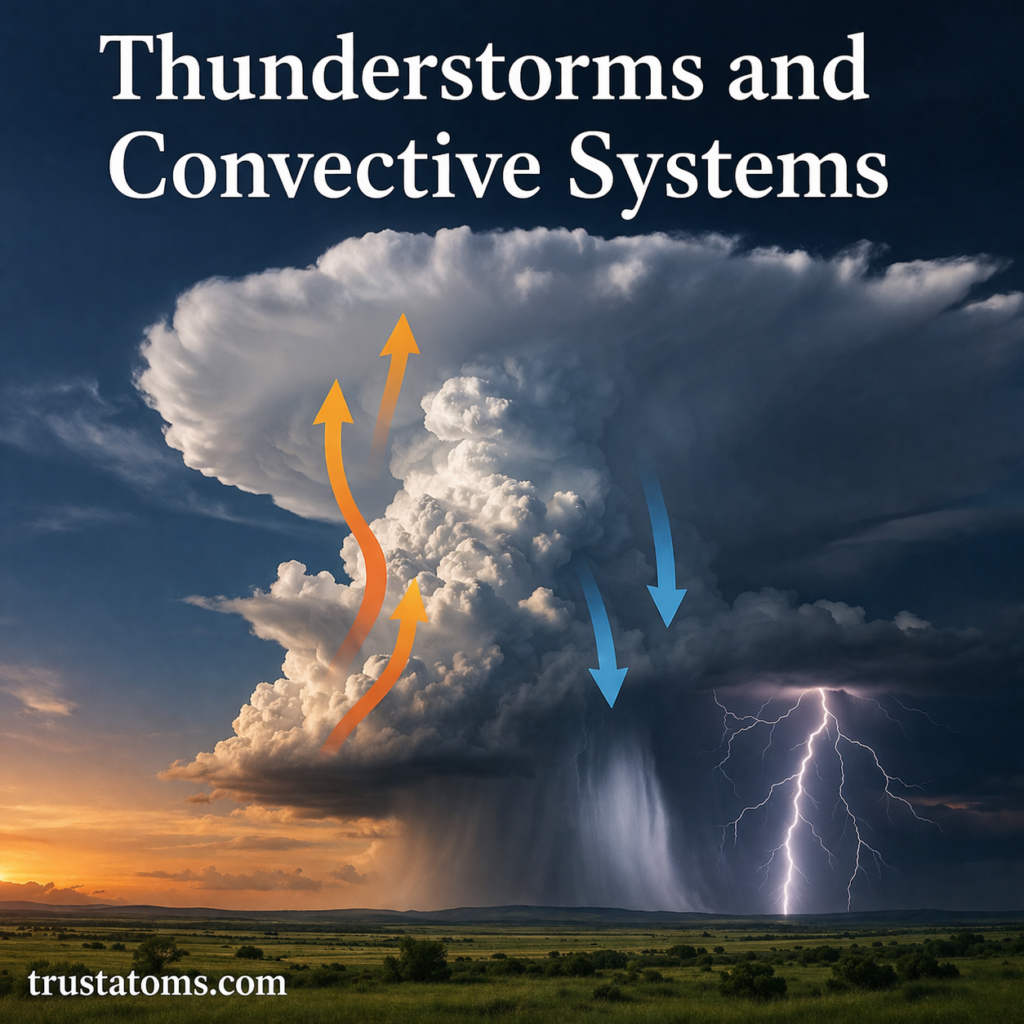
All thunderstorms originate from a specific type of cloud called a cumulonimbus cloud, which can extend high into the atmosphere.
The Role of Convection
Convection is the process that fuels thunderstorms. It involves the vertical movement of air due to temperature differences.
How Convection Works
- The Sun heats the Earth’s surface
- Warm air near the surface becomes less dense
- This warm air rises upward into the atmosphere
- As it rises, it cools and condenses into clouds
This rising motion is called an updraft, and it is the engine of a thunderstorm.
Key Ingredients for Thunderstorms
Thunderstorms require three main ingredients:
1. Moisture
- Usually comes from oceans, lakes, or humid air masses
- Provides water vapor needed for cloud formation
2. Instability
- Occurs when warm air is beneath cooler air
- Encourages rising motion and cloud growth
3. Lift
- A trigger that forces air upward
- Can come from:
- Cold fronts
- Mountains (orographic lifting)
- Surface heating
Without these three ingredients, thunderstorms cannot form.
Stages of Thunderstorm Development
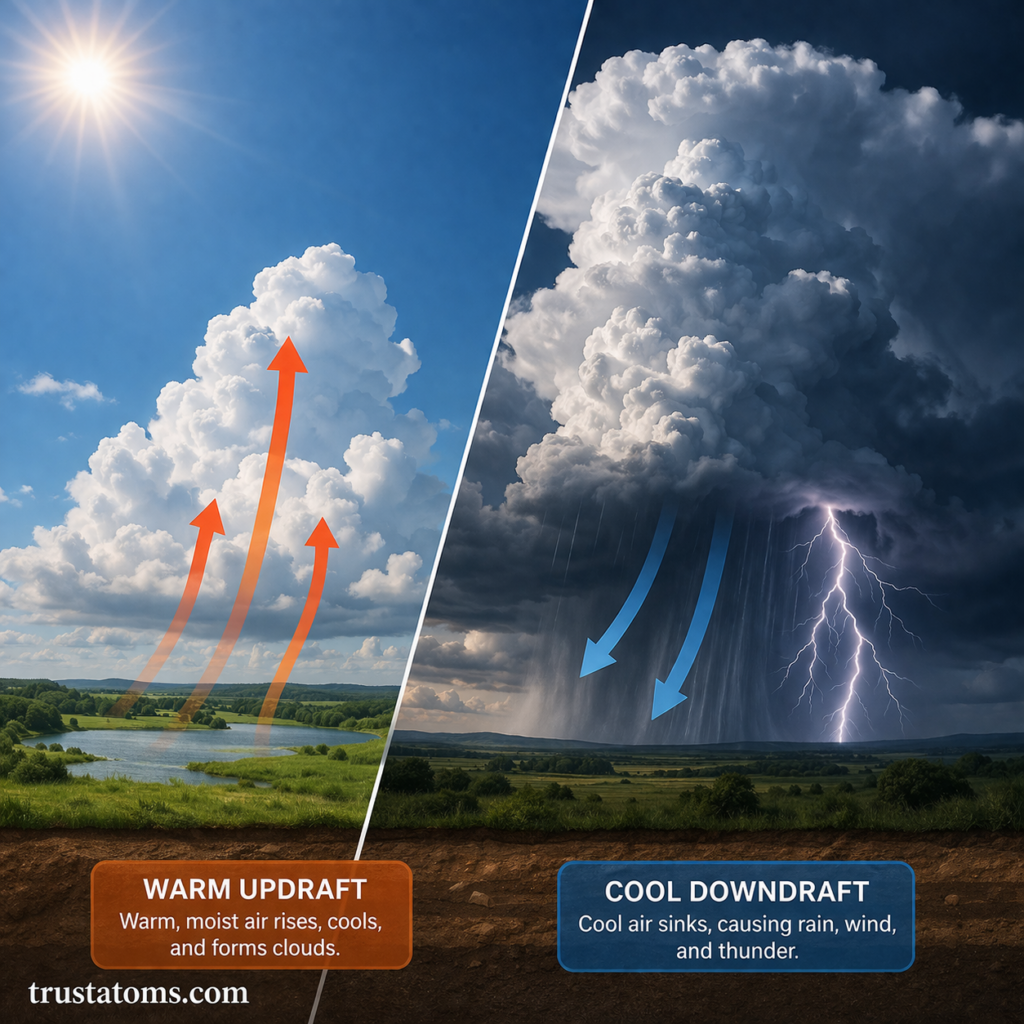
Thunderstorms typically go through three stages:
1. Cumulus Stage (Developing Stage)
- Warm air rises rapidly (strong updrafts)
- Clouds begin to grow vertically
- No precipitation reaches the ground yet
2. Mature Stage
- Both updrafts and downdrafts are present
- Heavy rain, lightning, and possibly hail occur
- Strong winds develop
This is the most intense phase of the storm.
3. Dissipating Stage
- Downdrafts dominate
- Rainfall weakens
- The storm gradually dies out
Types of Thunderstorms
Thunderstorms vary in size and intensity depending on atmospheric conditions.
Single-Cell Thunderstorms
- Short-lived (30–60 minutes)
- Usually not severe
- Common in summer afternoons
Multi-Cell Thunderstorms
- Clusters of storms at different stages
- Can produce heavy rain and gusty winds
- More organized than single-cell storms
Squall Lines
- Long lines of storms along a front
- Produce strong winds and heavy rain
- Can extend for hundreds of miles
Supercell Thunderstorms
- Highly organized with a rotating updraft (mesocyclone)
- Capable of producing:
- Tornadoes
- Large hail
- Severe winds
Supercells are the most dangerous type of thunderstorm.
How Lightning Forms
Lightning is one of the defining features of thunderstorms.
The Process
- Collisions between ice particles inside the cloud create electrical charges
- Positive charges build at the top, negative charges at the bottom
- When the difference becomes strong enough, a discharge occurs
This discharge is lightning.
Thunder is the sound produced when lightning rapidly heats and expands the surrounding air.
Convective Systems and Organization
When thunderstorms group together, they form convective systems, which can impact large regions.
Mesoscale Convective Systems (MCS)
- Large clusters of thunderstorms
- Can last for several hours or even overnight
- Often bring widespread rainfall
Mesoscale Convective Complexes (MCC)
- A type of MCS with a circular shape
- Can cover hundreds of miles
- Known for producing prolonged heavy rain
These systems are important contributors to regional weather patterns.
Severe Weather Hazards
Thunderstorms can produce a variety of hazards:
1. Heavy Rain and Flooding
- Intense rainfall over short periods
- Can lead to flash floods
2. Strong Winds
- Downbursts and gust fronts
- Can cause structural damage
3. Hail
- Forms when strong updrafts carry water droplets into freezing layers
- Can damage crops, vehicles, and buildings
4. Tornadoes
- Associated mainly with supercell thunderstorms
- Caused by rotating updrafts
Why Thunderstorms Matter
Thunderstorms play a crucial role in Earth’s climate system:
- Help redistribute heat and moisture
- Contribute to the global water cycle
- Influence local and regional weather patterns
They are both beneficial and potentially destructive.
Final Thoughts
Thunderstorms and convective systems are powerful demonstrations of atmospheric energy in motion. Driven by convection, these storms range from brief afternoon showers to large, organized systems capable of severe weather.
By understanding the ingredients, stages, and types of thunderstorms, we gain insight into how weather develops—and how to better prepare for its impacts.